Book II, chapter 37 — the images the tradition still carries.
You've felt it in those moments when ordinary astrology falls short—when your Sun sign explains the broad strokes but misses the particular genius of your restlessness, the specific texture of your ambition, the exact flavor of your melancholy. There's something more granular at work in your character, something that operates in ten-degree increments rather than thirty-degree signs. The Renaissance masters knew this. They called them the faces of the zodiac.
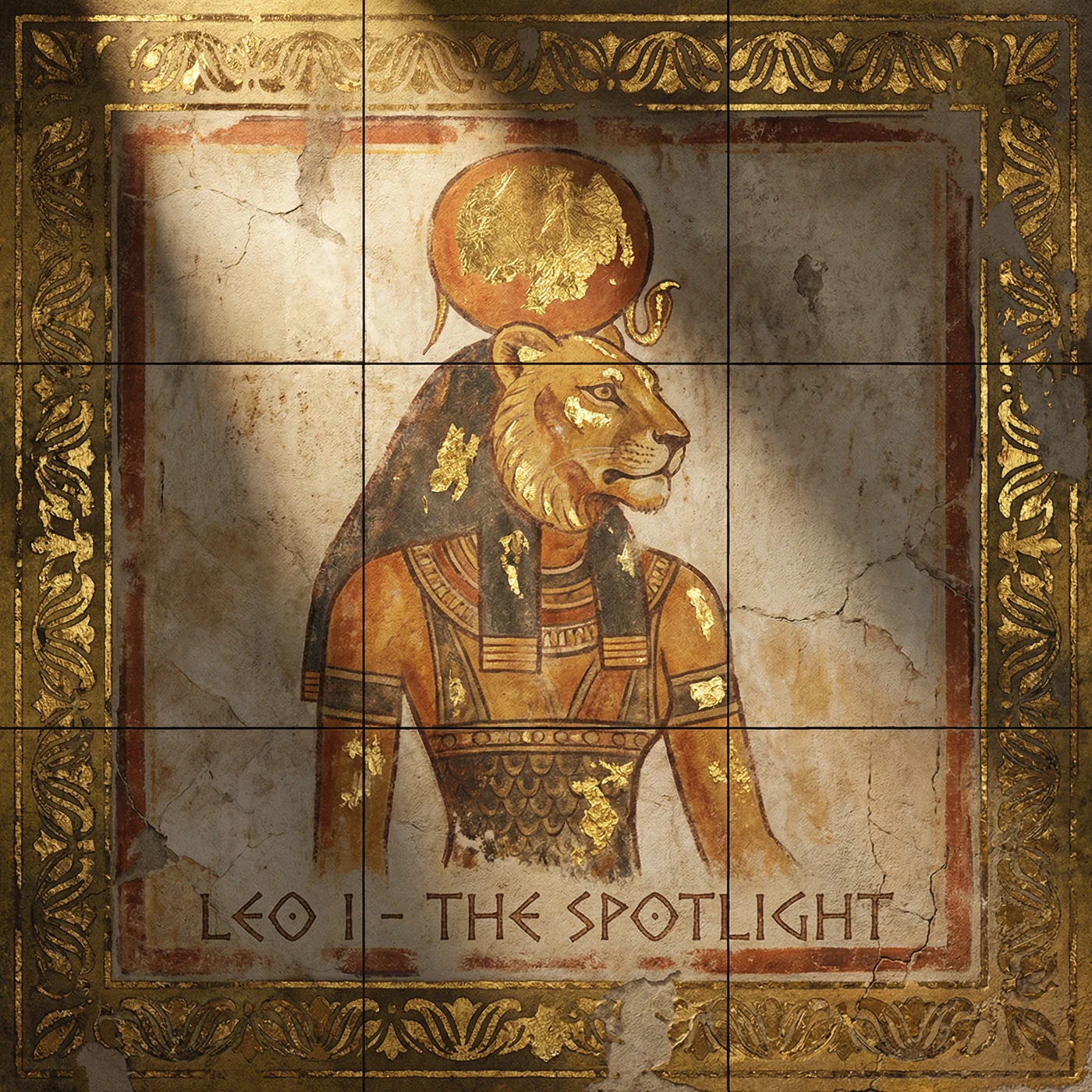
The Thirty-Six Guardians
Heinrich Cornelius Agrippa von Nettesheim stood at his window in Cologne sometime in the 1520s, watching merchants haggle in the square below. Each carried himself differently—not just Taurus versus Gemini differently, but with subtler distinctions that defied the twelve-fold division. The baker born in early Taurus moved with the steady rhythm of THE PLOW, while his neighbor, born twenty days later, carried himself with the patient authority of A LINGA-YONI, the sacred union that transforms raw matter into abundance. Same sign, different worlds.
Agrippa had inherited something precious from the Arabic astronomers: a system that divided each zodiac sign into three faces, thirty-six images in total. Where the twelve signs painted with broad brushstrokes, the decans worked in fine detail. Each ten-degree segment carried its own planetary ruler, its own symbolic image, its own flavor of power. The first decan of Aries belonged to Mars and bore THE AXE—the primordial splitter that creates two from one. But the second decan, ruled by the Sun, carried THE CROWN, speaking not of conquest but of sovereignty earned through virtue practiced over time.
This wasn't astrology as personality typing. This was astrology as spiritual technology—thirty-six distinct doorways into different modes of being, each offering its own gifts and demanding its own price.
The Architecture of Influence
The Renaissance mind understood something we've largely forgotten: that the sky operates on multiple scales simultaneously. The zodiac signs provide the seasonal framework—Aries initiating, Taurus stabilizing, Gemini diversifying. But within each season, finer rhythms pulse. The decans reveal these micro-seasons, the way light changes not just month to month but week to week, the way your energy shifts in subtle increments as the Sun progresses through its annual journey.
Agrippa's genius lay in synthesizing centuries of tradition into a workable system. The Egyptian astronomers had first noticed that certain stars rose with specific portions of the zodiac, creating a calendar of thirty-six ten-day periods. The Greeks inherited this and assigned planetary rulers. The Arabic astrologers preserved and refined the system through centuries of careful observation. Agrippa gathered these threads and wove them into a coherent magical practice.
Each decan operates through a specific planetary combination. Take the three faces of Cancer: THE MOTHER AND CHILD (Venus with the Moon), A WALLED GARDEN (Mercury with Mars), and THE OVERFLOWING CUP (Moon with Jupiter). All share Cancer's fundamental watery, nurturing nature, but each expresses it through different planetary lenses. The first speaks of unconditional love, the second of protective boundaries, the third of emotional abundance that sometimes becomes overwhelming luxury.
The Tarot Connection
The most elegant proof of the decans' psychological reality lies in their correspondence with the numbered cards of the Tarot. Not the Major Arcana with their archetypal drama, but the Minor Arcana's quieter revelations—the Twos through Tens that map so precisely onto the thirty-six faces that coincidence becomes impossible.
Consider Scorpio's journey through its three decans. The first, A JAWBONE, corresponds to the Five of Cups—disappointment, the hungry ghost energy of desire that can never be satisfied. But move ten degrees deeper and you encounter AN APPARATUS FOR MUTUAL DISTILLATION paired with the Six of Cups, where that same Scorpionic intensity transforms into the pleasure of authentic exchange between two beings who see each other clearly. Ten degrees further brings A CROW and the Seven of Cups—debauchery, the moment when desire separates from its object and reveals itself as the true source of satisfaction.
This isn't metaphorical poetry. This is precise psychological cartography. Each decan-Tarot pairing describes a specific way consciousness organizes itself around desire, work, relationship, power. The Renaissance mages weren't trafficking in vague symbolism—they were mapping the actual mechanics of how human experience unfolds in ten-degree increments around the zodiac.
A Living Example
Watch someone born with their Sun in Virgo II, THE HAMMER AND THE ANVIL, and you'll see the decan system's precision in action. This isn't generic Virgo perfectionism—this is the specific genius of the master craftsman who transforms raw skill into enduring work. Ruled by Venus and Saturn in combination, they possess both aesthetic refinement and the discipline to manifest it in physical form. The corresponding Nine of Pentacles shows a woman alone in her garden, surrounded by the fruits of her labor—not the anxious striving of early Virgo, nor the completion-focused energy of late Virgo, but the particular satisfaction of skill practiced until it becomes art.
You'll find them in their workshops at midnight, not because they're compulsive, but because they've discovered that mastery requires a specific relationship with time and solitude. They understand that Venus without Saturn creates beautiful ideas that never manifest, while Saturn without Venus creates functional objects devoid of soul. The hammer needs the anvil—one provides the force, the other the resistance that shapes raw metal into tools that last for generations.
Working with the Faces
The practical magic of the decans lies not in their exotic imagery but in their capacity to reveal the specific nature of your gifts and challenges. Your Sun sign tells you what fuel you burn; your decan tells you how that fuel ignites and what it produces when it burns cleanly.
Begin by identifying which face holds your Sun. Not just "I'm a Leo" but "I'm Leo II, A CROWN OF LAURELS, ruled by Jupiter alone, corresponding to the Six of Wands." Feel how this differs from Leo I's contested stage or Leo III's embattled defender energy. Your decan is your spiritual home base—the particular frequency of solar power that charges your essential self.
But don't stop there. Your Moon's decan reveals how you process emotion and memory. Your rising sign's decan shows how you meet the world and how it meets you. Each planet in your chart carries the flavor of its decanic placement, creating a symphony of influences more nuanced than the twelve-sign system alone could provide.
The Renaissance masters worked with these energies through meditation on the images, through talismans crafted during specific planetary hours, through invocation of the Hebrew angels assigned to each face. But the deepest magic happens through recognition—the moment you see your own essential nature reflected in one of the thirty-six faces and understand, perhaps for the first time, why you move through the world exactly as you do.
The faces of Agrippa aren't ancient curiosities but living technologies for understanding the specific ways consciousness manifests through individual human lives. In a world that increasingly demands we choose between scientific materialism and vague spirituality, the decans offer a third path—precise, practical mysticism that honors both the outer movements of celestial bodies and the inner landscape of human experience.
Your personal Book of the Self reveals not just which decan holds your Sun, but how all thirty-six faces operate in your unique chart, creating a complete map of your consciousness crafted specifically for your moment of birth.