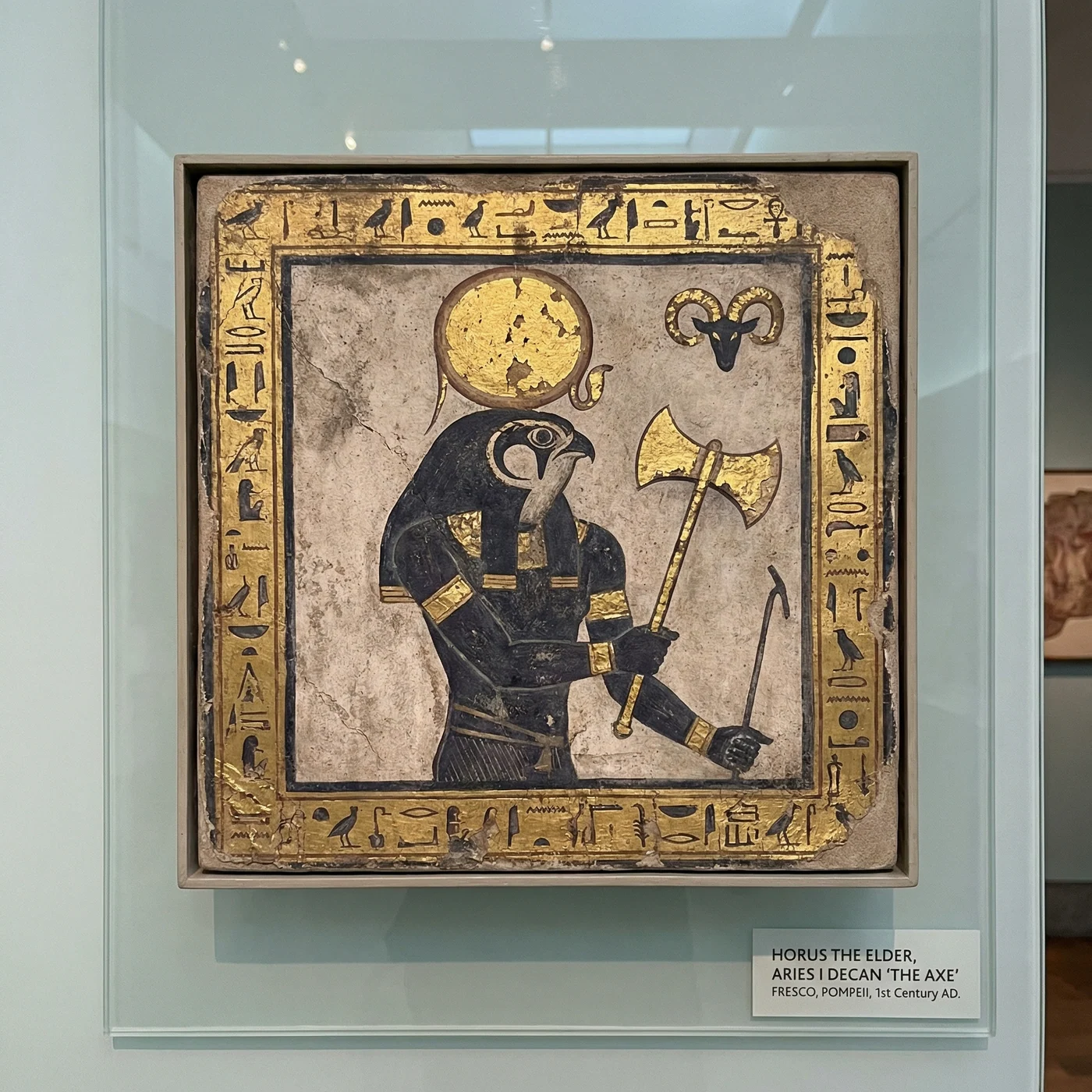
The first face of Aries — The Axe, ruled by Mars. What this face asks of the people born wearing it.
You stand at the edge of the forest, ax in hand, staring at the towering oak that blocks your path forward. Your muscles coil with anticipation. Behind you lies everything familiar—the cleared ground, the settled world, the agreements others have made about how things should be. Ahead waits the unknown territory you must claim as your own. The blade catches morning light as you raise it overhead. This moment before the first strike holds everything: your hunger for independence, your willingness to destroy what stands between you and your vision, your raw certainty that you alone know which way leads home. The ax falls. The sound splits the air like thunder.
This is the face you carry when the world feels too small, when compromise tastes like poison, when you would rather break everything than bend. This is the blade that cuts through what others call impossible.
The Weapon That Opens Worlds
The Axe arrives in the zodiac's first breath, where the primal force of Aries meets the ancient power of separation. Here stands the archetypal tool that transforms one into two—the implement that splits logs for winter fires, fells trees for shelter, and carves paths through wilderness. Yet the Axe holds deeper mysteries than its obvious violence suggests.
Every beginning requires an ending. Every creation demands destruction of what came before. The Axe serves this fundamental law of manifestation, teaching that new worlds can only emerge when old certainties fall away. Those who carry this face understand instinctively that gentle persuasion often fails where decisive force succeeds. They possess an almost cellular knowledge that some bonds must be severed, some obstacles removed entirely, some conversations ended with action rather than words.
The ancient images speak consistently across cultures: a dark figure with blazing eyes, weapon raised, manner fierce beyond negotiation. This is not cruelty for its own sake, but the concentrated will that refuses to be turned aside. When the Arabic sages gazed into this decan's essence, they saw the spirit that grants victory in war—not through strategy or alliance, but through the pure application of overwhelming force at the crucial moment.
The blade's edge teaches the mathematics of transformation. It shows how a single line of pressure, applied with sufficient commitment, can separate what seemed permanently joined. This knowledge extends far beyond literal cutting. It reveals itself in the decisive word that ends a failing relationship, the career change that slices through years of accumulated expectation, the moment of truth that cleaves away everything false from what remains authentic.
Mars and the Conqueror's Gaze
Mars rules this face with undiluted authority, lending his red force to every manifestation of the Axe's power. Here the war god appears not as the strategic general or the disciplined soldier, but as the primal warrior whose very presence changes the nature of any situation. This is Mars unrestrained by social niceties, untempered by consideration for consequences, burning with the pure desire to impose will upon resistant reality.
The Two of Wands carries this Martian fire in its imagery of the Conqueror's Gaze—a figure standing upon castle walls, looking out over territories that exist only in potential, holding a globe that represents the world as it might become rather than as it currently stands. This card captures the essential paradox of the Axe: it destroys in service of a vision that does not yet exist. The conqueror's vision justifies the weapon's necessity.
In the Thoth deck's Two of Wands, titled Dominion, the theme intensifies into pure authority over circumstances. Here we see not the struggle to achieve power, but power itself as a natural state—the condition that emerges when will aligns perfectly with action. The crossed wands form the foundation for manifestation, suggesting that true dominion begins with the courage to divide what seems unified, to choose one path by definitively rejecting all others.
Mars lends this face its characteristic impatience with incremental progress. Those touched by the Axe often find themselves constitutionally unable to wait for permission, consensus, or ideal conditions. They possess an almost supernatural ability to identify the single action that will cascade into systemic change, and an equally supernatural compulsion to take that action regardless of who counsels patience or compromise.
When the Sun Carries the Axe
The Sun in Aries I produces individuals whose very identity depends on their capacity for decisive action. These natives cannot conceive of themselves as passive recipients of circumstance. Instead, they understand their core self as an active force—the thing that happens to the world rather than the thing the world happens to. Their sense of personal authenticity depends entirely on their willingness to use whatever force proves necessary to maintain their independence.
This placement often manifests as an almost physical need to initiate rather than respond. These individuals feel most alive when breaking new ground, beginning fresh projects, or cutting through situations others find hopelessly tangled. They possess an instinctive understanding that leadership means going first into uncertain territory, that authority derives from demonstrated willingness to take risks others avoid.
The shadow side emerges when the ax becomes an end in itself rather than a means toward a larger vision. Sun in Aries I can produce individuals addicted to conflict, who unconsciously create problems simply to experience the rush of solving them through force. They may struggle with situations requiring patience, collaboration, or gradual development of trust. Their strength lies in breakthrough moments; their weakness appears in the maintenance required between breakthroughs.
Yet when this placement operates at its highest level, it produces pioneers in the truest sense—individuals whose willingness to separate from established patterns creates new possibilities for everyone who follows. They serve as the cutting edge of collective evolution, the force that keeps human experience from calcifying into rigid tradition.
When the Moon or Rising Carries the Axe
The Moon in Aries I creates a complex emotional landscape where the need for security conflicts with the compulsion toward independence. These individuals derive emotional nourishment from acts of separation and self-assertion, yet they also crave the very stability their actions often destroy. They may find themselves caught in cycles where they establish security, feel suffocated by it, break free through dramatic action, then seek to establish security again.
This lunar placement often indicates someone whose earliest experiences taught them that survival depends on the willingness to fight. They may have learned to equate love with struggle, care with conquest. Their emotional reactions tend toward the extreme—gentle affection feels foreign while passionate intensity feels like home. They require relationships that can withstand their periodic need to test boundaries through provocation.
As a Moon placement, the Axe can indicate powerful psychic defenses developed early in life. These individuals learned to cut away whatever threatens their emotional core, sometimes before fully examining whether the threat was real. They may struggle with premature endings—severing relationships or abandoning projects at the first sign of difficulty rather than working through complexity.
Aries I rising creates an appearance of readiness for action that precedes conscious decision-making. These individuals project an aura of barely contained force, as if they might spring into motion at any moment. Others instinctively step aside, offer them leadership roles, or seek their protection during crises. They cannot help but appear dangerous—not necessarily in a threatening way, but in the sense that they clearly possess the capacity to change any situation they enter.
The rising Axe often attracts circumstances that require decisive intervention. These individuals find themselves repeatedly cast as the one who must make the difficult choice, deliver the hard truth, or take the action others consider necessary but lack the courage to attempt themselves. They serve as agents of collective will, expressing what groups feel but cannot articulate.
The Practice of the Blade
Working with the Axe requires understanding the difference between destruction and elimination. Destruction implies waste, the reduction of order into chaos. Elimination serves precision—the surgical removal of specific obstacles to allow desired growth. The Axe teaches this discrimination through practice, through learning to identify exactly what must be severed and exactly what must remain intact.
Begin by examining your life for false unities—situations where things have grown together that serve better apart. This might appear as relationships that have outlived their purpose, careers that demand compromise of essential values, or habits that once served survival but now prevent growth. The Axe's wisdom lies not in cutting everything, but in cutting the right things at the right moment with the right degree of force.
Develop comfort with the irreversible nature of decisive action. The Axe cannot unsplit the log, cannot unfell the tree, cannot take back the word that ends the conversation permanently. This finality terrifies many people into perpetual hesitation. Those who master this face learn to make peace with consequences before acting, understanding that the regret of right action taken boldly outweighs the regret of right action delayed indefinitely.
Practice the art of clean separation. When you must end something—a relationship, a job, a living situation—do it completely rather than gradually. The Axe teaches that half-measures often create more suffering than decisive breaks. Clean endings allow all parties to begin genuine healing rather than remaining suspended in ambiguous hope.
Cultivate the vision that justifies the weapon. The Axe without purpose becomes mere violence. The Axe in service of clear intention becomes a tool of liberation. Spend time clarifying what you wish to create, not just what you wish to destroy. Let your capacity for separation serve your capacity for manifestation rather than operating as an end in itself.
Most importantly, learn to recognize when the moment for action has arrived. The Axe's power depends on timing—the ability to sense when a situation has reached the point where force will create breakthrough rather than simply creating damage. This recognition develops through experience, through learning to feel the difference between resistance that requires patience and resistance that requires cutting through.
The face of the Axe prepares you for the moments when everything depends on your willingness to act decisively despite uncertainty, to choose a direction despite incomplete information, to trust your deepest instincts about what must change and what must remain. It teaches the terrible and necessary art of ending what no longer serves life's movement toward greater expression.
The 36 Codex offers complete personalized analysis of how the Axe operates within your unique astrological signature, revealing the specific ways this face of decisive action manifests across all areas of your life experience. Each book provides detailed examination of your birth chart's decan placements, offering practical guidance for working skillfully with the ancient faces that shape your path.