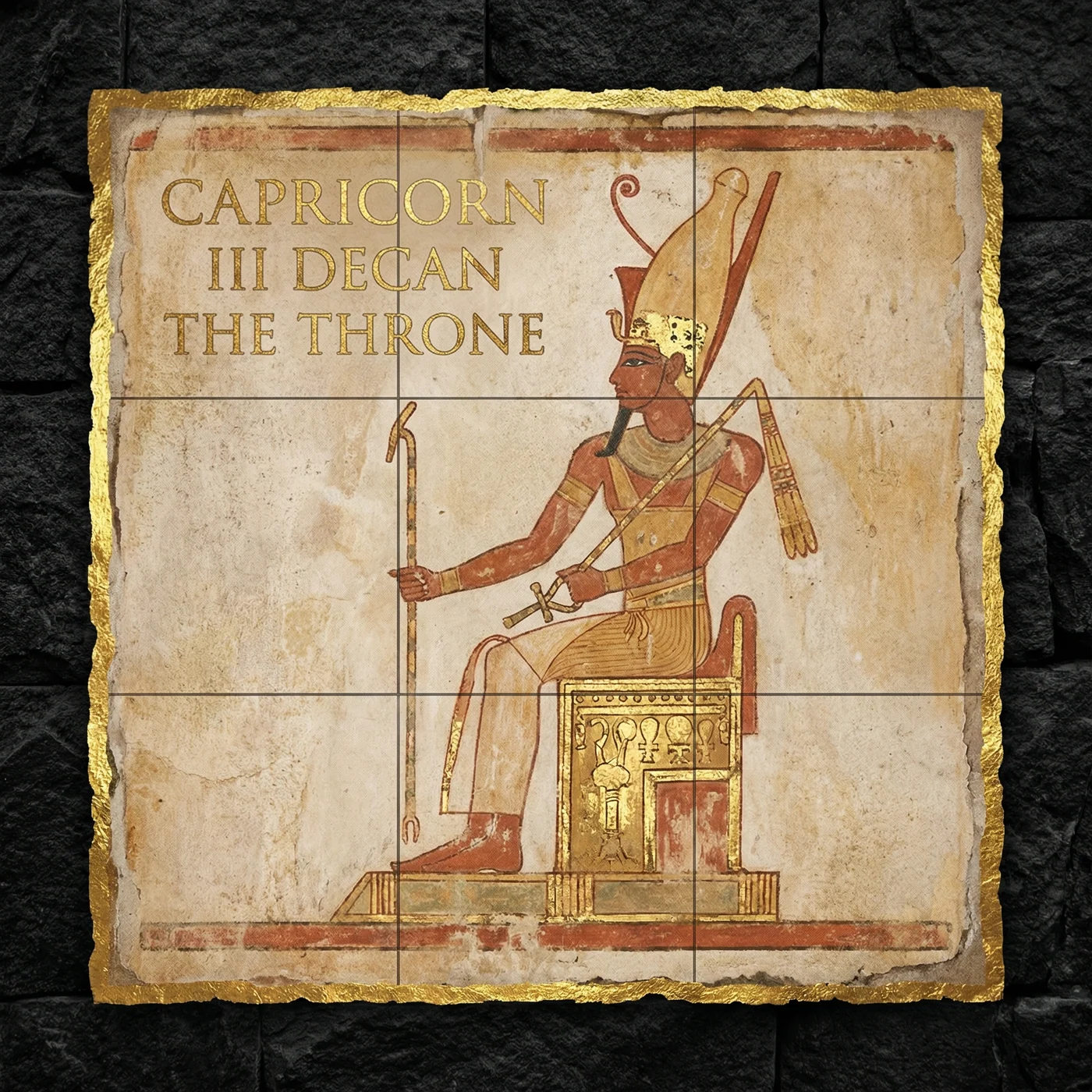
The third face of Capricorn — The Throne, ruled by Sun. What this face asks of the people born wearing it.
The boardroom falls silent as she enters. Twenty years of strategic decisions, of saying no when others would cave, of building systems that outlast their creators—all of it has led to this moment. The quarterly reports spread before her represent not mere numbers but territories conquered, markets claimed, empires built from careful calculation and unwavering will. Her signature carries the weight of thousands of livelihoods, her word reshapes entire industries. She has climbed matter's highest peak and found herself alone at the summit, crown heavy on her head, throne carved from the bones of lesser ambitions. This is the burden and the glory of The Throne: to sit where all roads converge, where every decision ripples outward through the world below.
The Seat of All Authority
The Throne stands as the final face of Capricorn, where the long ascent through matter's kingdom reaches its apex. Where the first face descended into the body of the world and the second built monuments to human achievement, the third face claims dominion over all it surveys. This is not the throne of inherited privilege but of earned sovereignty—the seat claimed through understanding how power actually moves through the arteries of the world.
The image speaks of environmental mastery, where one's surroundings become an extension of will itself. Cities rise and fall at the regent's word. Markets shift with their moods. The very landscape arranges itself according to their vision. Yet this throne sits heavy, for with absolute power comes absolute responsibility. Every choice cascades through layers of consequence, every decree shapes the fate of countless souls who will never stand so high.
The name itself—The Throne—removes all pretense of democracy or shared leadership. Here sits the final authority, the place where all deliberation ends and decision begins. It is the chair from which empires are administered, where the abstract machinery of power transforms into concrete reality through the sovereign's will. The throne demands occupants who can hold the weight of worlds without buckling, who can make terrible choices with steady hands.
The Sun's Domain and the Four of Pentacles
The Sun rules this decan with the merchant planet Mercury, creating a fusion of sovereign authority and commercial acumen. The Sun here shines not as the inspiring light of dawn but as the harsh noon glare that reveals every shadow, every flaw in the kingdom below. This is executive consciousness at its peak—the capacity to see systems entire, to understand how each moving part serves the greater mechanism of power.
Mercury's presence speaks to the intelligence required for true rulership. The throne is not won through strength alone but through superior information, faster calculation, more precise understanding of how influence travels through networks of obligation and desire. This is the Mercury of the merchant prince, who sees every relationship as a ledger entry, every conversation as a transaction in the currency of power.
The Rider-Waite Four of Pentacles captures this dynamic perfectly: a figure seated on a throne-like chair, gripping golden disks with fierce possession. One pentacle crowns his head, two anchor his feet, one he clutches to his chest—every point of power secured, every avenue of wealth controlled. The card's subtitle "Power" speaks to mastery achieved, but also to the terrible isolation that comes with absolute control. The Thoth version emphasizes this further, showing locked gates and sealed fortifications—power that protects itself by cutting off all access, all vulnerability.
This is not the fluid power of water or the inspiring power of fire, but the crystallized power of earth at its most refined. Here authority becomes tangible, measurable, defensible. Yet the very solidity that makes such power endure also makes it brittle. The miser king on his throne rules perfectly—and perfectly alone.
When the Sun Carries The Throne
Those born with the Sun in Capricorn III arrive in this world carrying blueprints for empire. They possess an almost supernatural understanding of how institutions work, where power really flows, which levers actually matter when everything needs to change at once. From childhood they gravitate toward positions of responsibility, not from a desire to serve but from an instinctive recognition that someone must make the hard choices—and they have the stomach for what others cannot bear.
Their path involves learning to wield authority without being consumed by it. The solar native of this decan faces the constant temptation to mistake control for connection, to confuse being obeyed with being understood. They excel at creating systems that work, building organizations that endure, establishing their own small kingdoms where their word becomes law. Yet their greatest victories often feel hollow, their grandest achievements strangely lonely.
The afflicted expression turns the throne into a prison. These natives become tyrants of their own making, ruling over diminished kingdoms with iron fists wrapped around fool's gold. They confuse hoarding with security, isolation with independence. Their need to control everything ultimately controls them, transforming kings into servants of their own need for power. The cure lies in remembering that true sovereignty serves something greater than itself—that the highest throne is still a seat of service, not mere dominion.
When the Moon or Rising Carries The Throne
The Moon in Capricorn III creates souls who feel emotionally responsible for everything—family fortunes, institutional success, the proper functioning of whatever system currently surrounds them. They inherit burdens they never chose, finding themselves thrust into positions of authority through circumstance rather than ambition. Their emotional security depends on maintaining control over increasingly complex webs of obligation and duty.
These natives often sacrifice their own needs on the altar of organizational necessity. They become the reliable ones, the ones who clean up messes and make hard decisions while others sleep peacefully. Their challenge lies in learning when to accept responsibility and when to delegate it—understanding that not every crisis requires their personal intervention, that systems can function without constant oversight.
When The Throne rises at the moment of birth, it marks individuals whose very presence commands attention and respect. They walk into rooms and immediately assess power structures, instinctively understanding who really matters and how to navigate complex hierarchies. Others naturally look to them for leadership, sensing their capacity to handle whatever pressures come.
Yet this Ascendant can create a burden of expectations difficult to sustain. These natives may feel required to project authority even when they crave simplicity, to make decisions even when they prefer to follow. Their gift for seeing the bigger picture becomes a curse when everyone expects them to have answers, to provide direction, to sit steady on thrones they never asked to claim.
The Practice of Sovereignty
Working with The Throne requires understanding the difference between power and authority—between the capacity to force compliance and the ability to inspire genuine allegiance. This face teaches through the weight of responsibility, through the loneliness of final decisions, through the recognition that true leadership serves something beyond personal ambition.
The practice begins with accepting responsibility for your own small kingdom—whatever domain currently falls under your influence. This might be a business, a family, a creative project, or simply your own life circumstances. The Throne asks you to stop waiting for someone else to make the hard choices, to stop pretending that avoiding leadership absolves you of its consequences.
Yet the deeper work involves learning to hold power lightly enough that it doesn't corrupt, firmly enough that it doesn't slip away. The sovereign must remain connected to those they serve while maintaining the emotional distance necessary for difficult decisions. They must care deeply about outcomes while remaining unattached to personal credit or blame.
The shadow work of this decan involves confronting your own relationship with control—examining where the desire for security becomes the need for dominance, where appropriate authority becomes inappropriate tyranny. The Throne teaches that the highest forms of power are often invisible, that the most effective control is often indistinguishable from freedom, that true sovereignty creates more sovereignty rather than hoarding it jealously.
Meditation on The Throne involves sitting with the weight of consequence, feeling into what it means to be responsible for outcomes that affect others. It means practicing the kind of decision-making that considers not just immediate results but generational impacts, not just personal benefit but systemic health. This is the consciousness that builds institutions worthy of inheritance, that exercises power in service of something greater than itself.
The ultimate teaching of this decan is that every throne is temporary, every kingdom eventually passes to other hands, every empire ultimately returns to dust. The sovereign's true immortality lies not in the monuments they build but in the wisdom they pass forward, not in the power they accumulate but in the capacity they develop in others to wield power wisely.
Those ready to work more deeply with the energies of their birth chart will find comprehensive guidance in The Book of the Self—a complete astrological portrait that reveals how each planetary placement shapes your unique path through this incarnation.