Two people make a chart of their own. The midpoint method, and what the third entity wants.
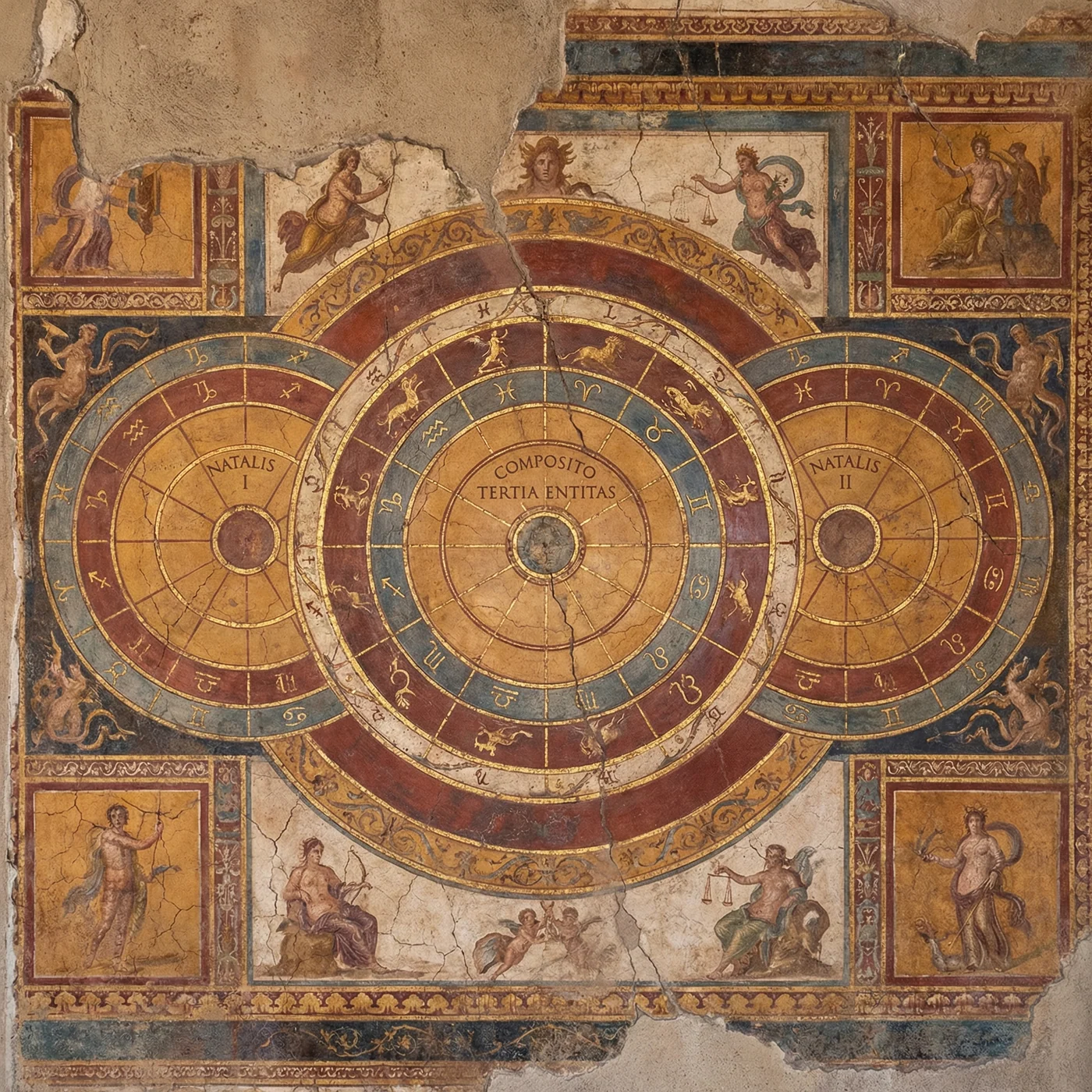
There comes a moment in every significant relationship when you stop seeing two separate people negotiating their differences and begin witnessing something entirely new—a third presence that emerges from your union but belongs fully to neither of you. It might arrive during an argument where you both suddenly step back, recognizing that "we" have patterns "you" and "I" never possessed alone. Or in those uncanny instances when friends remark that you've begun to speak with a shared voice, finishing thoughts that neither of you started. This invisible entity, born from the intersection of two birth charts, is what astrologers call the composite chart—your relationship as its own living being.
Unlike synastry, which examines how your planets interact with your partner's, the composite chart calculates the mathematical midpoints between every corresponding placement in your natal charts. The result is a third chart entirely, one that describes not how you affect each other, but what you create together. Where your Sun sits at 15 degrees Gemini and your partner's rests at 15 degrees Libra, your composite Sun emerges at 0 degrees Virgo—the exact midpoint in the zodiacal circle. This new Sun doesn't belong to either of you individually; it represents the core identity of your relationship itself.
The Mathematics of Union
This technique traces its origins to the medieval Arabic tradition, where astrologers sought to understand not merely how celestial bodies influenced individuals, but how multiple charts could be synthesized into a single horoscope representing collective entities. The method found its way into European practice through translations of Arabic texts, though it wasn't until the 20th century that astrologers began applying it specifically to romantic partnerships and other intimate bonds.
The composite chart operates on a profound mathematical principle: every relationship exists at the center point between its participants. Just as the Earth and Moon orbit around their common center of gravity—a point called the barycenter—every human relationship establishes its own gravitational center, a unique energetic signature that emerges from the precise mathematical balance between the natal charts involved.
When you calculate these midpoints, you're not creating an artificial construct but discovering something that already exists. The composite chart reveals the invisible architecture of connection, the energetic blueprint that governs how your relationship moves through time and responds to external pressures. It shows you why certain conflicts arise repeatedly, what your partnership exists to accomplish, and where you'll find your deepest sources of mutual strength.
The Third Entity
What distinguishes the composite chart from other relationship techniques is its recognition that significant partnerships develop their own autonomous existence. Your composite chart doesn't describe how you behave when you're together—it describes what you become together. This distinction proves crucial when attempting to understand relationship dynamics that seem to transcend individual personality.
Consider the composite Sun, which represents the relationship's core identity and purpose. If your individual Suns suggest two people who are naturally introverted and conflict-avoidant, but your composite Sun falls in Aries, your relationship itself will be bold, pioneering, and comfortable with confrontation. Together, you'll initiate projects neither of you would dare attempt alone, speak truths that would remain unspoken in isolation, and find yourselves taking leadership roles that contradict your individual natures.
The composite Moon reveals even more intimate secrets about your shared emotional landscape. It shows how your relationship processes feeling, what it needs to feel secure, and where it's most vulnerable to disruption. A composite Moon in Scorpio's first decan—THE JAWBONE, ruled by Mars and Pluto—creates a relationship that feeds on intensity and transforms through crisis. This partnership will instinctively seek depth over surface harmony, preferring the discomfort of absolute honesty to the false peace of unspoken resentments.
The composite Ascendant, meanwhile, describes how your relationship presents itself to the world and what kinds of experiences it attracts. Unlike your individual rising signs, which show your personal masks and approaches to new situations, the composite Ascendant reveals the face your partnership wears in public and the first impressions it creates in others.
When the Universe Conspires
To illustrate how dramatically the composite chart can differ from its component parts, consider two individuals whose natal charts suggest fundamental incompatibility. She has Sun in Cancer, Moon in Pisces, and Libra rising—a deeply emotional, intuitive person who values harmony and abhors conflict. He carries Sun in Capricorn, Moon in Virgo, and Scorpio rising—practical, analytical, and comfortable with confrontation when necessary. Synastry analysis might focus on how his earth-sign practicality grounds her water-sign emotions, or how her diplomatic Libra Ascendant softens his intense Scorpio rising.
But their composite chart tells a completely different story. Their composite Sun lands at 20 degrees Leo—the decan of THE BANNER, ruled by Mars alone, corresponding to the Seven of Wands and embodying pure courage under pressure. This relationship exists to take a stand, to defend something worth protecting, to fight battles that matter. Their composite Moon falls in Sagittarius, their composite Ascendant in Gemini. Together, they become explorers and communicators, adventurers and teachers, despite neither individual chart suggesting such tendencies.
In practice, this couple finds themselves constantly thrust into situations requiring them to advocate for causes they believe in. They meet at a community meeting about local development, bond over shared concerns about environmental protection, and within months find themselves organizing neighborhood initiatives neither would have joined as individuals. Their relationship has its own mission, its own reason for existing, which emerges not from their individual purposes but from the unique space they create together.
This is the composite chart's great revelation: relationships are not simply the sum of their parts but entirely new entities with their own destinies, challenges, and gifts. The composite Venus shows how this entity experiences and expresses love—not how the two individuals love each other, but how their partnership itself embodies the principle of attraction and harmony. A composite Venus in Aquarius's third decan—THE KNOT, ruled by Moon and Venus—creates a relationship that finds beauty in complexity and expresses love through the patient untangling of difficult problems.
The Seasons of Relationship
The composite chart also reveals timing patterns that govern your partnership's development. The composite Sun's annual return marks your relationship's birthday, a time when its core themes intensify and new directions become possible. Transits to composite planets affect not your individual experiences but your shared life—when Jupiter crosses your composite Midheaven, opportunities expand for your partnership's public role or shared career endeavors, regardless of what might be happening to your individual professional lives.
Eclipse cycles hitting sensitive points in the composite chart often coincide with relationship turning points that feel fated, inevitable, beyond personal control. These aren't challenges to your individual growth but to your shared evolution, moments when the relationship itself must transform to survive and flourish.
Understanding these patterns allows you to work with your relationship's natural rhythms rather than against them. During composite Mars returns, expect increased activity and possible conflict—but recognize these as signs of the relationship asserting its own needs and boundaries, not necessarily indicators of personal incompatibility. When composite Saturn aspects suggest contraction and serious evaluation, you're not experiencing relationship failure but relationship maturation, the necessary process by which your union develops lasting structure and commitment.
Living as Three
Working consciously with your composite chart means acknowledging that every significant relationship involves three entities: you, your partner, and the relationship itself. This third being has its own needs, its own timing, its own ways of responding to stress and opportunity. Sometimes what serves your individual growth may conflict with what your relationship requires, and sometimes your partnership's evolution demands changes neither of you would choose independently.
The composite chart becomes particularly valuable during periods of relationship difficulty, offering perspective that transcends blame and personal grievance. When conflicts arise repeatedly around the same themes, the composite chart often reveals that these aren't personal failings but structural features of your shared entity—challenges that your relationship exists to work through and transform.
Regular attention to your composite chart's transits and progressions creates a practice of relationship tending that goes beyond individual self-care or couple's therapy. You begin relating to your partnership as a living being requiring its own form of nourishment, attention, and respect. You celebrate its victories, comfort it during difficulties, and make space for its independent growth and expression.
This perspective proves especially powerful when making major decisions that affect your shared life. Rather than negotiating between competing individual preferences, you can ask what serves the relationship's highest purpose, what honors its unique nature and supports its ongoing evolution. The answers often surprise you, suggesting choices neither of you would make alone but both recognize as unmistakably right for who you become together.
Your composite chart lives in the space between your individual stories, weaving them into something entirely new. In The Book of Us, we calculate and interpret this third chart with the same depth and nuance we bring to individual natal analysis, revealing the invisible entity you've created together and the cosmic purpose it serves.