The third face of Leo — The Banner, ruled by Mars (sole rulership. What this face asks of the people born wearing it.
You stand at the edge of the battlefield, dust settling around your feet, banner still clutched in your bloodied fist. The fighting ended hours ago, but your grip hasn't loosened. Your allies call to you from the celebration, but something in you cannot believe the war is truly over. You scan the horizon for the next wave of enemies, the next test, the next reason to raise your colors and prove your worth once more. This is the territory of Leo III—where victory tastes like preparation for the next battle, where rest feels like betrayal, and where the soul learns to carry its standard through every season of existence.
The Face of Sacred Defiance
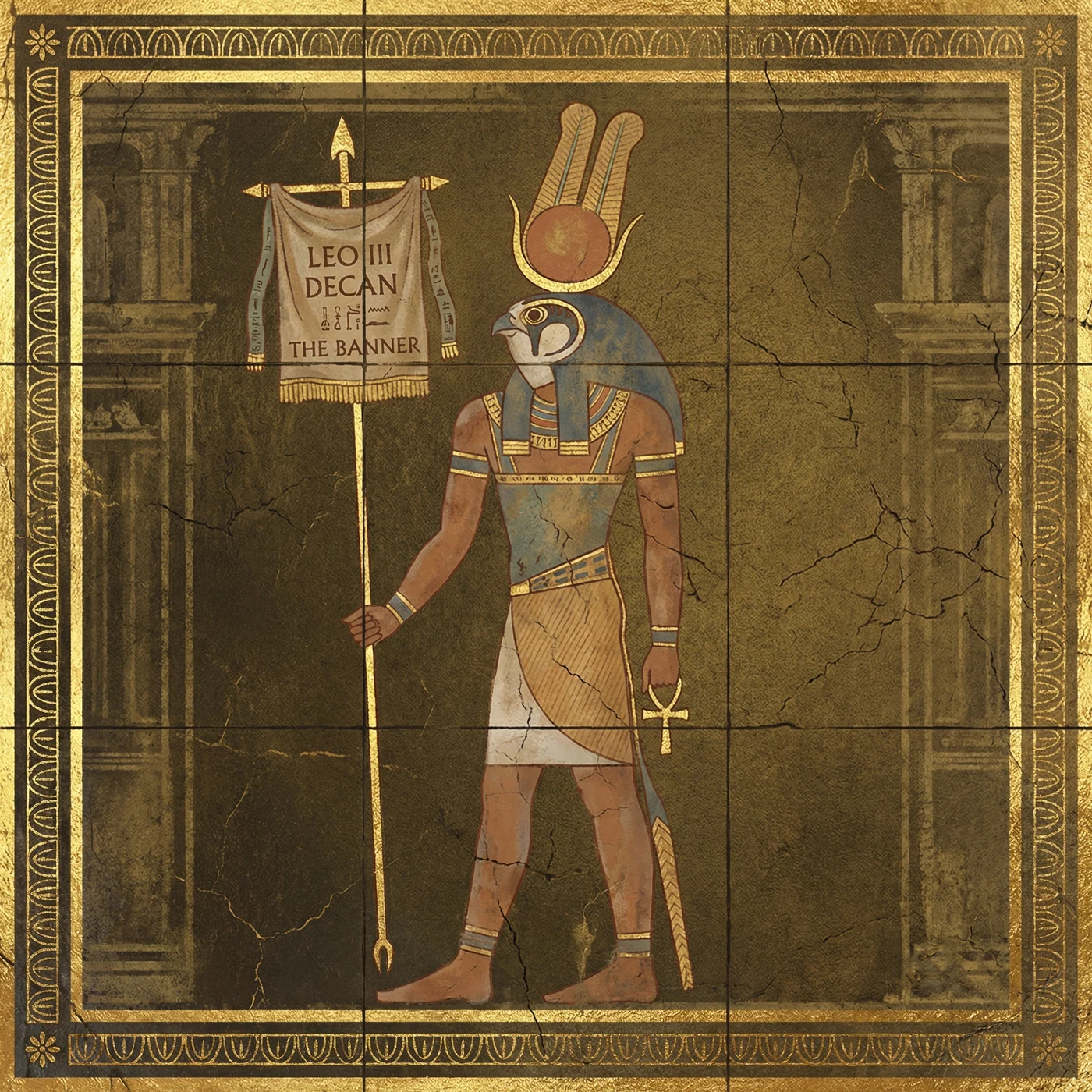
Leo III bears the image of THE BANNER—not the triumphant flag of conquest, but the weathered standard of those who defend what cannot be surrendered. This is the decan of sacred boundaries, where the spirit learns that some things are worth more than peace, more precious than comfort, more vital than the opinion of the crowd. The banner is both symbol and weapon, declaration and shield, a piece of cloth that becomes the axis around which entire worlds turn.
In the ancient images, we see figures who have moved beyond the easy victories of Leo's earlier faces. Where Leo I struggled for the spotlight and Leo II claimed the crown of laurels, Leo III holds something far more costly—the standard of an unconquerable principle. This is not the warrior drunk on glory, but the defender who has counted the cost and chosen to pay it. The banner they carry bears no king's colors, but the emblem of something that transcends any single battle: truth itself, justice itself, the irreducible core of what makes life worth living.
The figures of this decan are often surrounded by enemies, outnumbered but never outmatched in spirit. They have learned the terrible mathematics of principle—that some equations cannot be solved by compromise, some problems cannot be negotiated away, some stands must be taken regardless of the odds. Their banner does not promise victory in any conventional sense; it promises only that when the accounting is done, they will be found on the right side of what matters.
Mars in Sole Command
Mars rules this decan without planetary partners, bringing the pure essence of the red planet to Leo's stage. But this is not Mars as berserker or conqueror—this is Mars as guardian, as the sacred warrior who fights not for spoils but for sanctuary. The god of war reveals here one of his most noble faces: the defender of the defenseless, the champion of causes that have no other champions, the force that says "no further" when all else counsels retreat.
This Martian influence manifests as an almost supernatural capacity for endurance under pressure. Those touched by this decan possess what the ancients called adamantine will—a quality of determination that becomes harder under stress, more refined through opposition. They are the people who discover reserves of strength they never knew they possessed, who find that adversity clarifies rather than clouds their vision.
The Seven of Wands reflects this perfectly in both its traditional forms. The Rider-Waite image shows a figure on higher ground, using a single wand to hold back six others—outnumbered but not overcome, elevated by the righteousness of their position. The Thoth version names this card "Valor," capturing the essential quality that Mars bestows here: not fearlessness, but the courage to act in full knowledge of what courage costs. This is valor in its truest sense—not the absence of fear, but the mastery of it in service of something greater than oneself.
Mars in this decan teaches that true strength is not measured by what you can conquer, but by what you can protect. The banner becomes a focusing lens for this protective force, a visible symbol of invisible principles that transforms the bearer into something more than human—a living representation of uncompromising truth.
When the Sun Bears the Banner
Those born with the Sun in Leo III carry their banner as their very identity. Their core self is organized around the principle of noble resistance, and they approach life with the understanding that their deepest purpose involves standing for something that others might abandon. These natives often feel called to causes that seem impossible, drawn to defend positions that appear indefensible, compelled to champion ideas whose time has not yet come—or may never come.
The solar expression of this decan manifests as an almost prophetic quality of leadership. These individuals often see the battles that must be fought before others recognize them as necessary. They may spend years preparing for conflicts that seem to exist only in their imagination, gathering resources and allies for struggles that appear to be fantasies. Then, when the crisis finally arrives, they are the only ones ready, the only ones who have maintained the skills and the will necessary to meet what everyone else experiences as a surprise.
But there is a shadow side to this solar placement. The embattled consciousness can become so accustomed to struggle that it creates conflicts where none need exist. These natives may find themselves fighting battles that have already been won, defending positions that are no longer under threat, maintaining a state of alert readiness that exhausts both themselves and those around them. They may struggle to recognize when it is time to lower the banner, when the war is truly over, when the vigilance they have maintained so faithfully can finally be relaxed.
The key to integrating this solar energy lies in learning to distinguish between authentic calls to service and the habitual patterns of defensiveness. When the Sun shines through Leo III with wisdom, it illuminates not just the battles worth fighting, but also the moments of peace worth celebrating.
When the Moon or Rising Bears the Banner
With the Moon in Leo III, the emotional nature is organized around themes of protection and defense. These individuals often experienced childhoods where they learned early that some things could not be compromised, where they discovered that safety sometimes required taking a stand that others found uncomfortable or inconvenient. Their emotional security becomes tied to their ability to maintain clear boundaries, to defend what they hold sacred, to ensure that the standards they have raised continue to fly.
The lunar expression creates a particularly poignant relationship with the past. These natives often become the keepers of family traditions, the guardians of ancestral wisdom, the ones who remember what others have forgotten and refuse to let it die. Their banner may bear the colors of their heritage, their culture, their lineage—whatever inheritance they have been entrusted to preserve and pass on.
When Leo III rises on the horizon, it colors the entire personality with qualities of dignified resistance. These individuals present themselves to the world as people who can be counted on when counting matters most. Others instinctively recognize them as allies in difficult times, as people who will not abandon their posts when the situation becomes challenging. Their very presence communicates reliability in crisis, steadfastness under pressure, the kind of loyalty that cannot be purchased or negotiated away.
The Ascendant expression often manifests through the way these individuals move through space—there is something in their bearing that suggests readiness, alertness, the quality of someone who has learned to sleep with one eye open not from paranoia but from responsibility. They carry themselves like people who have been entrusted with something precious and know that the trust is justified.
The Practice of Sacred Vigilance
The practical work of Leo III involves learning to discern when vigilance serves life and when it merely serves habit. This decan teaches the art of principled engagement—how to fight for what matters without becoming consumed by the fighting itself, how to maintain clear boundaries without building walls that exclude all possibility of connection, how to bear witness to truth without becoming isolated by the loneliness that truth-telling sometimes requires.
The banner becomes both the tool and the teacher in this work. Whether literal or metaphorical, it serves as a focal point for organizing one's energy around what is most essential. The practice involves regularly examining what your banner represents—what principles you are willing to defend, what values you would not compromise even under pressure, what vision of the world you are working to protect or create.
This is not the astrology of passive acceptance or easy peace. Leo III calls its children to active engagement with the forces that would diminish what they hold most dear. But it also teaches discrimination—the wisdom to know which battles serve the greater good and which serve only the ego's need for conflict. The highest expression of this decan involves becoming a guardian of possibilities, someone who fights not just against what they oppose but for what they hope to see flourish.
The banner, in the end, is a promise—a commitment to continue standing for something larger than personal comfort, convenience, or safety. It transforms those who carry it into living symbols of humanity's capacity to choose principle over expedience, truth over comfort, the long view over the immediate advantage.
For those who feel called to deeper understanding of their own relationship with these themes of sacred resistance and principled engagement, The Book of the Self offers personalized insights into how Leo III's energy manifests uniquely within your birth chart, revealing the specific nature of the banner you have been called to carry and the particular battleground where your vigilance serves the greater good.