Neptune in Libra — the generation that carries it, and what it does in a private chart.
You have felt it in the air of certain rooms—that quality of suspended judgment, the way conversations circle around conclusions without ever quite landing. Perhaps you noticed it first in your parents' generation, or in the cultural artifacts they left behind: the music that dissolved boundaries between genres, the art that questioned its own foundations, the relationships that redefined themselves mid-stream. This is the signature of Neptune in Libra, a generational placement that has spent decades teaching the world that harmony and dissolution are not opposites, but dance partners.
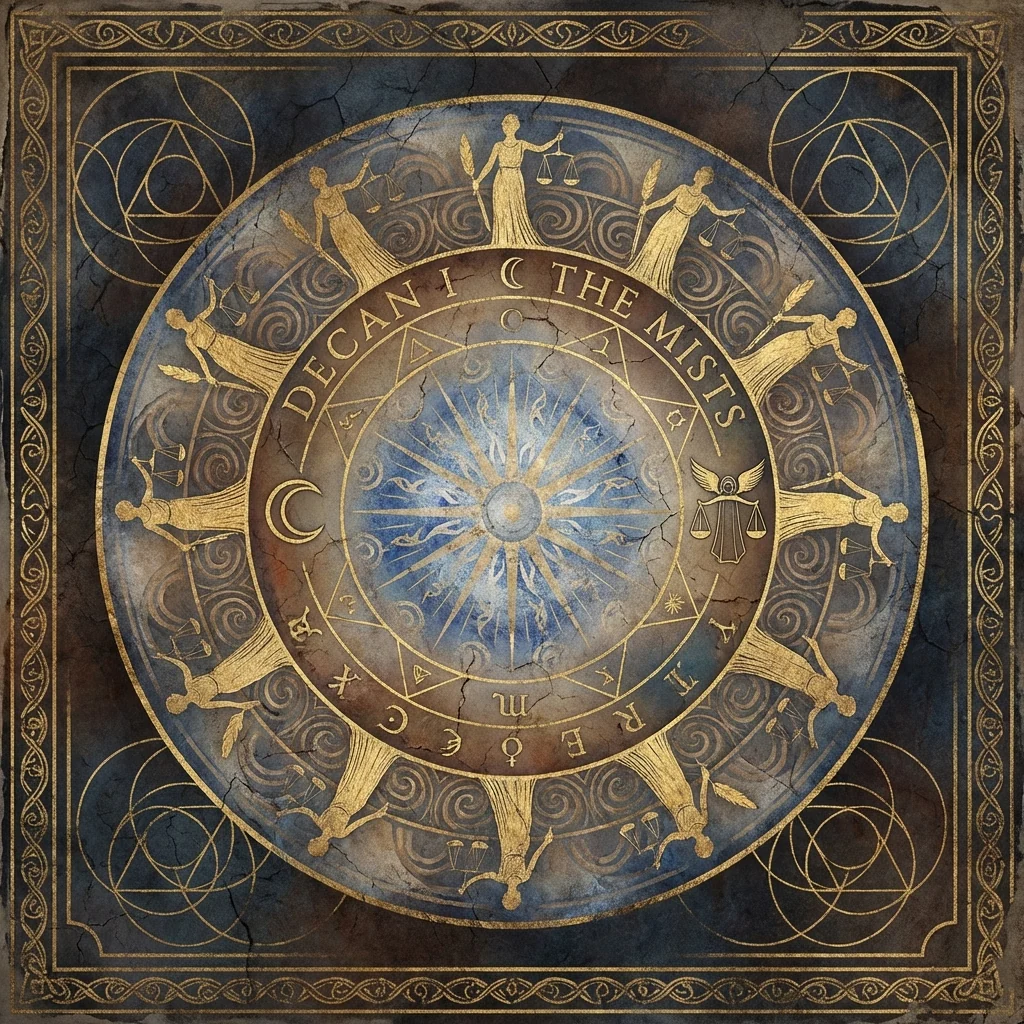
The Mist That Settles on the Scales
When Neptune, planet of dreams and dissolutions, takes up residence in Libra, the sign of balance and relationship, it does not simply occupy space—it transforms the very nature of what balance means. Those born under this influence, roughly between 1943 and 1957, carry within them a fundamental understanding that true equilibrium is not static but fluid, not achieved but continuously negotiated.
The traditional image of Libra's scales suggests a mechanical precision: add weight to one side, subtract from the other, find the perfect point of rest. But Neptune's presence introduces uncertainty into this equation. The scales themselves begin to shimmer, their measurements becoming approximate, their judgments provisional. What emerges is not the paralysis of indecision, but a sophisticated awareness that most questions worth asking have multiple valid answers.
This generation learned to navigate relationships through intuition rather than rulebook, to create art that merged forms rather than perfected them. They sensed that the pursuit of perfect balance might be less important than the dance of rebalancing, that partnerships might thrive not through the elimination of conflict but through the graceful management of ongoing tension.
The Gyroscope's Secret
Within the third decan of Libra lives A Gyroscope, ruled by Jupiter, Mercury, and Saturn—a mechanical marvel that maintains its stability precisely through motion. This image captures something essential about Neptune's work in Libra: the discovery that lasting harmony comes not from finding the perfect position but from developing the ability to adjust continuously to changing conditions.
The gyroscope spins in space, apparently defying gravity, maintaining its orientation through the very forces that might seem to destabilize it. Similarly, the Neptune in Libra generation has learned to find stability through adaptability, to create lasting relationships through constant renegotiation of terms, to build institutions that bend rather than break.
This is why their approach to partnership often confounds both older and younger generations. They neither cling to rigid role definitions nor abandon structure entirely. Instead, they have developed an intuitive understanding of when to hold firm and when to yield, when to assert individual needs and when to dissolve boundaries for the sake of union. Their relationships often have a quality of ongoing improvisation, each partner responding to the other's movements in an endless dance of mutual accommodation.
The Dissolution of Artificial Boundaries
The Neptune in Libra cohort came of age during a time when many of society's most fundamental categories were being questioned and redefined. They witnessed and participated in the blurring of racial boundaries, the reimagining of gender roles, the fusion of musical styles, the emergence of new forms of spiritual practice that borrowed freely from multiple traditions. This was not mere rebellion against existing structures, but something more profound: a recognition that many of the boundaries previous generations had taken for granted were actually fluid, permeable, subject to conscious revision.
In their hands, Neptune's dissolving influence did not create chaos but rather revealed hidden connections. They developed an almost mystical appreciation for the spaces between categories—the recognition that jazz and classical music shared common ground, that Eastern and Western philosophy might complement rather than contradict each other, that love could take forms not yet catalogued by convention.
This gift for seeing through artificial separations became both their strength and their challenge. While they excelled at bringing together elements that others saw as incompatible, they sometimes struggled with the practical necessity of making firm distinctions. Their children learned early that a single question might receive three different answers depending on context, that family decisions emerged from discussion rather than decree, that life's most important truths were often found not in choosing between options but in discovering unexpected third alternatives.
The Practical Magic of Everyday Diplomacy
Consider Maria, born in 1951 with Neptune in Libra's first decan, A Blindfold and a Sword. By her fortieth birthday, she had worked as a translator at the United Nations, mediated labor disputes for a municipal government, and raised three children with a husband whose cultural background could hardly have been more different from her own. Her friends often asked how she managed it all—the competing demands, the cultural complexity, the constant negotiations required by her various roles.
What they did not understand was that for Maria, this was not management but artistry. She had developed an intuitive sense for the emotional currents in any room, an ability to sense when someone felt unheard before they themselves recognized their frustration. Her approach to conflict was neither to eliminate it nor to take sides, but to create space for all parties to discover solutions that honored everyone's deepest needs.
At work, she became known for her ability to help adversaries find common ground they had not known existed. At home, family dinners often resembled diplomatic summits, with children and adults alike learning to articulate their perspectives and negotiate compromises. Her marriage endured not because it was free of conflict, but because both partners had learned to treat their differences as creative tensions rather than problems to be solved.
This was Neptune in Libra at its finest: the transformation of everyday relationships into opportunities for mutual discovery, the recognition that harmony achieved through authentic engagement is far more valuable than peace maintained through avoidance.
Working with the Generational Gift
Those who carry this placement, and those who live and work with them, benefit from understanding its particular genius. This is not a generation that responds well to ultimatums or artificial deadlines. Their decision-making process requires time for reflection, consultation, and the exploration of options that might not be immediately obvious. What can appear to others as indecisiveness is actually a sophisticated form of due diligence—a recognition that hasty choices often create more problems than they solve.
Their gift lies in their ability to hold multiple perspectives simultaneously without losing their center. They excel in roles that require mediation, translation, or the integration of diverse viewpoints. They thrive in collaborative environments where their talent for finding unexpected common ground can be fully utilized. They struggle in situations that demand quick, unilateral decisions or that penalize them for changing course as new information emerges.
Understanding their approach requires patience and a willingness to trust in processes that might not follow conventional timelines. Their children learn early that important family decisions emerge through discussion rather than decree. Their colleagues discover that projects benefit from their input even when—especially when—they raise questions that others have not considered. Their partners find that relationships deepen through ongoing negotiation rather than initial perfect alignment.
The key to working successfully with Neptune in Libra energy is to appreciate that its apparent indecision often masks a profound wisdom about the complexity of human relationships and the provisional nature of most apparent solutions. They are teaching the rest of us that in a world of constant change, the ability to remain flexible while maintaining one's essential values is not a weakness but a form of practical magic.
For those seeking to understand their own Neptune in Libra placement, the work lies not in overcoming their tendency toward careful consideration, but in learning to trust their intuitive sense of timing and balance. The Book of the Self offers detailed guidance for integrating this and other generational signatures into a complete understanding of your unique astrological constitution.