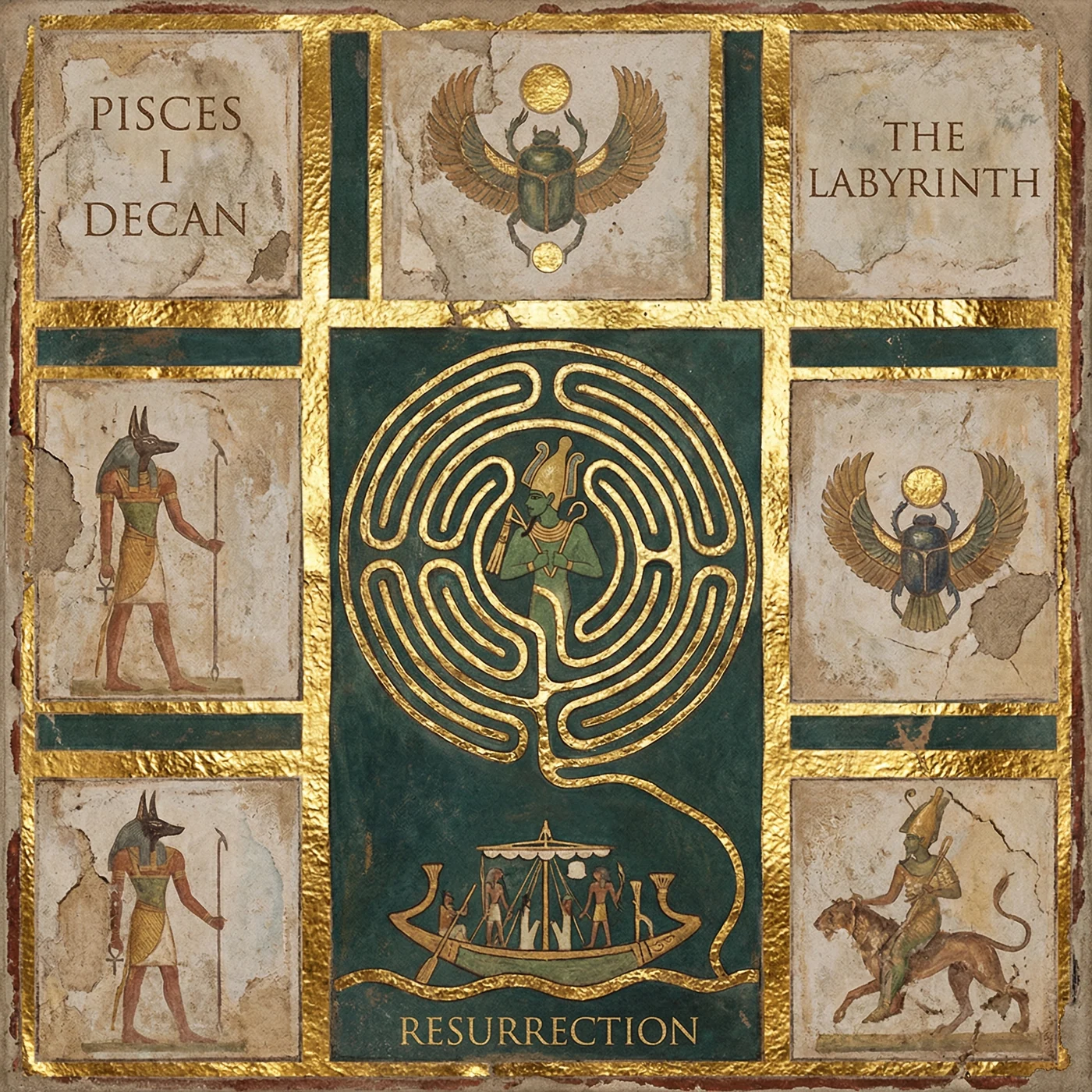
The first face of Pisces — The Labyrinth, ruled by Saturn. What this face asks of the people born wearing it.
You find yourself standing at the edge of something vast and invisible, feeling the walls of a structure you cannot see. Your fingers trace boundaries that exist but do not appear, following corridors that lead deeper into a mystery you built without knowing. This is the moment when everything you thought was real reveals itself as constructed, when the solid ground beneath your feet becomes the floor of an endless maze. You are discovering that you have always lived within the labyrinth—you are only now learning to map its walls.
This is the recognition that comes to those who carry the first face of Pisces, whether in their Sun, Moon, or Rising. It is the moment when the seeker realizes they are not lost in the labyrinth; they are the labyrinth. And somewhere in its deepest chamber waits the Maker, the architect of all the invisible structures that shape a life.
The Face of the Maze
The first decan of Pisces bears the image of THE LABYRINTH, that ancient symbol of the inward journey where every path leads both toward and away from the center. Here, in these ten degrees from zero to nine of the Fishes, we encounter not the simple maze of hedges and walls, but the labyrinth of consciousness itself—the intricate pattern of assumptions, beliefs, and unconscious structures that create the reality we inhabit.
Unlike the crude mazes that offer false choices and dead ends, the labyrinth contains only one path. But that path spirals inward and outward in such complex loops that the walker often believes they are lost, often feels they are moving away from their destination when they are, in fact, approaching it. The labyrinth teaches patience with the indirect route, faith in the pattern when the pattern cannot be seen.
Those who carry this face know the particular frustration of feeling trapped within structures they cannot identify. They sense the walls but cannot touch them, feel the corridors but cannot map them. This is the predicament of consciousness awakening to its own constructions—the prison that is invisible precisely because it is made of the substance of mind itself.
The labyrinth is not external but internal, not made of stone but of story. It is woven from the tales we tell ourselves about who we are, what is possible, and what is real. Every assumption becomes a wall, every belief a corridor. The deeper we travel into this structure, the more we recognize it as our own creation—and the more possibility opens for its transformation.
Saturn's Discipline and the Eight of Cups
This decan operates under the dual rulership of Saturn and Jupiter, but it is Saturn who provides its fundamental signature. The old planet of boundaries and limitations here reveals the most subtle boundary of all—the edge between the constructed and the unconstructed, the made and the unmade. Saturn in Pisces I does not build walls of stone but walls of assumption, not chains of metal but chains of narrative.
The tarot card that captures this energy is the Eight of Cups, known in the Rider-Waite tradition as "Indolence" and in Crowley's Thoth system by the same name. The card shows a figure departing from a carefully arranged set of cups, walking away from what appears to be achievement or completion. But this is not laziness—it is the profound recognition that what was built with such care is not the real destination.
The Eight of Cups represents the moment of the Great Departure, when the seeker abandons the constructions that once seemed so important. The cups are not knocked over in anger or frustration; they are left standing as monuments to a stage of understanding that has been outgrown. This is Saturn's gift in this decan—the capacity to recognize the walls of our own making and the courage to walk away from them.
The figure in the card turns their back not on success but on the illusion of success, not on completion but on the recognition that completion was never the point. They walk toward the unknown, guided by an inner certainty that what they seek cannot be found within the structures they have spent so long building and maintaining.
This is why the card carries the shadow meaning of "indolence"—to the external world, the departure looks like laziness, like giving up. But those who carry Pisces I understand that sometimes the most profound action is the willingness to stop acting, to abandon the familiar maze and trust in the deeper pattern that underlies all constructions.
The Solar Expression
When the Sun travels through or is born within this decan, it illuminates the labyrinth from within. These natives carry a natural understanding that life is more complex than it appears, that every situation contains hidden dimensions and invisible structures. They are drawn to psychology, mysticism, and any field that maps the unseen influences that shape human experience.
The solar expression of Pisces I creates individuals who serve as guides for others navigating their own invisible mazes. They have an intuitive understanding of how consciousness creates reality and how reality, in turn, shapes consciousness. This makes them natural therapists, counselors, and spiritual teachers—not because they have found the way out of the labyrinth, but because they have learned to navigate it with grace.
There is often a quality of patient wisdom about these individuals, a recognition that the indirect path is sometimes the only path. They understand that growth happens in spirals rather than straight lines, that apparent regression often precedes breakthrough. They have made peace with the labyrinthine nature of development and can help others do the same.
Yet the solar expression can also manifest as a kind of paralysis, a recognition of complexity that prevents decisive action. When the Sun shines too brightly on the maze, every choice reveals infinite ramifications, every path shows both promise and peril. These natives must learn to act despite uncertainty, to move forward while acknowledging the limitations of their vision.
The Lunar and Rising Expression
When the Moon or Ascendant falls in this decan, the labyrinth becomes the emotional or persona-level reality. These individuals experience life as a series of invisible chambers, each with its own atmosphere and laws. They are sensitive to the hidden structures that govern social interaction, the unspoken rules that shape relationships, the unconscious patterns that repeat across generations.
The lunar expression often manifests as a deep emotional intelligence coupled with a sense of being lost in feelings that seem to follow their own mysterious logic. These natives understand that emotions are not simple reactions but complex patterns that spiral through the psyche, connecting past and future in ways that linear thinking cannot grasp.
They may find themselves in relationships that feel familiar in unsettling ways, reliving patterns they cannot quite identify or escape. But this is precisely their gift—the ability to sense the deeper currents that flow beneath the surface of interpersonal connection. They become the ones others turn to when trapped in their own emotional mazes.
When Pisces I rises on the horizon, the individual presents to the world as someone who understands hidden things. Others sense in them a guide through complexity, a person who has learned to find meaning in confusion. There is often something mysteriously knowing about their presence, as if they carry maps to territories others have never seen.
But this placement can also create a persona that feels insubstantial, as if the individual is always slightly elsewhere, always partly dissolved into the larger pattern. They must learn to maintain enough boundaries to function while remaining open enough to serve their role as guides through the invisible.
The Practice of the Labyrinth
Working with Pisces I requires developing comfort with not knowing where you are going while maintaining faith that you are going somewhere meaningful. This is the practice of walking the labyrinth—not trying to solve it like a puzzle, but allowing it to work its transformation through the simple act of following the path.
The first step is learning to recognize the labyrinth itself, to identify the invisible structures that shape your experience. This requires developing what might be called "structural sensitivity"—the ability to feel the walls of assumption, the corridors of habit, the chambers of belief that form the architecture of your inner world.
Begin by noticing the stories you tell yourself about limitations, about what is possible and impossible in your life. These stories are not facts but constructions, walls in the labyrinth of your own making. The practice is not to tear them down immediately but to recognize them as constructions, to feel their artificial nature even while they continue to function.
The second movement is developing patience with the indirect path. The labyrinth teaches that the quickest route to the center is not a straight line but a spiral that sometimes seems to lead away from the destination. This requires trusting in patterns larger than your immediate perception, having faith in the intelligence of the maze itself.
When you find yourself in situations that feel repetitive or circular, resist the urge to force a linear solution. Instead, ask what the spiral is teaching, what understanding emerges from moving through the pattern rather than trying to escape it. Often the gift is not in reaching the center but in learning to move through complexity with grace.
The deepest practice of this decan involves recognizing yourself as both the walker and the maker of the labyrinth. Every assumption you release creates new passages; every belief you examine changes the structure of the maze. You are not trapped in someone else's construction but engaged in an ongoing creative process with the architecture of your own consciousness.
This recognition brings both responsibility and freedom. You cannot blame external forces for the shape of your inner world, but neither are you condemned to walk forever in patterns that no longer serve. The labyrinth is alive, responsive, always willing to reshape itself in response to new understanding.
Those who master this practice become what the tradition calls "psychopomps"—guides who can help others navigate the transition between different levels of reality. They serve not by providing answers but by teaching others to read the invisible maps, to trust in the deeper intelligence that guides all genuine transformation.
The ultimate gift of Pisces I is the recognition that what appears to be imprisonment is actually initiation, that the maze is not a trap but a teaching device, and that the center we seek is not a destination but a state of consciousness that can be carried anywhere. In learning to navigate our own labyrinths, we develop the capacity to help others find their way through the invisible structures that shape all human experience.
The Book of the Self offers a complete mapping of your personal labyrinth, revealing the unique configuration of invisible structures that shape your life's pattern and providing guidance for navigating them with wisdom and grace.