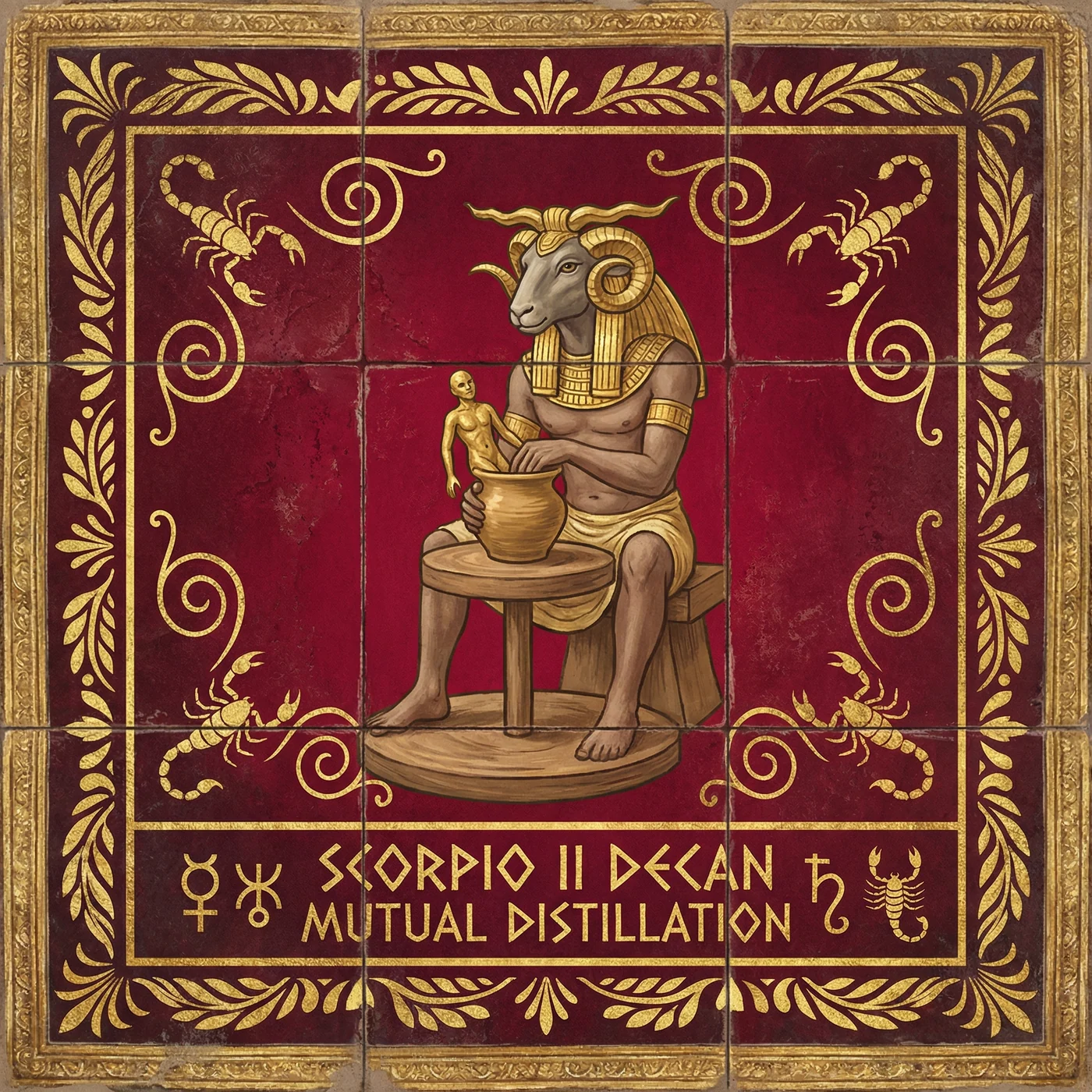
The second face of Scorpio — An Apparatus For Mutual Distillation, ruled by Sun. What this face asks of the people born wearing it.
You know the moment when two people discover they can speak without words—when glances carry entire conversations, when the space between you becomes charged with something neither of you created alone. It might happen across a laboratory bench as you perfect a formula together, or in the quiet after an argument when you realize you've both been transformed by the friction. This is not the desperate hunger of early Scorpio, nor the intoxicating illusions that follow. This is something rarer: the discovery that two separate beings can create a third thing together, something that exceeds what either could produce in isolation.
The Apparatus Itself
The image that governs this face is precise in its implications: an apparatus for mutual distillation. In the alchemical laboratory, mutual distillation involves passing the same substance back and forth between two vessels, each passage refining and concentrating the essence until something far purer emerges. The process requires perfect timing, absolute trust in the equipment, and the patience to let transformation happen gradually.
When this process succeeds, both vessels become instruments of the other's refinement. When it fails, both become contaminated by what the other could not properly digest.
The name reveals the fundamental mechanics at work in this decan. Unlike simple extraction or purification, mutual distillation assumes that both participants possess something the other needs, and that neither can achieve their highest expression without the sustained, intimate exchange the process demands. The apparatus itself becomes sacred—not just the two vessels, but the careful construction that allows essences to pass between them without loss or corruption.
Those who carry this face understand intuitively that the most profound transformations happen not in isolation but through sustained intimate exchange. They are drawn to relationships—romantic, intellectual, creative, spiritual—where both parties serve as catalyst and vessel for the other's development. But they also learn, sometimes painfully, that not everyone is equipped for this level of mutual refinement.
The Solar Ruler and the Card of Pleasure
The Sun rules this decan, bringing the solar capacity for sustained creative fire to the Scorpio depths. This is not the harsh noon sun of Leo, but the autumn sun that ripens the late harvest—warm enough to complete the work of transformation, angled low enough to reveal every shadow and texture.
Under solar rulership, the exchanges that happen here carry the quality of conscious creation. The Sun illuminates what each party brings to the distillation and provides the steady heat necessary to keep the process moving. Solar fire here doesn't consume or dominate; it serves the greater work of mutual refinement.
The Six of Cups appears in both Rider-Waite and Thoth systems as Pleasure, but this pleasure has a specific signature. In the Rider-Waite image, a boy offers a cup of flowers to a girl—the gesture is tender, unguarded, given freely without calculation. The Thoth card reveals the same essential dynamic: pleasure that arises from natural exchange rather than conquest or consumption.
This pleasure emerges from the recognition that giving and receiving can become indistinguishable when two beings are properly attuned to each other. It's the pleasure of the laboratory when an experiment succeeds, of the conversation that teaches both speakers something they didn't know they knew, of the creative collaboration where ideas emerge that belong fully to neither party and completely to both.
The solar nature of this pleasure means it tends to be conscious, creative, and generative. It builds something lasting rather than simply consuming itself in the moment of satisfaction.
The Sun's Expression
When the Sun itself occupies this decan in someone's birth chart, it places their core identity in service to the process of mutual refinement. These are people who come alive in the context of meaningful exchange—they identify themselves through their capacity to create transformative relationships with others.
Their sense of self develops through intimate partnerships of all kinds: business collaborations that become creative crucibles, friendships that survive and deepen through honest confrontation, romantic relationships that serve as vehicles for conscious evolution. They often possess an uncanny ability to see what others need for their own development and to provide it while simultaneously drawing from the exchange what they need for their own growth.
The shadow side manifests when they become too identified with their role as transformer or catalyst. They may lose track of their own authentic desires while serving the apparatus of exchange, or they may unconsciously manipulate relationships to maintain their sense of being needed. Learning to recognize when the apparatus has completed its work—when it's time to let a relationship evolve beyond the intensity of mutual distillation—becomes crucial for their development.
Their creative fire burns brightest when it serves something larger than personal expression: the relationship itself, the work being created together, the mutual recognition of what's possible when two conscious beings commit to each other's highest development.
Moon and Rising: The Receiving Vessels
When the Moon occupies this decan, the emotional nature seeks the security that comes from being truly known and simultaneously knowing another at the deepest levels. These individuals possess powerful instincts about the emotional alchemy of relationships—they sense immediately whether someone is capable of the kind of intimate exchange this decan represents.
Their emotional satisfaction comes through caring for others while being cared for in return, but their needs are sophisticated. Surface-level attention or generic affection leaves them feeling starved. They require relationships where emotional truth-telling is not only safe but essential to the ongoing connection. The danger lies in their tendency to try to create this level of intimacy through sheer emotional intensity rather than through the patient construction of trust that genuine mutual distillation requires.
When this decan rises, it colors the personality with an immediate radar for relational possibility. These people enter rooms scanning not for status or entertainment, but for the potential of meaningful connection. Others sense in them the capacity for depth and often find themselves sharing more than they intended. Their challenge lies in maintaining appropriate boundaries while remaining open to the profound encounters their nature attracts.
Their relationships tend to be fewer but deeper, marked by the kind of ongoing exchange that continues to teach both parties something new about themselves years or decades into the connection. They become masters of what might be called emotional alchemy—the art of transforming the base metals of human reactivity into the gold of conscious intimacy.
The Practice of Mutual Distillation
Working with this decan means learning to distinguish between relationships that offer genuine mutual development and those that simply provide intensity, comfort, or distraction. The apparatus for mutual distillation requires specific conditions: both parties must possess something the other genuinely needs, both must be willing to be changed by the exchange, and both must have developed enough stability to remain themselves while being transformed.
The practice begins with radical honesty about what you bring to relationships and what you genuinely need from them. This is not the honesty of emotional dumping or confession, but the precise assessment required in any laboratory: what are the actual properties of the substances being worked with?
Next comes the cultivation of what alchemists call the hermetic vessel—the capacity to contain intense transformational processes without leaking, exploding, or contaminating the work. In relational terms, this means developing the ability to stay present with both your own reactions and the other person's process even when the exchange becomes challenging.
The apparatus itself must be tended carefully. This means creating and maintaining the structures that allow intimate exchange to flourish: regular communication about the relationship itself, agreements about how conflict will be handled, protection of the space where vulnerable truth-telling can occur.
Most importantly, this practice requires learning to recognize when the distillation process has achieved its purpose. The goal is not to maintain intensity indefinitely, but to extract the essence that serves both parties' highest development. Sometimes this means allowing relationships to evolve into new forms; sometimes it means recognizing when the apparatus has fulfilled its function and can be honorably dissolved.
Those who master this practice become invaluable collaborators, friends, lovers, and teachers. They develop the capacity to see others clearly enough to serve their development while remaining grounded in their own authentic needs and purpose. They create around themselves a network of relationships characterized not by dependency or casual connection, but by the ongoing mutual recognition of what becomes possible when conscious beings commit to each other's transformation.
The Book of the Self offers detailed guidance for working with the specific alchemical signature of your own chart, including practices tailored to your unique configuration of mutual distillation patterns and the specific forms of intimate exchange most likely to serve your development.