Two charts, two truths: the space between you, and the third entity your union becomes. When to read each.
You know that moment when you meet someone and the conversation flows like water finding its course, when every story they tell seems to answer something you didn't know you'd been asking? And you know the other moment too—when you and that same person, months later, sit across a dinner table in perfect silence, not hostile but somehow inhabiting an entirely different country than the one where you first met? These moments point to something astrology has long recognized: there are actually two relationships happening simultaneously, and they require different maps entirely.
The ancient practitioners understood this instinctively. When they wanted to examine how two people affected each other, they laid one chart over another and watched the planets speak across the space between them. When they wanted to understand what those two people created together—the invisible third thing that emerged from their union—they calculated an entirely different chart, one that belonged neither to person A nor person B, but to the relationship itself. These became known as synastry and composite, respectively, and they remain the two fundamental approaches to reading any significant bond.
The Dance of Influence: Understanding Synastry
Synastry comes from the Greek meaning "arrangement of stars together." It operates on the principle that your natal chart continues to be your chart, but when another person enters your orbit, their planets begin conversing with yours in an ongoing celestial dialogue. Your Venus in the second decan of Libra—governed by Saturn and Mercury, the place of negotiation and careful partnership—suddenly finds itself in aspect to their Mars. Your careful, consensus-seeking approach to love meets their direct, warrior-like passion, and something sparks or clashes or transforms in the meeting.
This technique emerged naturally from the practice of natal astrology itself. Once astrologers could calculate birth charts with precision, the next logical question became: what happens when two charts interact? The Hellenistic astrologers began overlaying charts, watching how one person's planets fell into another's houses, noting which planets formed aspects across the charts. They discovered that synastry reveals the mechanism of attraction and friction—why you feel instantly comfortable with one person's way of being in the world and perpetually irritated by another's.
Consider a relationship where one person has their Sun in the first decan of Cancer—A Mother and Child, ruled by Venus and the Moon, corresponding to the Two of Cups. Their core identity emerges from nurturing, from the bonds that sustain life, from the alchemy of care itself. Their partner has Mars in the third decan of Capricorn—The Throne, ruled by the Sun and Mercury, corresponding to the Four of Pentacles. This Mars acts through structure, through the accumulation and protection of resources, through the kind of power that builds lasting institutions.
In synastry, we would examine how these placements speak to each other. The Cancer Sun person experiences identity through emotional connection and care-giving. The Capricorn Mars person takes action through building security and establishing control. The synastry between them reveals a fascinating dynamic: the Cancer Sun activates the Capricorn Mars person's desire to provide and protect, while the Capricorn Mars gives the Cancer Sun person the stability and security that allows their nurturing nature to flourish. Each person remains themselves, but in proximity to the other, different facets of their nature come alive.
Working with synastry means learning to read the conversation between charts. You identify the aspects—conjunctions, trines, squares, oppositions—between the planets of both people. You notice which of your houses their planets fall into, and vice versa. Their Venus in your fifth house suggests they activate your creative and romantic nature. Your Saturn in their tenth house suggests you provide structure and discipline to their career and public image. The relationship becomes a mutual triggering of potentials, each person calling forth possibilities in the other that might otherwise remain dormant.
The Third Entity: Understanding Composite Charts
The composite chart operates from an entirely different premise. Instead of examining how two separate entities interact, it calculates the mathematical midpoints between all corresponding planets and creates a single chart that belongs to the relationship itself. If your Sun is at 15 degrees Aries and your partner's Sun is at 15 degrees Libra, the composite Sun sits at 15 degrees Cancer—not in either of your natal charts, but at the point that equalizes the distance between you.
This technique emerged much later in astrological history, developed in the twentieth century as astrologers began thinking more psychologically about relationships. The composite chart reveals what you become together—not who you each are individually, but what emerges from your union. It shows the personality, purpose, and evolutionary trajectory of the relationship as its own living entity.
The composite often surprises people because it can be radically different from what you might expect based on individual charts. Two people with strong fire sign emphasis might have a composite chart dominated by earth, suggesting that together they become practical, methodical, focused on building something lasting in the material world. Their individual charts might suggest passion and spontaneity, but their union creates stability and patience.
Imagine a composite chart with Venus in the second decan of Pisces—The Net, ruled by Jupiter and Mars, corresponding to the Nine of Cups in the tarot. This placement suggests a relationship that finds its deepest fulfillment through emotional and spiritual satisfaction, where the love between the partners becomes a source of genuine happiness and contentment. The Net implies that this relationship captures something precious—perhaps healing each person's past disappointments in love, creating the kind of emotional abundance that both people had dreamed of but never quite achieved alone.
The composite Sun reveals the relationship's core purpose and identity. Composite Moon shows its emotional nature and how it nurtures itself. Composite Venus indicates how it expresses love and what it finds beautiful. Each planet in the composite chart describes an aspect of the relationship's own personality, entirely separate from the personalities of the individuals involved.
Working with composite charts requires a shift in perspective. Instead of asking "How do we affect each other?" you ask "What are we together?" Instead of looking for compatibility or conflict between separate charts, you interpret the composite as if it were the natal chart of the relationship itself. A composite Mars in the third decan of Scorpio—A Crow, ruled by Venus and Mars, corresponding to the Seven of Cups—suggests a relationship that takes action through transformation and depth, that finds its energy in cleaning up what has died, in being messengers between different worlds or stages of life.
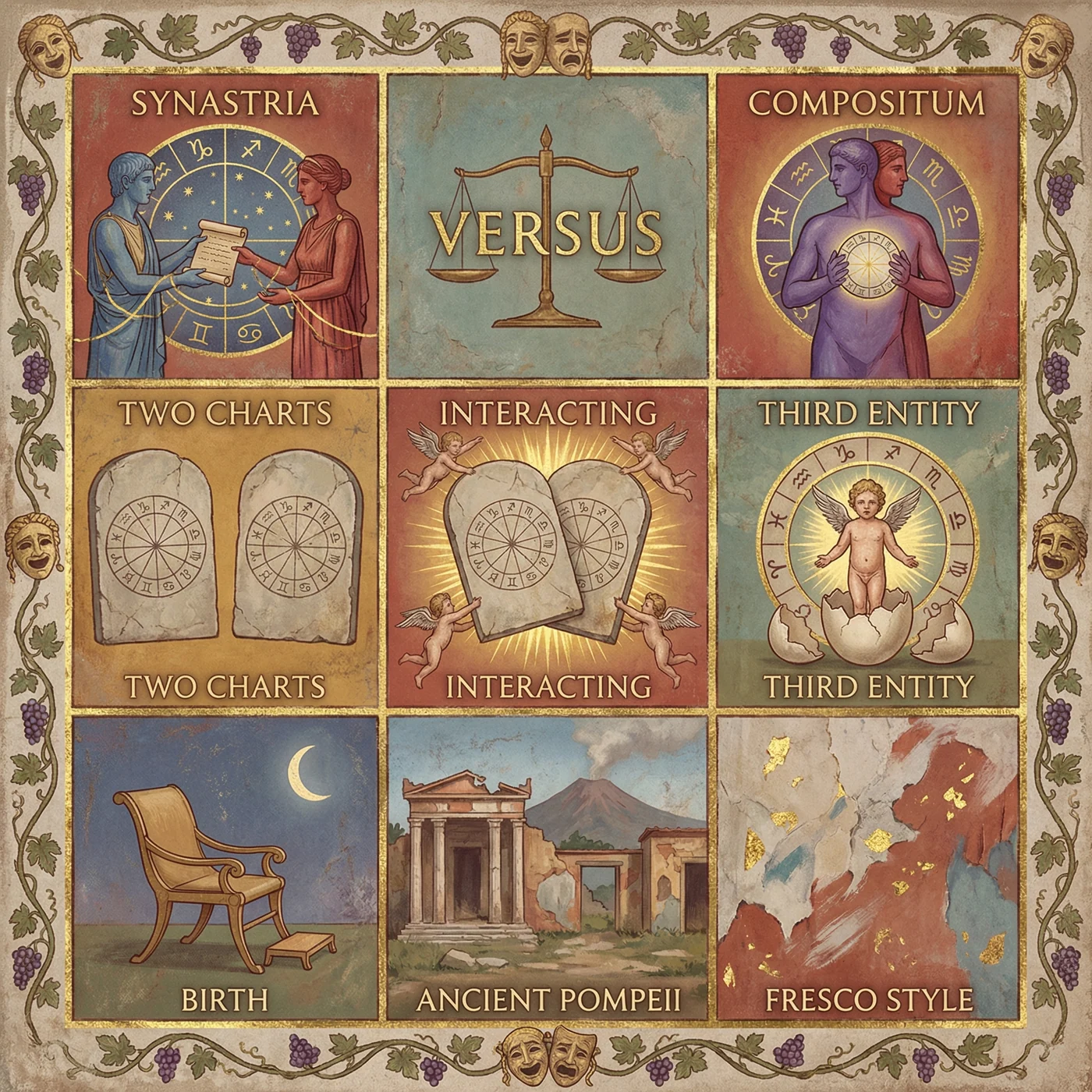
Two Maps for One Territory
The profound insight here is that both approaches capture something essential and neither alone tells the complete story. Synastry excels at explaining the day-to-day experience of being with someone—why their laugh makes you feel instantly at home, why their way of handling money drives you to distraction, why you feel more creative in their presence, why certain conversations between you always seem to end in the same place. It maps the mechanical reality of how your different planetary energies activate and challenge each other.
Composite charts excel at revealing the relationship's deeper purpose and evolutionary direction. They show what you're building together, what you came together to create or heal or learn. They explain why some relationships feel fated even when the day-to-day dynamics are challenging, why others feel pleasant but seem to lack a deeper purpose, why certain unions produce something greater than the sum of their parts.
The most skillful relationship astrology uses both techniques as complementary lenses. Synastry helps you understand the dynamics you're working with—the natural patterns of harmony and friction, the ways you trigger growth in each other, the practical chemistry of your daily interaction. Composite helps you understand what you're working toward—the relationship's own journey of development, its gifts and challenges, its reason for existing.
In practice, this might look like discovering through synastry that your partner's Saturn conjunct your Moon creates a dynamic where they provide structure for your emotional nature, helping you feel more secure and grounded, while you soften their sometimes rigid approach to life. The composite chart might then reveal that your relationship's purpose involves healing ancestral patterns around emotional expression and creating new templates for how security and sensitivity can coexist.
Neither approach judges whether a relationship should exist—both simply describe the territory you're navigating together. Some synastries show profound harmony, others show creative tension that sparks mutual growth. Some composite charts suggest relationships meant to heal old wounds, others point toward building something entirely new in the world. All combinations have their gifts and their challenges, their seasons of ease and their seasons of intensive growth.
The 36 Codex creates relationship readings that weave both approaches together, showing you not only how you affect each other but what you're creating together—the full architecture of your bond across all its dimensions.