Death — the ending that clears the field. The card, read in full.
You know that moment when something in your life comes to an absolute end — not just pauses or changes, but terminates completely. The relationship that cannot be salvaged. The version of yourself that no longer fits. The dream that must be buried so something truer can emerge. In that moment, standing at the threshold between what was and what might be, you encounter the actual meaning of the Death card. Not the melodramatic fortune-teller's prediction of literal mortality, but something far more immediate and necessary: the sacred art of conscious conclusion.
The Death card appears in tarot not as harbinger of physical demise, but as the archetypal master of transformation through termination. Where other cards speak of change as gradual evolution, Death announces the moments when evolution requires revolution — when the old form must be completely dissolved before the new can take shape.
The Architecture of Ending
Death operates through what the alchemists called solve — the dissolution that must precede any true reconstruction. This is not destruction for its own sake, but the recognition that some things cannot be modified or improved; they can only be concluded. The Death card governs those passages in life when holding on becomes the enemy of growth, when our deepest loyalty must shift from preserving what exists to honoring what wants to emerge.
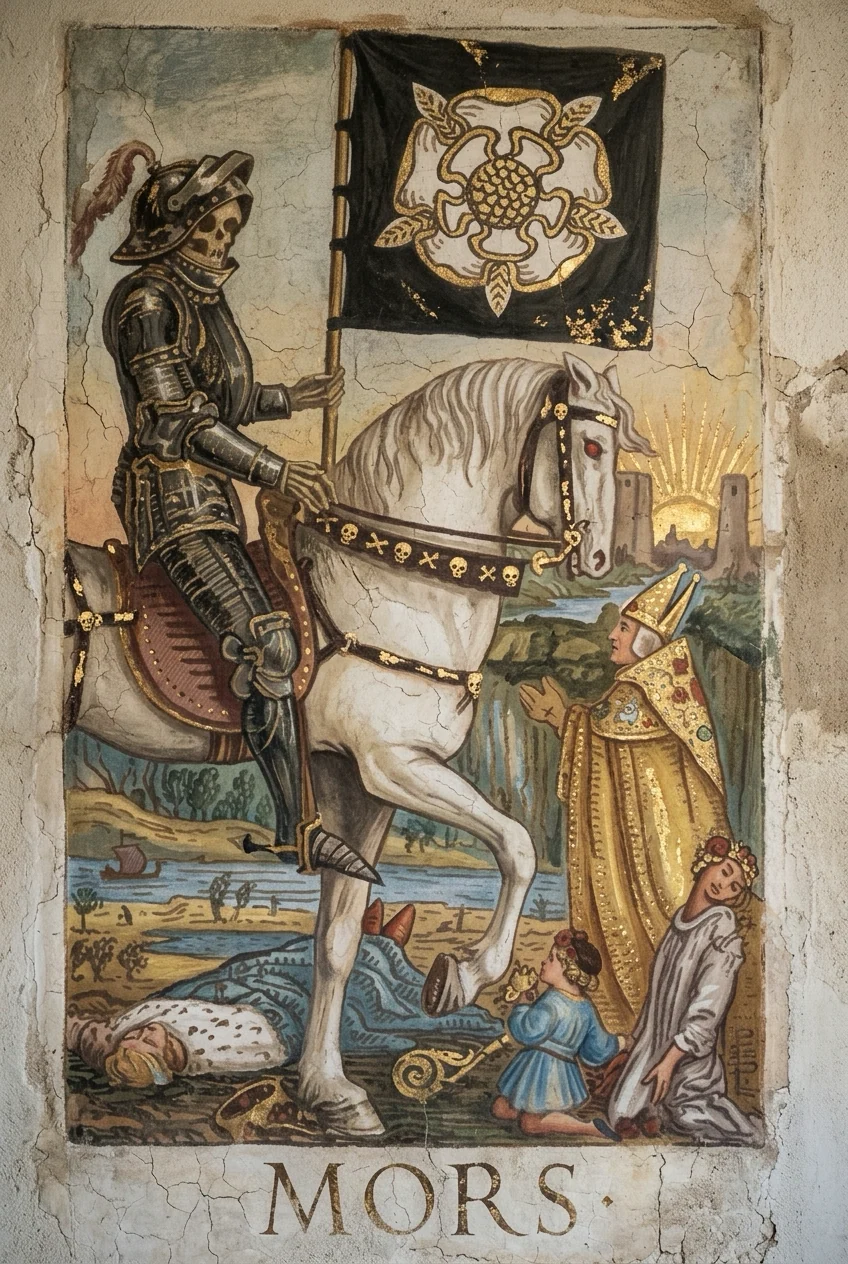
In the Rider-Waite imagery, Death rides a pale horse across a landscape where king and commoner, adult and child, all must acknowledge his passage. The message encoded here is not democratic mortality, but the truth that no position, no achievement, no identity is exempt from the requirement to transform. The bishop who attempts to negotiate with Death in the card's imagery represents our tendency to believe that our spiritual attainments or worldly authority might exempt us from the fundamental law of change. Death's indifference to such pleas reveals a deeper mercy: that transformation serves life itself, not our personal preferences about how that life should unfold.
The distant sun rising between two towers in the card's background points toward the resurrection that follows conscious completion. But this is not the resurrection of what died — it is the emergence of what was always waiting beneath the forms we mistook for permanent.
The Sacred Technology of Conclusion
Death teaches a precise technology for conscious ending that most of us never learn. We are taught how to begin things, how to maintain them, how to improve them, but rarely how to conclude them with the dignity and intentionality they deserve. The Death card reveals ending as a creative act, requiring as much skill and awareness as any beginning.
This technology operates on multiple levels simultaneously. On the psychological level, Death governs the ego's necessary deaths — the dissolution of self-concepts that have become prisons rather than vehicles. The ambitious young professional who must die so the wise mentor can emerge. The dutiful child who must be buried so the authentic adult can be born. These deaths are not failures but graduations, initiations into larger versions of who we are becoming.
On the relational level, Death oversees the conscious conclusion of bonds that have completed their purpose. Not every relationship is meant to last forever, and the Death card appears when we must honor what a connection has given us while releasing its form. This might be the friendship that served us perfectly during one life phase but cannot adapt to who we are becoming. Or the romantic partnership that taught us essential lessons about love but cannot evolve into the deeper intimacy we now require.
On the material level, Death governs our relationship with loss itself — the loss of money, status, health, or circumstances we had counted on. Here the card teaches us to meet material dissolution without making it mean anything about our essential worth or our future possibilities. Death shows us how to lose gracefully, understanding that in a universe of constant change, the ability to let go cleanly is one of life's most practical skills.
The Resurrection Principle
What makes Death sacred rather than merely destructive is its intimate connection to resurrection. But the resurrection Death offers is not the return of what died — it is the emergence of what was always present but could not manifest while the old forms remained in place. This is why Death often appears in readings when we are clinging to situations that no longer serve us, relationships that have become dutiful rather than alive, or versions of ourselves that feel increasingly constricted.
The card teaches us to trust the dark interval between death and rebirth, the fallow time when we cannot yet see what is coming but can sense that something new is stirring. This interval requires a particular kind of faith — not faith that everything will return to how it was, but faith that consciousness itself is indestructible and will find new forms of expression once the old ones have been composted.
Consider Maria, a successful attorney who had built her entire identity around professional achievement. When a series of health crises forced her into extended medical leave, every external marker of who she thought she was dissolved. Her corner office, her packed calendar, her sense of indispensability — all of it evaporated. For months she felt like she was dying, and in a sense she was. The driven, performance-oriented version of herself was experiencing its necessary death. During the long recovery, stripped of all her usual ways of generating self-worth, she began to discover parts of herself that had been buried under decades of ambitious striving. A love of poetry emerged. A gift for listening that went deeper than legal analysis. A capacity for presence that transformed her relationships with her teenage children.
When Maria eventually returned to legal work, it was in a completely different form — as a mediator specializing in family conflicts, work that drew on the contemplative depth her illness had revealed. The attorney who had "died" during her medical leave could never have made this transition. That version of herself lacked both the inner resources and the freedom from old identity that the new work required.
Working with Death's Teaching
When Death appears in your awareness — whether through the actual tarot card or through life circumstances that carry its signature — the invitation is to practice conscious conclusion. This means learning to identify what in your life has completed its purpose and requires honorable dismissal rather than continued life support.
Begin by examining what you are maintaining out of habit rather than vitality. What relationships continue only because ending them feels too difficult? What projects persist only because you have already invested so much energy that stopping feels like failure? What aspects of your identity feel increasingly hollow but remain in place because you cannot imagine who you would be without them?
Death teaches us to approach these recognitions not with violence toward what must end, but with gratitude for what these forms have provided and clarity about when their service is complete. The practice is to become comfortable with the gap between endings and new beginnings, understanding that this interval of not-knowing is not empty space but fertile darkness.
Create rituals for conscious completion. When a relationship ends, take time to honor what it taught you before moving into anger or forgiveness. When a life phase concludes, acknowledge its gifts before rushing toward the next achievement. When old dreams die, grieve them fully so their energy can be recycled into dreams that better fit who you are becoming.
Most importantly, practice dying before you die. This means regularly releasing attachments to outcomes, identities, and securities that make you feel solid but actually make you brittle. The more comfortable you become with the small deaths of daily life — the death of how you thought your day would unfold, the death of how you expected others to respond, the death of plans that must change — the more gracefully you can meet the larger deaths that reshape your entire world.
Death reveals that consciousness itself never dies; only its temporary forms die. Learning to identify with the awareness that witnesses all forms rather than with the forms themselves is the card's deepest teaching. From this perspective, every ending becomes an adventure in discovering what new expression of life wants to emerge through us.
The Book of the Self offers detailed exploration of Death's role in your personal birth chart — where this energy of conscious conclusion operates most powerfully in your life, and how to work skillfully with its transformative demands.