Judgement — the call to rise. The card, read in full.
You know the moment when everything suddenly makes sense — when the scattered pieces of your life arrange themselves into a pattern you can finally see. Not the gentle dawn of understanding, but the trumpet blast that shatters sleep and calls you to account. This is not revelation as comfort, but as clarion call. The card of Judgement arrives when the time for unconscious drifting has ended.
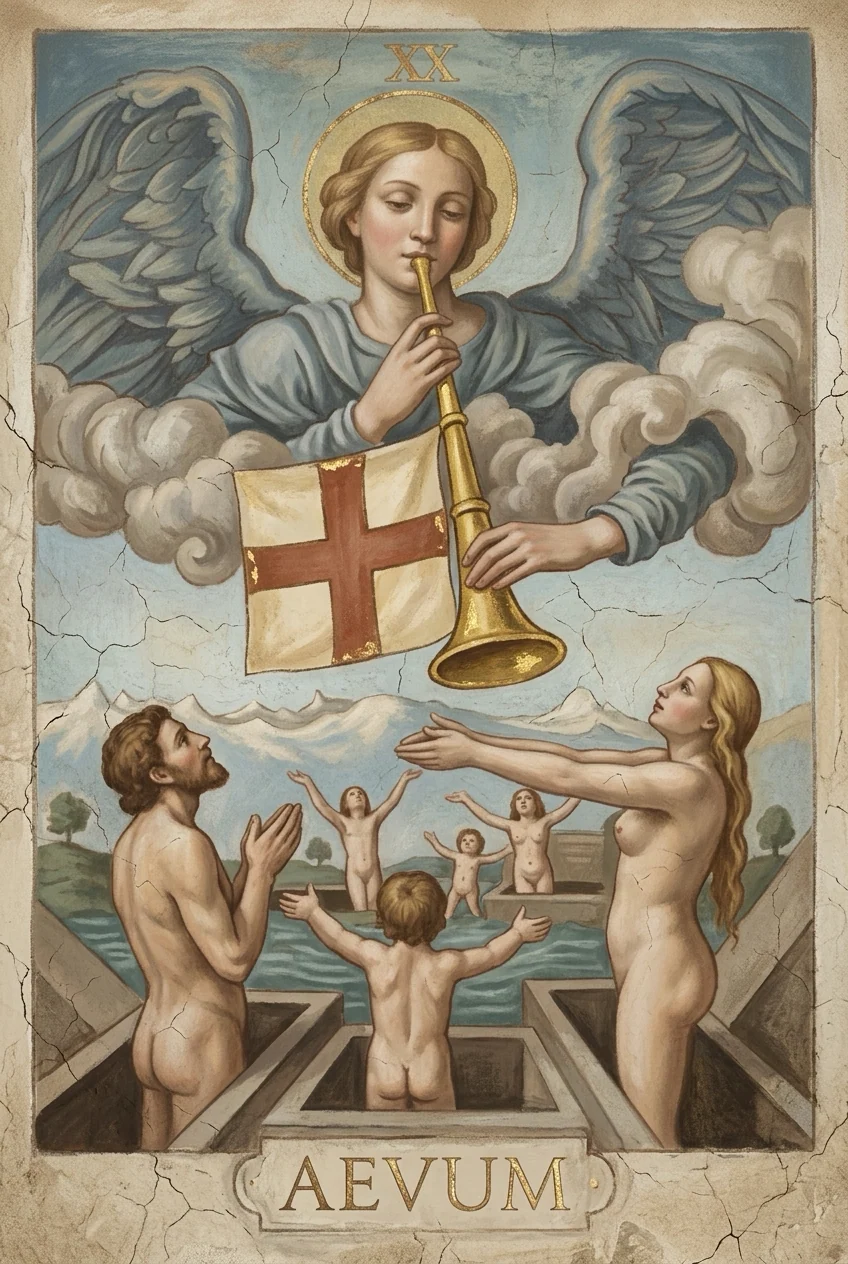
The Horn That Wakes the Dead
Judgement depicts the moment when what has been buried rises to be weighed. In the traditional image, an angel sounds a trumpet above graves that split open, releasing figures who lift their arms in recognition or surrender. This is not the Christian resurrection alone, though that story captured something essential about the card's meaning. It is the moment when the consequences of all your choices stand before you, demanding acknowledgment.
The horn belongs to the principle of cosmic justice — what the Egyptians called Ma'at, the force that weighs the heart against a feather and finds it either worthy or wanting. But this weighing is not punishment from above; it is the soul's own recognition of what it has become through its actions. The trumpet does not impose judgment from outside but awakens the judgment that has been accumulating within.
This is why the figures in the card rise willingly. They are not dragged from their graves by force but called by their own deeper knowing. The angel's horn sounds the note that resonates with what they have always suspected about themselves. Judgement comes as relief — the end of pretending, the moment when masks fall away and what remains is simply what is.
The Scales That Cannot Lie
The power of Judgement flows from the same source as the astrological principle that governs Libra — the recognition that every action creates consequences that must eventually be balanced. But where Libra works through relationship and social exchange, Judgement operates at the level of the soul's fundamental accounts.
Consider how this works in lived experience. You can maintain a persona for years, decades even, telling yourself and others a story about who you are and what you stand for. But the deeper self keeps its own ledger, noting every compromise, every moment of courage, every kindness, every cruelty. Judgement arrives when this hidden accounting surfaces into consciousness with such force that denial becomes impossible.
The card often appears in readings when someone approaches a threshold — the end of a marriage, a career change, a spiritual awakening — moments when the accumulated weight of all their choices presses for recognition. The old identity can no longer contain the reality of who they have become through their actions. The angel's trumpet sounds, and they must rise to meet themselves.
The Court of No Appeal
What makes Judgement different from ordinary self-reflection is its finality. This is not the gentle encouragement to "do better next time" but the moment when time itself testifies. The court that convenes when this card appears recognizes only one law: you have become what you have repeatedly chosen to be.
The figures rising from their graves cannot argue with this testimony. Their lives have been their argument, made day by day through a thousand small decisions. The merchant who chose profit over principle, the parent who chose fear over love, the artist who chose safety over truth — all find their real values revealed not in their words but in the accumulated pattern of their choices.
Yet this recognition, however stark, carries its own liberation. To see clearly what you have become is to understand, perhaps for the first time, what you might yet choose to be. The angel's horn that ends one phase of existence announces the beginning of another. Judgement is both conclusion and commencement.
The Awakening in Everyday Life
Sarah had spent fifteen years building a successful marketing career, telling herself she was "good at reading people" and "helping companies connect with customers." But as Judgement energy gathered in her life, she began to see her work differently. The campaigns she crafted weren't connecting brands with people — they were manufacturing desires that led to debt and dissatisfaction. The skills she prided herself on were manipulation refined into art.
The recognition didn't arrive through external crisis but through the accumulated weight of small compromises that finally breached some internal threshold. She found herself unable to write copy that sounded convincing even to herself. The angel's horn had sounded in her professional life, and she could no longer pretend that success and integrity were the same thing.
This awakening forced her to confront not just her career but the person she had become through her work — someone who had learned to see others as targets rather than human beings. The judgment was clear and final: she had trained herself in a form of sophisticated dishonesty. But this recognition also revealed what she truly valued and opened the path toward work that honored rather than exploited human connection.
Working with the Call
When Judgement appears, resistance only prolongs the inevitable. The card asks not for self-punishment but for honest recognition. What have your choices made of you? What patterns run through your life like underground rivers, shaping the landscape whether you acknowledge them or not?
The practice is to listen for the horn that sounds in your own depths — the voice that speaks with the authority of lived experience rather than wishful thinking. This voice knows which relationships nourish your real self and which demand its sacrifice. It recognizes the difference between the work you do for survival and the calling that draws your deepest capacities into expression.
Judgement energy builds slowly, then strikes with the force of undeniable recognition. To work with it consciously is to welcome the clarity before crisis demands it. What needs to rise from burial in your life? What truth have you been avoiding that your deeper self knows perfectly well?
The angel's trumpet sounds not to condemn but to call you home to yourself — to the person your choices have been shaping all along, beneath the stories you tell and the roles you play. In the end, Judgement is not about being found worthy or wanting by some external standard, but about recognizing the worthiness or corruption you have cultivated through your own persistent choices.
The Book of the Self maps the complete landscape of this awakening, revealing how the moment of recognition connects to the larger patterns that shape a life from birth to fulfillment.