The Chariot — will that holds the reins. The card, read in full.
You know that moment when everything is pulling in different directions—your heart wants one thing, your mind insists on another, your body rebels against both—and yet somehow you find yourself moving forward anyway? That strange sensation of being simultaneously out of control and completely in command? You're experiencing The Chariot, and it has nothing to do with victory parades or confident leadership, despite what most tarot books will tell you.
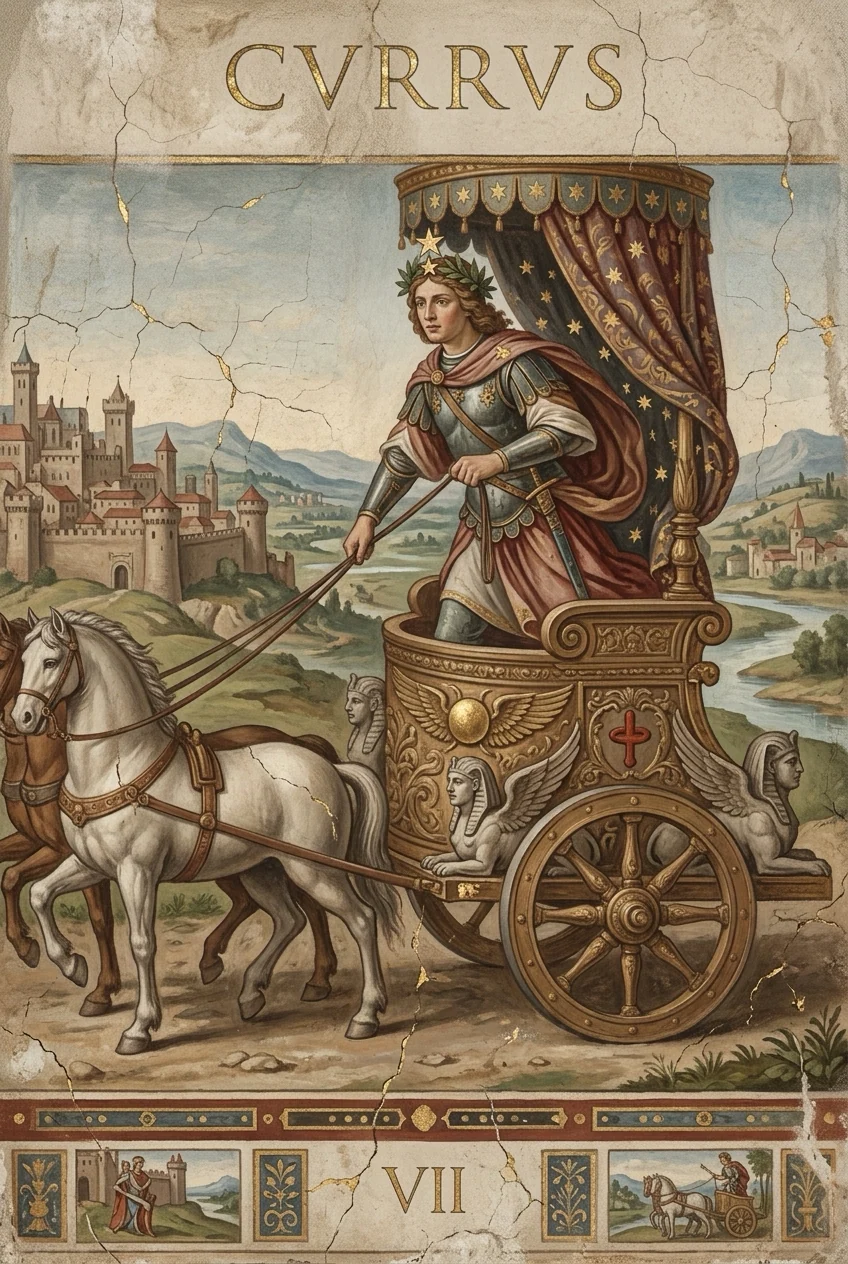
The Vehicle of Contradictions
The Chariot is fundamentally about being the driver of an impossible vehicle. Picture the card: a figure sits in a chariot pulled by two creatures—sometimes sphinxes, sometimes horses—that appear to be moving in opposite directions. The deeper mystery isn't how the charioteer controls these opposing forces, but how forward motion happens at all when everything seems to be working against itself.
This is the essence of embodied consciousness. Your spirit animates a physical body that doesn't always obey, carries emotions that shift like weather, operates a mind that argues with itself hourly. The Chariot represents the moment you realize that mastery isn't about eliminating these contradictions—it's about learning to navigate through them while they remain completely unresolved.
The card emerges from Cancer, the sign of the Crab, and like that sideways-scuttling creature, The Chariot's movement is rarely direct. Cancer governs the tender space between vulnerability and protection, the fierce love that would destroy anything threatening what it cherishes, the soft belly protected by a hard shell. The Chariot channels this same energy: the protective vehicle that carries your most vulnerable self through a world that requires both armor and openness.
The Ancient Art of Sacred Driving
In the ancient Mediterranean world, chariots were not merely vehicles of war or sport—they were symbols of the soul's relationship to matter itself. The Platonic charioteer allegory speaks of reason attempting to guide two horses, one noble and one base, through the realm of forms. But The Chariot in the tarot operates from a more primal understanding: sometimes the base horse knows shortcuts the noble one cannot see, and sometimes you must let both run until they exhaust themselves.
The earliest magical images for Cancer's first decan show a mother and child, that fundamental relationship where two beings exist in a state of mutual devouring—the child literally consuming the mother's body through milk, the mother's identity transformed by the fierce love that would sacrifice everything for this small creature's survival. The Two of Cups, assigned to this decan, shows two lovers whose chalices unite with a winged lion rising from their joined vessels. This is The Chariot's secret: it moves through the alchemy of apparently opposing forces feeding each other.
The chariot becomes the vessel where hunger and nourishment, vulnerability and strength, protection and exposure can coexist without resolution. You are simultaneously the tender thing requiring protection and the fierce guardian providing it, the vulnerable child and the devoted parent, the one who needs and the one who provides.
What Control Actually Means
Modern tarot interpretation often presents The Chariot as a card of willpower and control, but this misses the profound paradox at its heart. True control—the kind that allows forward movement through impossible circumstances—requires a willingness to be simultaneously in command and completely surrendered.
Watch a master horseman: they hold the reins, yes, but they're also constantly responding to the horse's movement, breathing with its rhythm, allowing their body to become part of the animal's motion. The control is mutual, a conversation between rider and mount where both are simultaneously leading and following.
The Chariot operates on this same principle. You guide the opposing forces within you not by dominating them, but by becoming skilled at the dance between assertion and yielding. When your body resists your will, you learn to ask what it's trying to tell you. When your emotions pull against your logic, you discover what essential truth the feeling carries. When circumstances seem to conspire against your plans, you find the hidden current that will carry you toward your destination by an unexpected route.
A Working Example
Consider Maria, whose Chariot energy emerged most clearly during the year she cared for her dying father while launching a new business and navigating the end of her marriage. Every rational voice told her she was attempting the impossible—how could she be present for her father's final months while building something new while dismantling something that had defined her for fifteen years?
But The Chariot doesn't operate by rational planning. Each morning, she would sit in her car in the hospital parking lot, feeling pulled in completely different directions by grief, ambition, relief, terror, love, and anger. Instead of trying to resolve these contradictions, she learned to let them all be present while she took the next right action.
Her business grew through conversations with other families in hospital waiting rooms. Her father's stories of starting his own shop gave her courage during her divorce proceedings. Her lawyer's advice about protecting her assets helped her navigate decisions about her father's care. The three impossible situations became a complex ecosystem where each fed the others in ways she never could have orchestrated.
The opposing forces never reconciled—she remained simultaneously grieving and celebrating, terrified and confident, ending and beginning. But The Chariot carried her through the complexity, teaching her that she could be large enough to contain all of it without breaking.
Working with The Chariot's Wisdom
When The Chariot appears in your life, it's calling you to develop what might be called sacred driving skills. This means learning to hold the reins firmly while remaining responsive to what your various internal forces are trying to tell you. It means accepting that forward motion through complex circumstances rarely follows a straight line.
Begin by identifying the opposing forces currently pulling at you. Instead of trying to resolve them immediately, practice letting them coexist. Notice how the tension between them might actually be generating the energy you need to move forward. Like a battery that works because of the dynamic between positive and negative terminals, The Chariot draws its power from polarity rather than resolution.
Develop your capacity to be multiple things simultaneously without losing your center. You can be both strong and vulnerable, both certain and questioning, both protective and open. The Chariot teaches that wholeness includes contradiction rather than eliminating it.
Pay attention to how your body wisdom collaborates with your mental planning. Often the opposing forces within you represent different types of intelligence—emotional, physical, intuitive, rational—that are trying to contribute to your navigation. The Chariot's skill lies in learning to receive information from all these sources while maintaining your role as the conscious driver.
The 36 Codex system offers a complete mapping of how these complex internal dynamics play out through the specifics of your birth chart, providing detailed guidance for working skillfully with the particular contradictions and polarities that shape your path. The Book of the Self reveals how your personal version of The Chariot operates, what opposing forces you're learning to harness, and how to develop the sacred driving skills that will carry you through whatever impossible terrain lies ahead.