The Devil — the chain you hold yourself. The card, read in full.
You know the moment. You're standing in your kitchen at two in the morning, eating ice cream straight from the container while scrolling through your ex's social media, knowing perfectly well you should be in bed, knowing this will make you feel worse, knowing you have an important meeting tomorrow. Yet you cannot stop. Your hand moves the spoon, your thumb swipes the screen, and some part of you watches it all happen as if from a great distance, powerless to intervene. This is not moral failure. This is not weakness. This is the territory of the Devil card—and it has nothing to do with Satan.
The Chains We Forge in Fire
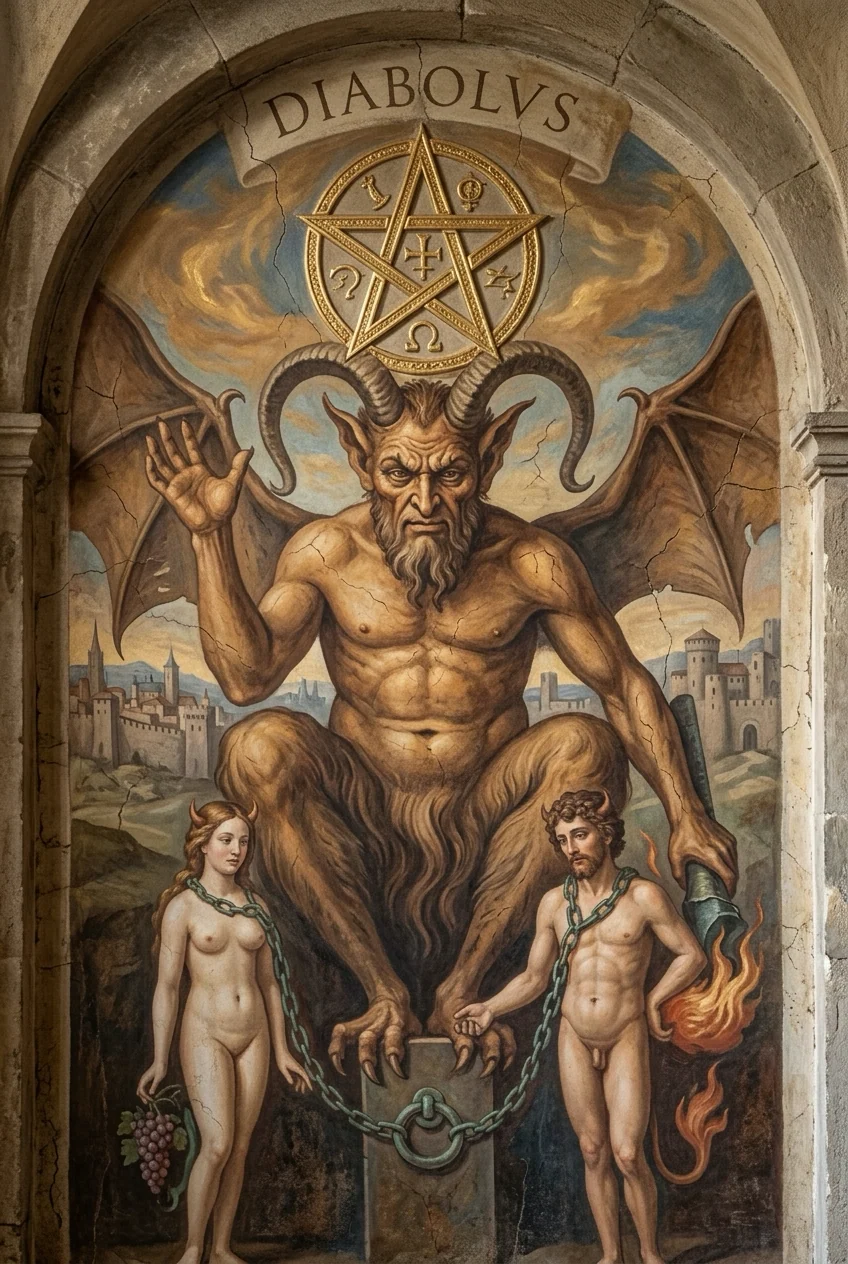
The Devil appears as the fifteenth trump in the Major Arcana, positioned precisely at the halfway point of the soul's journey through matter. In the Rider-Waite-Smith deck, we see a winged figure presiding over two chained humans—a man and a woman who could step free if they chose, for their bonds are loose around their necks. The Thoth version presents Baphomet, the goat-headed deity of the Templars, surrounded by the interlocking rings of manifestation. Both images point to the same essential truth: the Devil represents the moment when spirit becomes so entranced by matter that it forgets its own freedom.
This is not the cartoon devil of fire and brimstone. This is something far more sophisticated and dangerous—the part of consciousness that becomes hypnotized by its own creations. The astrological correspondence reveals the deeper pattern: Capricorn, the sign of crystallization and manifestation, ruled by Saturn, the planet of limitation and form. Here we encounter the essential paradox of incarnation itself—that spirit must take on the chains of matter to experience anything at all, yet in doing so risks becoming trapped by those very limitations.
The chains are real. But they are forged from our own desires, our own choices repeated until they become automatic, our own will turned against itself through the peculiar alchemy of habit and circumstance. The Devil does not tempt us into bondage—it shows us the bondage we have already chosen, so gradually that we failed to notice the weight of our own shackles.
The Hermaphrodite's Terrible Gift
To understand how we arrive at this predicament, we must look to where the pattern begins—in the second decan of Gemini, called THE HERMAPHRODITE in the ancient tradition. This face of the zodiac, ruled by both Mars and Venus, carries within it the seed of the Devil's dilemma. Here dwells the cosmic principle of duality made flesh, the eternal tension between opposing forces that seek resolution through union.
The Hermaphrodite represents the moment when consciousness discovers it contains not one possibility, but a near infinity. As the soul awakens to its dual nature—light and shadow, angel and demon, creator and destroyer—it faces a bewildering profusion of selves. Where there was once unity, now a multitude throngs. The personality splits to accommodate differing spirits, and the mind, powerful in the art of analysis, bisects the soul with surgical precision.
This multiplicity is both gift and curse. The natives of this decan possess tremendous intelligence and curiosity, able to explore the full range of what they might become. Devil horns and angel wings hold similar appeal, and ethical polarities are investigated with the same thoroughness applied to any other field of study. Yet this very profusion can paralyze—the Eight of Swords prison built from too many options, where the abundance of choice becomes its own form of bondage.
The cruel irony is that the more we understand our capacity for both good and evil, the more complex our relationship with choice becomes. Simple moral categories dissolve under the microscope of self-knowledge. We discover that the same force that drives us toward love also pulls us toward destruction, that creativity and chaos spring from identical wells. The Devil emerges from this recognition—not as external tempter, but as the internal recognition of our own contradictory nature.
The Crystallization of Desire
The Devil card proper belongs to Capricorn, the cardinal earth sign where spirit reaches its maximum density in matter. If Gemini shows us the multiplication of possibilities, Capricorn shows us what happens when those possibilities crystallize into fixed patterns. This is the sign of the mountain goat, climbing ever upward toward some peak that promises ultimate satisfaction, yet finding at each summit only another mountain beyond.
Capricorn's ruler, Saturn, is the great teacher of limitation. Through restriction and resistance, Saturn forces consciousness to develop strength, structure, and eventually wisdom. Yet Saturn also rules crystallization—the process by which flowing water becomes rigid ice, by which flexible thought becomes rigid dogma, by which innocent desire becomes compulsive need. The Devil represents Saturn's shadow face: the moment when necessary structure becomes unnecessary prison.
Consider the executive who climbs the corporate ladder for thirty years, achieving every marker of success, only to realize they have built a golden cage. Consider the artist who begins creating from pure love, then gradually becomes enslaved to public opinion, market demands, and their own reputation. Consider the spiritual seeker who exchanges the fresh air of direct experience for the stale comfort of rigid beliefs. In each case, what began as authentic movement toward a worthy goal becomes mechanical repetition of behaviors that no longer serve their original purpose.
This is the Devil's particular sorcery—taking our own highest aspirations and turning them against us through the simple mechanism of time and repetition. The chains are forged from our own gold, the prison built from our own dreams. We become trapped not by what we hate, but by what we once loved so much that we could not bear to let it change.
A Concrete Example: The Burning Rose
Maria begins painting at forty-five, after her children leave home. For two years, she creates with wild abandon—abstract explosions of color that seem to channel something primal and urgent. Her husband converts the garage into a studio. Friends begin buying pieces. A local gallery offers to represent her work. She quits her accounting job to paint full-time.
Success arrives gradually, then suddenly. Her colorful abstracts sell well to young professionals decorating their first homes. The gallery asks for more pieces "like the red series." Maria paints more red pieces, refining the style that sells. A decorator orders twelve matching pieces for a hotel lobby. Maria paints twelve matching pieces, each slightly different but fundamentally the same.
Five years later, Maria stands in her studio surrounded by canvases that look increasingly alike—competent, professional, marketable, and somehow lifeless. She has become extraordinarily skilled at painting "Maria" paintings. Her technique has improved dramatically. Her income has tripled. Yet when she picks up a brush, she feels nothing. The wild joy that first drove her to the easel has been replaced by the mechanical execution of a formula that works.
She is trapped, but the cage is built from success, recognition, and financial security. The chains are forged from positive reinforcement, market demands, and her own perfectionism. She could pick up any other brush, try any other style, paint anything she wants. The bonds around her neck are loose. Yet she cannot move, paralyzed by the weight of her own achievement.
This is the Devil's masterpiece—not dramatic corruption, but the gradual transformation of authentic impulse into mechanical repetition. Maria's story could be replicated in any field where passion meets marketplace, where inspiration encounters expectation, where the free play of spirit crystallizes into the rigid forms of material success.
Working With the Devil's Wisdom
The Devil card does not appear in readings to condemn, but to illuminate. It points to areas where we have become unconsciously bound by our own choices, where yesterday's solutions have become today's problems. The first step in working with this energy is recognition—developing the capacity to see our chains clearly, without judgment or immediate impulse to escape.
The Devil teaches that liberation comes not through rejection of material existence, but through conscious engagement with it. The figures in the Rider-Waite image could remove their chains at any time—the bondage is maintained by unconsciousness, not by any external force. Freedom returns when we remember that we are the ones who forged the chains, and therefore the ones who can unmake them.
This requires what the alchemists called solve et coagula—dissolve and coagulate. We must first dissolve our identification with the patterns that bind us, seeing them clearly as constructions rather than inevitabilities. Then we must consciously coagulate new patterns that serve our current evolution rather than our historical momentum. This is delicate work—we cannot simply abandon the structures that support our lives, but we can gradually modify them to allow more space for authentic expression.
The Devil's ultimate gift is the recognition that all bondage is self-imposed, and therefore all liberation is self-achieved. The chains that seem so solid are actually woven from our own attention and energy. When we withdraw our unconscious investment in limiting patterns, they naturally begin to dissolve. When we consciously invest in patterns that serve our growth, new possibilities crystallize around us.
The key is remembering that we are the magician, not merely the subject of someone else's spell. The Devil shows us where we have hypnotized ourselves—but hypnosis works both ways. What consciousness has bound, consciousness can free.
Your personalized Book of the Self explores the specific ways these archetypal patterns manifest in your unique natal chart, revealing the particular chains you are here to transform and the specific keys to your liberation.