The Fool — the leap before the path. The card, read in full.
You know the moment when you realize you've been walking in circles for years, when the comfortable prison of your own making suddenly reveals its bars. The job that once felt secure now suffocates. The relationship that promised completion now feels like sleepwalking. The beliefs that once organized your world now seem like elaborate costumes you've forgotten how to remove. In that recognition—that sharp, crystalline instant when the known world reveals itself as insufficient—The Fool is born.
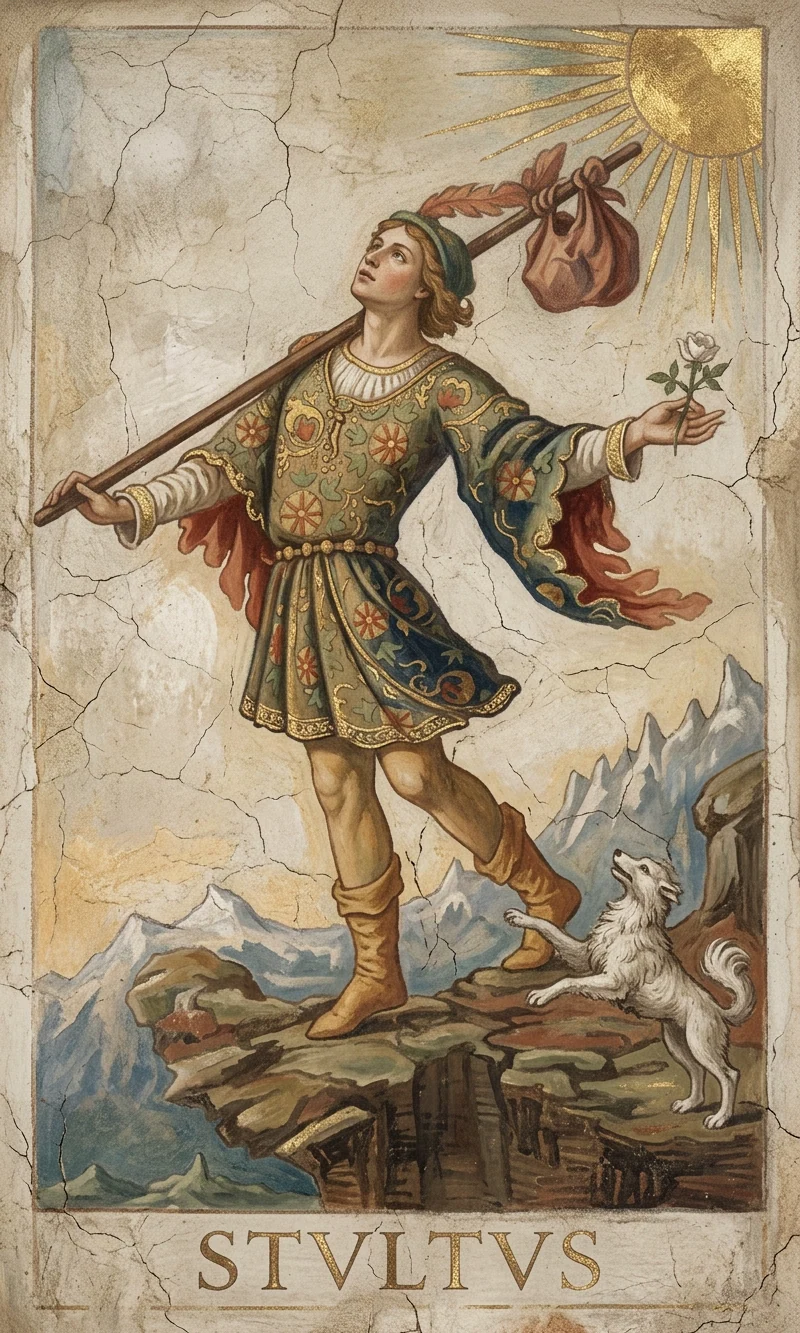
The Edge of Everything
The Fool stands at the cliff's edge not because he is reckless, but because he has exhausted the known. Behind him lies the encampment of his former life: the Five of Swords' aftermath, the scattered remains of battles fought over things that no longer matter. He carries only what he has salvaged and bound into a small bundle—the essential distilled from years of accumulation. The white rose in his hand speaks to the purity of his intent. The little dog at his heels represents the instinctual wisdom that knows when it's time to leap.
This is not the carefree wanderer of popular imagination, skipping toward adventure with a song on his lips. The Fool embodies divine discontent—the same sacred restlessness that drove Siddhartha from his palace, that compels the mystic toward the desert, that whispers to the artist at three in the morning that everything they've created thus far has been mere preparation. The Fool represents the moment when staying becomes more dangerous than leaving.
The cliff itself deserves attention. What lies at the bottom is not destruction but transformation—the death that precedes resurrection, the dissolution that enables rebirth. The ancient Egyptians understood this territory well. For them, death was not an ending but a transition to Amenti, a world like our own but more noble, populated by the gods themselves. Yet the passage between worlds was neither simple nor guaranteed. It required navigation through territories both epic and perilous, full of monsters and secrets that only the properly prepared could survive.
The Sacred Departure
The Fool's journey begins in disenchantment with the fabric of everyday life and its petty terrors. This is not mere dissatisfaction but a fundamental recognition that the world as currently experienced cannot contain what seeks to emerge. The comfortable becomes claustrophobic. The familiar becomes foreign. What once provided meaning now feels like an elaborate shell game where all the shells are empty.
This disenchantment is not failure but initiation. The Fool represents the only figure in the entire zodiacal pantheon described as an ascetic—one who has voluntarily embraced the unknown over the comfortable. Yet there is much to do before departing, many decisions to make. One might tarry a lifetime, or several, at this threshold. The Fool's power lies not in hasty action but in the willingness to abandon one's place of birth, family, culture, religion, or even reality when the time comes.
The bundle on the stick contains the Five of Swords—the salvaged insights from battles that taught more through their conclusions than their victories ever could. These are not possessions but distilled wisdom: the understanding that some fights cannot be won within the existing framework, that some problems can only be solved by stepping outside the system that created them, that some questions can only be answered by those willing to become living experiments.
The Mathematics of Transformation
The Fool operates by different mathematics than the other cards. Where other archetypes accumulate, The Fool subtracts. Where others build, The Fool dissolves. Where others defend positions, The Fool abandons territory entirely. This is not destruction for its own sake but the recognition that true creation often requires a return to zero—not the zero of emptiness but the zero of infinite possibility.
In the practical world, The Fool appears in moments of career change that make no sense to observers, in the dissolution of relationships that looked perfect from outside, in the abandonment of belief systems that once provided structure and meaning. The Fool energy manifests when someone liquidates their possessions to travel the world, leaves a prestigious position to pursue art, or walks away from a community that no longer reflects their deepest values.
The key distinction is that The Fool's departures are not escapes. They are movements toward something that cannot yet be named, guided by an intelligence that operates beyond rational calculation. The Fool trusts that stepping into the unknown will reveal what could never be discovered within the boundaries of the familiar.
The Territory Beyond Maps
Consider Sarah, a successful architect who spent fifteen years designing corporate buildings. At thirty-eight, she found herself unable to enter her office without feeling physically ill. The work that once excited her now felt like elaborate monuments to everything wrong with modern life. Her colleagues saw a mid-life crisis. Sarah recognized something else: the death of who she had been and the birth pains of who she might become.
She resigned without another position lined up, sold most of her possessions, and spent six months walking ancient pilgrimage routes across Europe. She carried a small notebook and sketched structures that emerged from the landscape rather than imposing upon it. When she returned, she had no clear plan but found herself drawn to designing healing centers, meditation spaces, and buildings that seemed to grow from the earth itself. Her income dropped by two-thirds. Her sense of purpose increased immeasurably.
The Fool's path is not about abandoning responsibility but about discovering what you are truly responsible for. Sarah's departure from architecture was actually a deeper commitment to architecture's sacred possibilities. Her willingness to lose everything revealed what could not be lost—the capacity to create spaces that serve life rather than merely containing it.
Working with Fool Energy
The Fool cannot be summoned through willpower or scheduled like an appointment. This energy arrives when the containers of your current life have grown too small, when the gap between who you are and who you're pretending to be becomes unbridgeable. The question is not how to become The Fool but how to recognize when The Fool energy is already present and whether you have the courage to honor it.
When The Fool appears in your inner landscape, resistance is natural. Everything in your conditioning screams against the leap. Security argues for staying. Pride insists on maintaining position. Fear catalogues everything that could go wrong. The Fool listens to these voices with compassion but does not let them determine the outcome.
Working with this energy requires distinguishing between genuine Fool moments and mere escapism. The Fool's departure serves emergence. Escapism serves avoidance. The Fool moves toward something that cannot yet be articulated. Escapism moves away from something it refuses to face. The Fool integrates the wisdom of the past while stepping beyond its limitations. Escapism abandons everything in favor of fantasy.
Practical Fool work begins with identifying what in your life has become a comfortable prison. What roles, relationships, or routines continue not because they serve growth but because they provide security? What would you attempt if you knew you could not fail? More importantly, what would you attempt even if you knew you would fail, simply because the attempt itself would reveal something essential about who you are?
The Fool's path is not for everyone, but for those called to walk it, there is no genuine alternative. The energy builds until the leap becomes inevitable. The only choice is whether to jump consciously or be pushed by circumstances beyond your control.
In The Book of the Self, we explore how The Fool's energy intersects with your unique astrological signature—where in your chart the call to sacred departure might manifest, and how to distinguish between genuine transformation and mere restlessness. Your personal Fool moments follow patterns written in your birth chart, waiting for the right seasons to emerge.