The Hanged Man — surrender as strategy. The card, read in full.
You know that moment when everything you've been pushing toward suddenly stops working, when the path forward disappears and you find yourself suspended between what was and what might be. Not stuck—suspended. There's a difference, though it takes time to feel it. The Hanged Man is the card of that suspension, that strange pause where surrender becomes vision and waiting becomes wisdom.
Most people encounter this card and see defeat, delay, or some cosmic punishment for unnamed crimes. They miss what's actually happening in that upside-down figure: a willing participant in a ritual of perspective. The man hanging from the World Tree isn't a victim. He's a student of a curriculum that can only be taught in stillness.
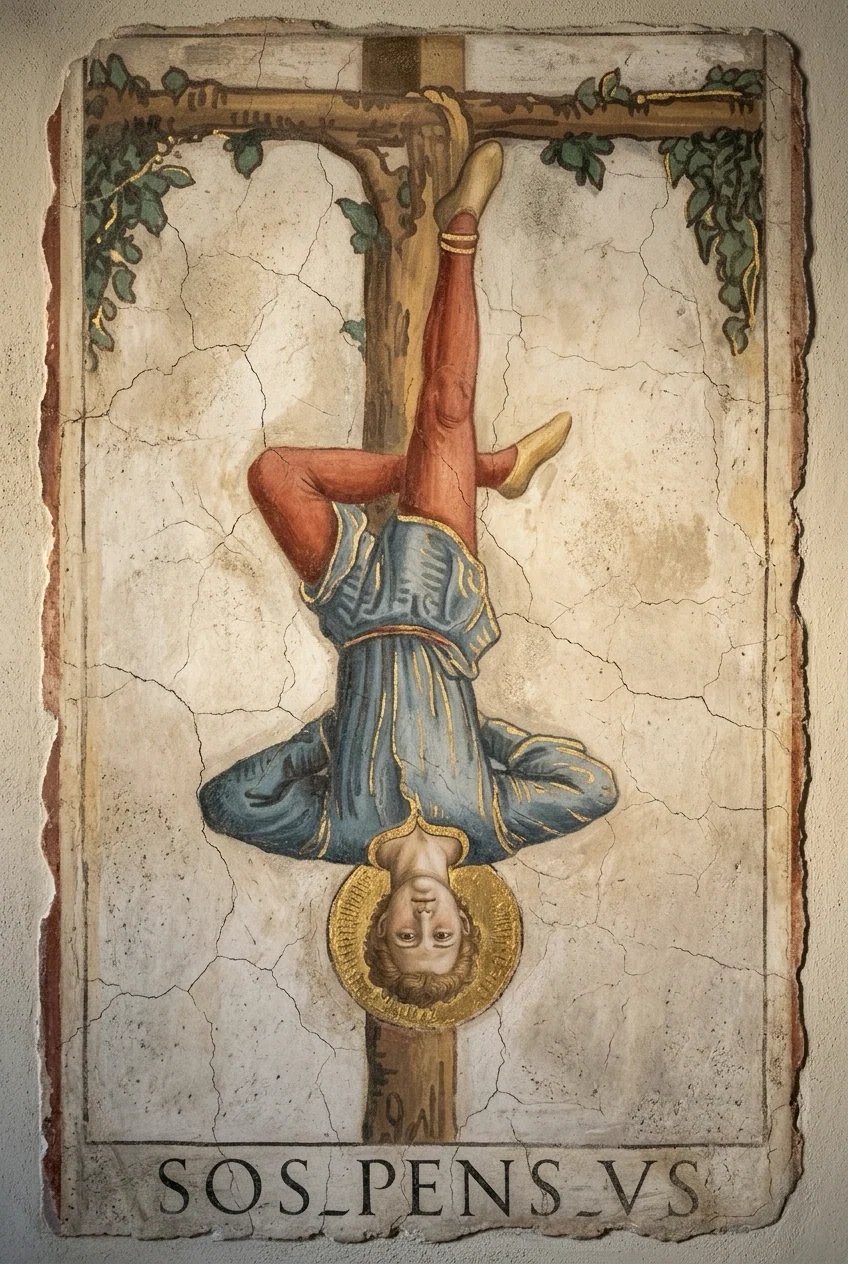
The Sacred Pause
The Hanged Man represents the moment when forward motion ceases to serve you, when the only way through is to let go of the way you've been moving through the world. This isn't the paralysis of indecision or the frustration of obstacles—it's the conscious choice to stop struggling against the current and see what the river itself has to teach.
In the traditional Rider-Waite-Smith image, the figure hangs by one foot from a living branch, hands bound behind his back, yet his face shows serene acceptance rather than distress. The bound hands aren't restraints imposed by others; they represent the voluntary release of grasping, the choice to stop trying to control outcomes through force of will alone.
The card arrives in readings when you've exhausted the strategies of the upright world—the pushing, the planning, the relentless forward motion that our culture equates with progress. The Hanged Man suggests that some forms of wisdom can only be accessed through surrender, some perspectives only available when you stop trying to orient yourself to familiar landmarks and allow a complete shift in viewpoint.
The World Tree and Sacred Sacrifice
The mythology behind this card reaches back to Odin's self-sacrifice on Yggdrasil, the World Tree. For nine days and nights, the All-Father hung himself from the cosmic ash, wounded by his own spear, neither eating nor drinking, until the runes revealed themselves to him. This wasn't masochism—it was the recognition that some knowledge requires a complete letting go of ordinary consciousness.
The World Tree connects all realms of existence, and to hang from it is to position yourself at the center of all possible perspectives. The Hanged Man's inverted position allows him to see what remains invisible to those who insist on keeping their feet firmly planted on solid ground. The binding isn't punishment but preparation—when your hands cannot grasp, your inner vision clarifies.
This is why the Hanged Man often appears when you're facing situations that cannot be solved through conventional action. Job loss that leads to a more authentic career path. Illness that forces a necessary slowing down. The end of a relationship that was holding you back from deeper self-knowledge. The card suggests that what appears to be a setback may actually be a setup for a breakthrough that couldn't happen any other way.
The Alchemy of Waiting
The Hanged Man teaches the difficult art of productive waiting. Not the passive resignation that gives up on life, but the active receptivity that allows life to work on you. This is the difference between being stuck and being in process. When you're stuck, you're fighting against your circumstances. When you're in the Hanged Man's process, you're allowing those circumstances to transform you.
Consider someone who loses their job and immediately frantically starts sending out resumes, networking with desperate energy, trying to recreate their old career path exactly as it was. Now consider someone who uses the unexpected pause to examine what they actually want from their work life, who allows the space to reveal desires they'd been too busy to acknowledge. The first person is stuck. The second is hanging from the World Tree.
The alchemical texts speak of the process called solve et coagula—dissolve and coagulate. Before the new can take form, the old must be completely dissolved. The Hanged Man represents the solve phase, the necessary dissolution of outdated patterns and perspectives. The coagulate phase—the new form emerging—belongs to other cards, other moments. The Hanged Man's gift is teaching you to trust the dissolving process itself.
A Living Example
Sarah had built her identity around being indispensable at work. She stayed late, answered emails at midnight, took on projects that weren't hers. When a company restructuring eliminated her position, she felt like the ground had vanished beneath her feet. Her first instinct was to immediately find another job where she could recreate the same pattern—the same role as the indispensable one who never said no.
But the job market had other plans. Weeks stretched into months. Instead of finding her identical replacement position, Sarah found herself with something she hadn't had in fifteen years: time. Time to notice that she'd been running from a fear of being ordinary, unremarkable. Time to discover that her worth wasn't actually tied to her productivity. Time to remember interests and dreams that had been buried under years of twelve-hour days.
When she finally did find work, it was part-time consulting that allowed her to use her skills without sacrificing her newly discovered self. The period of unemployment hadn't been a punishment or a failure—it had been an initiation into a more sustainable way of being. The Hanged Man had done his work.
Working with the Energy
When the Hanged Man appears in your life—whether in a reading or as an actual experience of suspension and waiting—the key is to resist the urge to struggle back to your previous orientation immediately. The card is asking you to consider that your current perspective might be limited, that the way you've been approaching your situation might be part of the problem rather than the path to the solution.
Start by examining what you're trying to control that might be better served by release. What are you gripping so tightly that your hands have gone numb? The Hanged Man suggests that loosening that grip won't lead to loss but to the discovery of resources you couldn't access while you were holding on so desperately.
Practice what the mystics call "active receptivity"—a state of engaged openness where you're fully present to what's happening without trying to immediately fix, change, or direct it. This might mean sitting with uncomfortable emotions instead of rushing to solution. It might mean allowing a relationship conflict to reveal its deeper patterns before jumping to repair the surface harmony. It might mean letting a creative project gestateunfinished instead of forcing it to premature completion.
The Hanged Man also suggests paying attention to what becomes visible when you stop moving in your habitual patterns. What do you notice about your life when you're not actively trying to improve it? What insights arise when you're not filling every moment with productive activity? The suspended perspective of this card often reveals truths that are invisible from ground level.
Finally, remember that the Hanged Man's sacrifice is voluntary and temporary. This isn't a card about permanent resignation or endless martyrdom. It's about the wisdom of knowing when to surrender your will to a larger process, trusting that the period of suspension serves a purpose that will become clear when the time comes to act again.
The Book of the Self explores how moments of suspension and surrender fit into the larger pattern of your unique spiritual journey, revealing how even apparent delays and setbacks serve the deeper rhythm of your becoming.