The Hermit — the lamp carried inward. The card, read in full.
You know the moment. Standing at your bedroom window at three in the morning, the world asleep around you, feeling more awake than you have in months. Or walking alone through empty streets after everyone else has gone home, suddenly understanding something about your life that daylight conversation could never reveal. That quality of solitude that isn't loneliness—that's fertile, necessary, almost sacred—that's where The Hermit lives.
Most people think The Hermit is about withdrawal, about becoming a recluse or rejecting the world. They see the hooded figure with the lantern and imagine someone who has given up on human connection, someone bitter or defeated. But this misses the card's true power entirely. The Hermit isn't about running away from life—it's about finding the still center that makes authentic engagement possible.
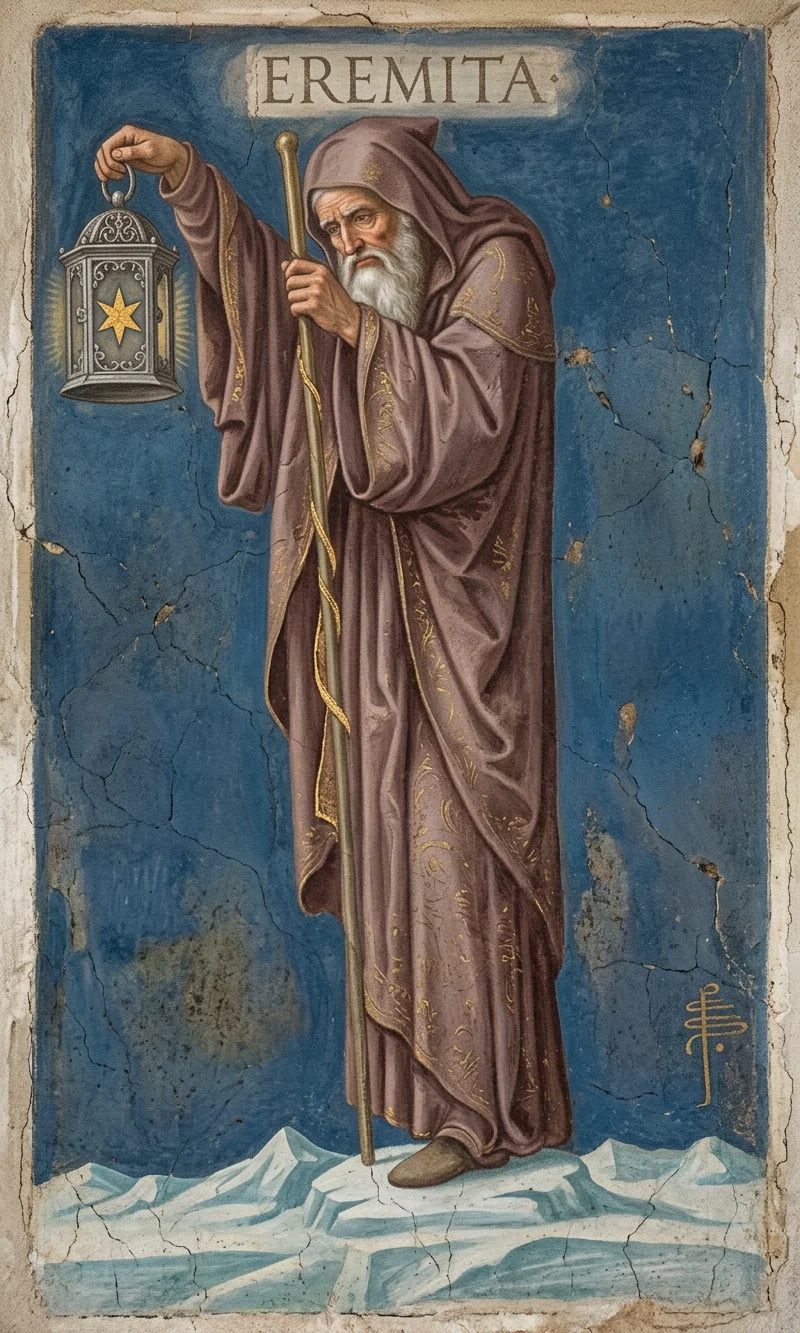
The Lantern in the Darkness
The Hermit carries a lantern not to light his way forward, but to illuminate what is already here. This is the crucial distinction that transforms our understanding of the card. The figure isn't lost and searching for a path—he has become the path. The light he carries isn't borrowed from external sources but generated from within, through the patient work of turning inward.
This inward turning requires a specific kind of courage. In our culture of constant connectivity and external validation, choosing solitude feels almost transgressive. The Hermit asks us to step away from the noise, not permanently, but long enough to remember who we are when no one is watching. This isn't the hermitage of defeat but of discernment—the recognition that wisdom requires space to emerge.
The lantern illuminates what meditation teachers call "the gap"—that pregnant pause between stimulus and response where choice lives. Most of us rush through life responding automatically to whatever demands our attention. The Hermit's gift is the cultivation of that sacred pause, the ability to respond from center rather than react from conditioning.
The Wisdom of the Mountain
Traditional images show The Hermit standing on a mountain peak, suggesting that this card represents the culmination of a long journey. But the mountain isn't a destination—it's a perspective. From this elevated vantage point, the Hermit can see patterns invisible from ground level. The daily dramas that once seemed overwhelming now appear as part of a larger weaving.
This perspective comes only through sustained inner work. The Hermit's solitude isn't empty but full—dense with the accumulated wisdom of examined experience. Every relationship, every success, every failure has been metabolized into understanding. This is why The Hermit appears as an elder figure: not because wisdom comes automatically with age, but because it requires time to digest life's lessons into nourishment.
The mountain represents what mystics call "the witness consciousness"—the part of us that observes without being swept away by what it observes. The Hermit has learned to identify with this witnessing awareness rather than with the endless parade of thoughts, emotions, and circumstances that flow through it. From this stable center, he can offer genuine guidance rather than mere opinion.
The Paradox of Solitary Service
Here lies The Hermit's deepest teaching: true solitude prepares us for authentic relationship. The figure withdraws not to avoid others but to discover what he has to offer them. The lantern he carries becomes a beacon for other travelers, not because he seeks followers but because genuine wisdom naturally illuminates.
The Hermit represents the stage in personal development when we stop looking for others to complete us and start discovering what completion looks like from within. This doesn't make us selfish—quite the opposite. Only when we're not desperately seeking from others can we genuinely give to them. The Hermit's solitude burns away the neediness that distorts most human interactions.
Consider someone who has done deep therapeutic work, who has faced their shadows and integrated their wounds. They don't need others to validate their worth or fix their problems. When they enter relationship, they bring wholeness rather than seeking it. This is The Hermit's gift—the capacity for connection without codependence, love without attachment to outcome.
The Inner Marriage
The most profound aspect of The Hermit's journey involves what alchemists called the inner marriage—the integration of opposing forces within the psyche. The card often appears when we're being called to reconcile contradictions that have long torn us apart: the need for independence and the desire for connection, the drive for achievement and the longing for peace, the rational mind and the intuitive heart.
This integration can't be forced or rushed. It requires the kind of patient attention that only solitude allows. Like the meditation master who sits with whatever arises without trying to change it, The Hermit learns to hold space for all parts of himself. Gradually, the warring factions within begin to recognize each other as necessary partners rather than mortal enemies.
A successful entrepreneur finds herself exhausted by constant networking and deal-making. The Hermit calls her to step back, not to abandon her ambitions but to discover what she truly wants to build and why. In solitude, she realizes that her drive for success masks a deeper creative impulse that has been starved for attention. When she returns to the world, her work carries new meaning and attracts different kinds of opportunities.
Working with the Hermit's Energy
When The Hermit appears in your life—whether through the card itself or through circumstances that force solitude—the invitation is clear: stop looking outside yourself for what can only be found within. This might mean taking a retreat from social media, declining invitations that feel obligatory rather than nourishing, or simply sitting quietly each morning before the day's demands take over.
The key is intentionality. The Hermit's solitude is chosen, not imposed. Even when external circumstances force withdrawal—illness, loss, unemployment—we can choose to meet these experiences as opportunities for deepening rather than mere endurance. What is this situation trying to teach me? What parts of myself have I been too busy to notice? What wisdom is available in this stillness?
Begin with small doses of intentional solitude. Sit with your morning coffee without reading anything or checking your phone. Take walks without podcasts or music. Notice what emerges in these spaces—often anxiety at first, then gradually a kind of settling, a remembering of who you are beneath all the roles you play.
The Hermit's path ultimately leads back to the world, but with transformed relationship to it. You return not as someone who needs the world to be different but as someone who can meet it exactly as it is, lantern held high, ready to illuminate whatever lies ahead.
The Book of the Self explores these deeper currents of transformation through your unique astrological blueprint, revealing how The Hermit's energy manifests in your particular journey of becoming.