The Tower — the lightning that tells the truth. The card, read in full.
You know the moment when everything you thought was solid reveals itself as an illusion. The job that defined you evaporates overnight. The relationship you built your world around crumbles in a single conversation. The belief system that organized your entire reality suddenly seems like a child's fairy tale. In that instant, as the familiar architecture of your life collapses around you, you are standing in The Tower.
Most people fear this card above all others in the tarot deck. They see catastrophe, destruction, divine punishment for hubris. They imagine lightning strikes and falling bodies, chaos descending without warning or mercy. But this understanding, while not entirely wrong, misses the deeper truth of what The Tower actually represents: the moment when false structures are demolished so that authentic ones can be built in their place.
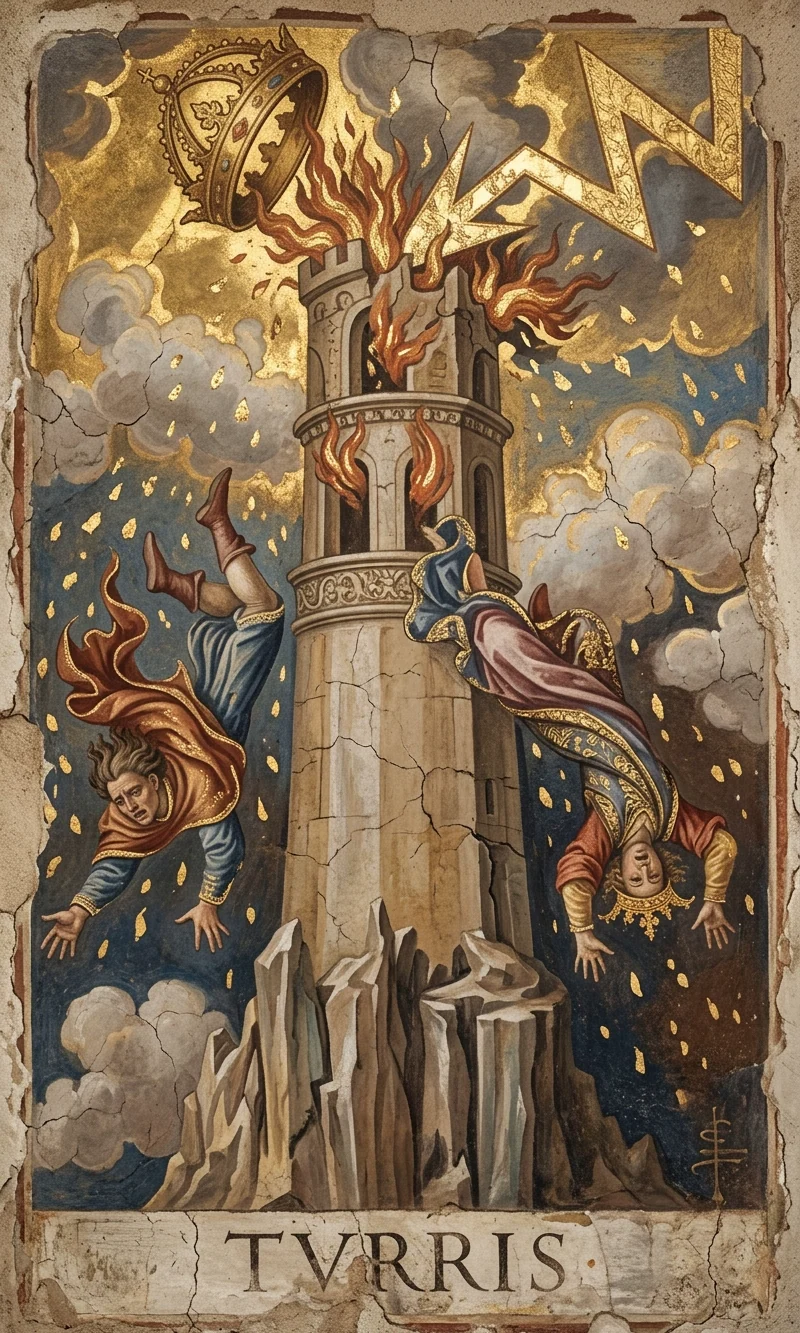
The Lightning of Recognition
The Tower is not about random destruction. It is about the lightning bolt of recognition that strikes when we can no longer maintain our illusions. Every structure that falls under The Tower's influence was already compromised—built on false foundations, maintained through denial, or constructed to serve an ego that had outgrown its original purpose.
The lightning that strikes The Tower comes from above, but it illuminates what was already unstable below. You cannot have a Tower moment with something genuinely solid. The marriage that ends in Tower energy was already dying, sustained only by habit and fear. The career that collapses was already misaligned with your authentic nature. The identity that crumbles was already a mask you had worn too long.
This is why The Tower, despite its fearsome reputation, is ultimately a card of liberation. It represents the moment when the universe refuses to let you continue building your life on foundations that cannot support your true weight. The destruction is surgical, precise—it removes only what was never meant to last.
The Architecture of False Security
To understand The Tower's necessity, you must first understand how we build these doomed structures in the first place. From childhood onward, we construct elaborate defensive architectures around our tender, authentic selves. We build towers of achievement to prove our worth, ramparts of relationships to shield us from loneliness, fortifications of belief to protect us from uncertainty.
These structures often serve us well for a time. The tower of professional success may indeed provide security and recognition. The fortress of a particular identity may offer belonging and purpose. But as we grow and change, as life demands more authentic expression from us, these same protective structures become prisons.
The Tower energy emerges when the gap between who we truly are and the structures we have built to contain ourselves becomes unbridgeable. The successful executive discovers that her corporate identity suffocates her creative soul. The devoted son realizes that his family's expectations have prevented him from ever discovering his own desires. The religious believer finds that his faith has become a cage that keeps him from experiencing the divine directly.
In these moments, The Tower's lightning strikes not as punishment, but as mercy. It demolishes what we could never have dismantled ourselves, because we had become too invested in maintaining the very structures that imprisoned us.
The Sacred Demolition
Consider Sarah, a brilliant architect who spent fifteen years building a prestigious firm with her business partner and romantic partner, David. Their life together was a tower in every sense—impressive from the outside, reaching toward the sky of conventional success, built with careful planning and sustained effort. They had the downtown loft, the shared professional reputation, the five-year plans that impressed their friends and families.
But Sarah had been feeling increasingly hollow inside this beautiful structure. She found herself drawn to sustainable design, to working with communities rather than wealthy developers, to a kind of architecture that served something larger than profit or prestige. Every time she brought up these interests, David reminded her of their obligations, their reputation, their carefully constructed life.
The Tower moment came not with drama, but with devastating clarity. Sarah was presenting their latest luxury development proposal to a room full of investors when she suddenly saw the entire project—and by extension, her entire life—as a monument to values she no longer shared. The words dried up in her mouth. She looked around the conference room, then at David's confused face, and simply said, "I can't do this anymore."
Within six months, everything they had built together was dismantled. The firm dissolved, their relationship ended, Sarah's professional identity evaporated. To outside observers, it looked like a catastrophic breakdown. But Sarah experienced it as the most liberating period of her life. With the false tower demolished, she was free to build something authentic.
The Wisdom of Destruction
The Tower teaches us that some forms of destruction are not only necessary but sacred. There is a wisdom in knowing when to let structures fall, when to stop reinforcing foundations that were never meant to bear the weight of our full authenticity. The card challenges our cultural obsession with preservation, maintenance, and security at all costs.
This is not to glorify destruction for its own sake, or to suggest that all stability is illusion. The Tower's lightning strikes only those structures built on false premises. A marriage based on genuine love and mutual growth will weather many storms. A career aligned with authentic purpose will bend without breaking under pressure. A spiritual practice rooted in direct experience will deepen rather than shatter when challenged.
The key is learning to distinguish between structures worth preserving and towers that need to fall. This requires brutal honesty about our motivations, our fears, and our authentic desires. It demands that we examine whether our achievements truly serve us or whether we have become servants to our achievements.
The Tower also teaches us about the creative power of destruction. In Hinduism, Shiva is simultaneously the destroyer and the regenerator, understanding that creation requires the composting of what came before. The forest fire clears away undergrowth so new growth can emerge. The molt allows the snake to grow beyond its previous skin.
Working with Tower Energy
When Tower energy appears in your life—whether through the actual card in a reading or through the lived experience of structures crumbling—the temptation is either to resist the destruction or to despair at the chaos. Neither response serves your highest good.
Instead, Tower moments call for what might be termed "conscious demolition." Rather than clinging to what is falling or rushing to rebuild immediately, create space to examine what is being cleared away and why. Ask yourself: What was this structure really serving? What was I afraid would happen if I dismantled it myself? What authentic impulse was this structure suppressing?
The period immediately following a Tower experience often feels like standing in rubble. This is appropriate. Do not rush to construct new towers immediately. Spend time with the cleared ground. Feel the relief of no longer maintaining structures that exhausted you. Allow yourself to remember desires and dreams that the old architecture had no room for.
When you do begin to rebuild, do so with consciousness. Build smaller at first, build with materials you trust, build with foundations deep enough to support not who you think you should be, but who you actually are. Build with flexibility, with spaces for growth, with exits that do not require lightning strikes to access.
The Deeper Mysteries
The Tower ultimately points toward a profound spiritual truth: that our attachments to form, to structure, to the apparent solidity of our constructed lives, are the source of much suffering. The Buddhist teaching of impermanence is not a philosophy to accept intellectually, but a reality to be lived. Everything we build will eventually fall. Everything we create will eventually dissolve. Everyone we love will eventually die, as will we.
This is not cause for despair but for liberation. When we truly understand the temporary nature of all forms, we can engage with life more playfully, more creatively, more authentically. We can build beautiful structures without becoming enslaved to them. We can love deeply without possessing. We can achieve without attaching our identity to our achievements.
The Tower, in its most profound sense, is an invitation to identify with the consciousness that witnesses all structures rising and falling, rather than with the structures themselves. It asks us to find our security not in what we have built, but in our capacity to build, to adapt, to begin again with whatever materials life provides.
In this light, The Tower becomes not a card of catastrophe but a card of ultimate freedom—the freedom that comes from knowing that no external structure can contain the vastness of who you truly are. The lightning strikes, the false towers fall, and what remains is what was always there: the indestructible awareness that you are, the creative consciousness that builds and rebuilds the world moment by moment.
If you find yourself drawn to understanding how The Tower operates in your own life, how your personal astrological blueprint reveals where and when these necessary demolitions might occur, The Book of the Self offers a comprehensive exploration of your cosmic architecture—including those structures that serve your authentic growth and those that may be ready for conscious dismantling.