The Wheel of Fortune — the turn nobody schedules. The card, read in full.
You know that moment when everything suddenly shifts—when the phone rings with news that changes everything, when a door opens that you didn't even know existed, when the very ground beneath your feet seems to tilt and realign? You're standing in the same place you were five minutes ago, but the entire landscape of possibility has transformed. This is not coincidence. This is not luck. This is the Wheel of Fortune in motion, and understanding its true mechanism changes how you navigate every turning point in your life.
The Engine of Cosmic Timing
The Wheel of Fortune operates as the great cosmic timepiece, but not in the way most people imagine. This is not about random good fortune or arbitrary reversals of circumstance. The Wheel represents the intersection of individual will with the larger patterns that govern all manifestation. It is Jupiter's card—Jupiter as the great benefic, the expander, the planet that opens doors when the time is precisely right.
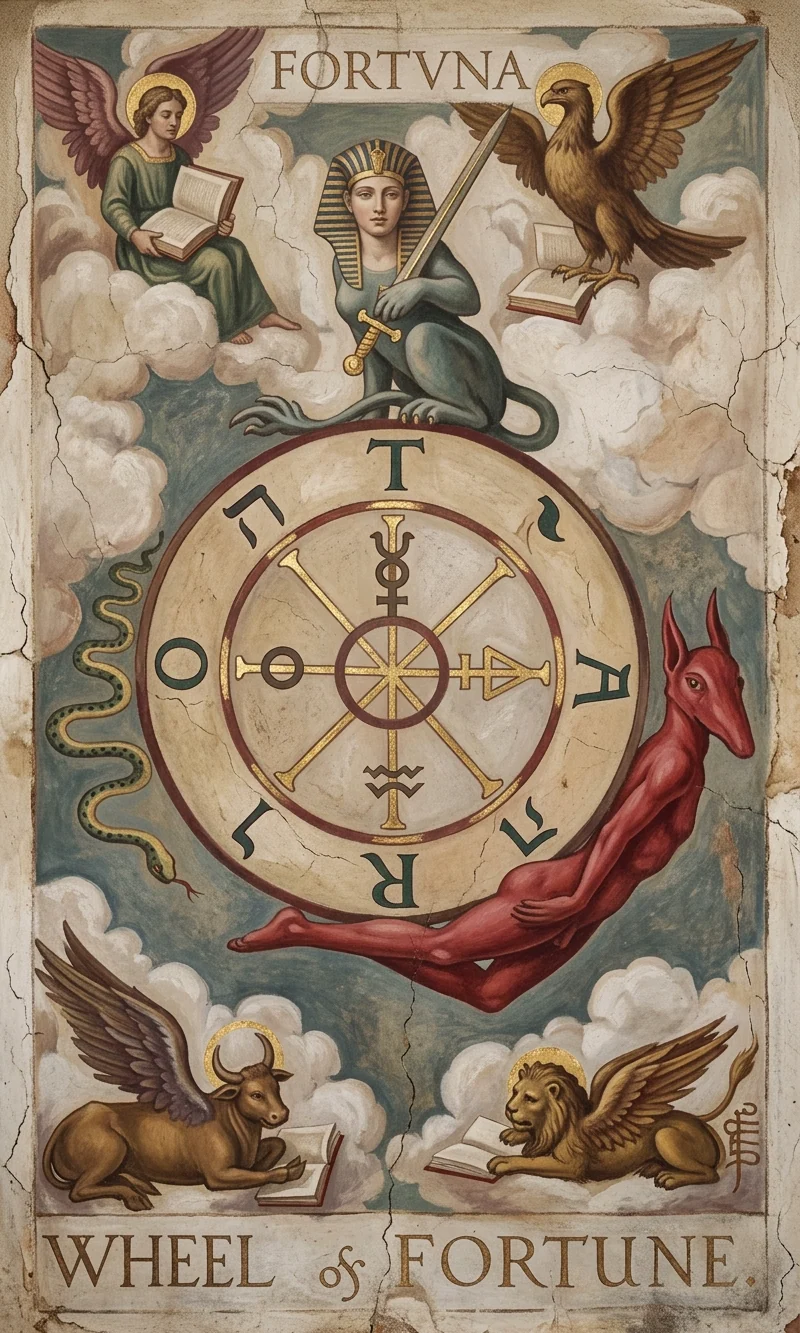
In the traditional image, we see the wheel itself suspended in space, marked with mysterious letters, flanked by figures both rising and falling. The four fixed signs of the zodiac—the eagle, the lion, the bull, and the human—occupy the corners, representing the stable forces that witness all change. But the crucial detail lies in the wheel's mechanics: it moves according to laws, not whims. The angel of Aquarius pours knowledge, the eagle of Scorpio transforms, the lion of Leo creates, and the bull of Taurus manifests. This is not chaos—this is the ordered unfolding of cosmic intelligence.
The Hebrew letters on the wheel—Yod, Heh, Vav, Heh—spell YHVH, the ineffable name, but they also spell TORA when read in the opposite direction. This reveals the wheel's deepest secret: it is simultaneously the divine name in manifestation and the teaching that emerges from understanding that manifestation. Every turn of the wheel delivers both experience and wisdom, but only to those who recognize the pattern.
The Doctrine of Kairos
The Greeks distinguished between two types of time: chronos and kairos. Chronos is mechanical time—the ticking of clocks, the turning of calendar pages, the steady march of seconds and minutes. Kairos is the right time, the opportune moment, the instant when action aligns with cosmic possibility. The Wheel of Fortune is pure kairos made visible.
This distinction explains why some people seem perpetually lucky while others struggle despite tremendous effort. Those who understand the Wheel have learned to recognize kairos—they feel the shift in the cosmic weather, sense when the wheel is about to turn in their favor, know when to act and when to wait. They understand that fortune is not random but rhythmic, following patterns as precise as planetary motion.
Ancient astrologers called Jupiter "the Greater Fortune" for precisely this reason. Jupiter's cycles—roughly twelve years for a complete zodiacal revolution, approximately one year in each sign—provide the underlying rhythm of the Wheel. When Jupiter aligns favorably with your natal chart, the Wheel turns toward expansion and opportunity. When it aspects difficult placements, the Wheel brings lessons disguised as setbacks, teaching through temporary constraint what cannot be learned through ease.
Consider how this plays out in lived experience. A woman spends three years developing a business plan, facing rejection after rejection from investors. Then, seemingly overnight, three different funding sources appear simultaneously. The shift feels sudden, but the Wheel was turning all along—her preparation during the difficult period created the foundation for Jupiter's eventual blessing. The fortune was not random; it was earned through persistence during the wheel's downward turn and claimed through recognition when it crested upward.
The Hermetic Principle of Rhythm
The Wheel operates according to the Hermetic principle that states: "Everything flows, out and in; everything has its tides; all things rise and fall; the pendulum-swing manifests in everything; the measure of the swing to the right is the measure of the swing to the left; rhythm compensates." This is not mere philosophy but practical magic for anyone who would work with the Wheel's power.
Understanding rhythm means recognizing that every expansion is balanced by contraction, every rise by fall, every blessing by challenge. This knowledge transforms how you relate to both fortune and misfortune. When the wheel turns upward, you prepare for the eventual downturn not through pessimism but through wisdom—saving resources, deepening foundations, expanding gradually rather than recklessly. When the wheel turns downward, you endure with patience, knowing that the very depth of the descent determines the height of the eventual ascent.
The Wheel teaches that nothing lasts forever, but this cuts both ways. Your current struggle is temporary, but so is your current success. This recognition brings both comfort and urgency—comfort in difficulty, urgency in ease. Those who master the Wheel learn to plant seeds during winter and harvest during summer, understanding that each season serves the larger cycle.
The most profound teaching here concerns the nature of the center. While the rim of the wheel rises and falls dramatically, the hub remains perfectly still. The Wheel of Fortune points toward that place in consciousness that can witness all changes without being destroyed by them—the part of you that watches fortune and misfortune with equal composure, knowing that both are temporary masks worn by the eternal.
The Practical Art of Wheel Working
Working consciously with the Wheel of Fortune requires developing three essential capacities: recognition, alignment, and surrender. Recognition means learning to read the signs that indicate where you stand on the wheel's rotation. Alignment means positioning yourself to receive the wheel's gifts when they come. Surrender means accepting the wheel's rhythm rather than fighting against it.
Recognition develops through careful observation of your own cycles. Track the major shifts in your life over the past decade—career changes, relationship transitions, relocations, spiritual openings, financial fluctuations. Notice the rhythm. For some people, major changes come every seven years, following Saturn's quarter-cycle. For others, the pattern follows Jupiter's rhythm of twelve years, or the lunar nodes' eighteen-year cycle. Your personal Wheel has its own signature rhythm, and learning to feel this rhythm gives you tremendous practical advantage.
Alignment means positioning yourself at the wheel's hub rather than identifying with its rim. When fortune comes, you receive it gratefully but don't mistake temporary expansion for permanent identity. When misfortune arrives, you endure it courageously but don't mistake temporary contraction for ultimate reality. This centered position allows you to act appropriately in each phase rather than being thrown off balance by changes.
Surrender represents the deepest teaching of the Wheel—the recognition that you are not the one turning it. Your will matters enormously in determining how you respond to the wheel's turns, but the turning itself follows laws greater than personal desire. Fighting the wheel's natural rhythm creates suffering. Cooperating with it creates what the ancient Chinese called "wu wei"—effortless action that accomplishes everything by working with rather than against the cosmic flow.
A practical example illustrates all three principles working together. An artist notices that his creative breakthroughs tend to follow periods of apparent barrenness (recognition). Rather than forcing productivity during fallow periods, he uses them for study, preparation, and rest, while maintaining discipline to complete projects when inspiration flows (alignment). He stops judging himself as successful or unsuccessful based on his current phase, understanding that both expansion and contraction serve his larger development (surrender).
The Integration
The Wheel of Fortune ultimately teaches that fortune and misfortune are both faces of the same cosmic intelligence, temporarily revealing and concealing itself through the play of circumstances. True fortune lies not in permanent gain but in conscious relationship with change itself—the ability to remain centered while the wheel turns, to act skillfully within whatever phase you find yourself, to trust the larger pattern even when you cannot see its design.
This understanding transforms your relationship with everything the external world calls success and failure. You still prefer comfort to discomfort, expansion to contraction, opportunity to obstacle—but you no longer depend on these preferences for your fundamental well-being. You have found the hub of the wheel, the still point around which all changes revolve.
The Book of the Self reveals how this cosmic timing expresses uniquely through your individual birth chart, showing the precise mechanics of how Jupiter's cycles interact with your natal placements to create your personal Wheel of Fortune rhythm. Understanding your individual pattern allows you to work consciously with these greater forces rather than being unconsciously moved by them.