The second face of Virgo — The Hammer And The Anvil, ruled by Venus. What this face asks of the people born wearing it.
You catch yourself adjusting the design for the seventh time this morning, moving elements by fractions until they align with something you cannot name but absolutely recognize when you see it. Your colleagues have already approved the work, called it finished, but your hands keep finding small improvements—a line weight here, a proportion there. This is not perfectionism speaking, though others might call it that. This is the knowledge that excellence lives in the details, that mastery reveals itself not in grand gestures but in the patient accumulation of precise choices. You are shaping something that will endure, and you know the difference between good enough and truly good.
The Face of Encasement
The second face of Virgo emerges clothed in layers—hair, leather, silk, and finally iron. Each covering serves a purpose, each shell both protects and conceals what lies beneath. Where the first face of Virgo revealed the raw potential of prima materia, this face shows the ongoing work of refinement, the patient process by which spirit wraps itself in matter to gain mastery over the physical world.
The ancient texts describe figures draped in multiple garments: a man covered in hair wearing three successive robes, another dressed in leather beneath a vestment of iron. These are not images of hiding but of purposeful encasement, the way a seed sheathes itself to survive winter, or how a craftsman dons protective gear to work with dangerous forces. The spirit here has descended into dense materiality not as punishment but as strategy—to oversee the world's processes with keen attention and to shape them according to inner vision.
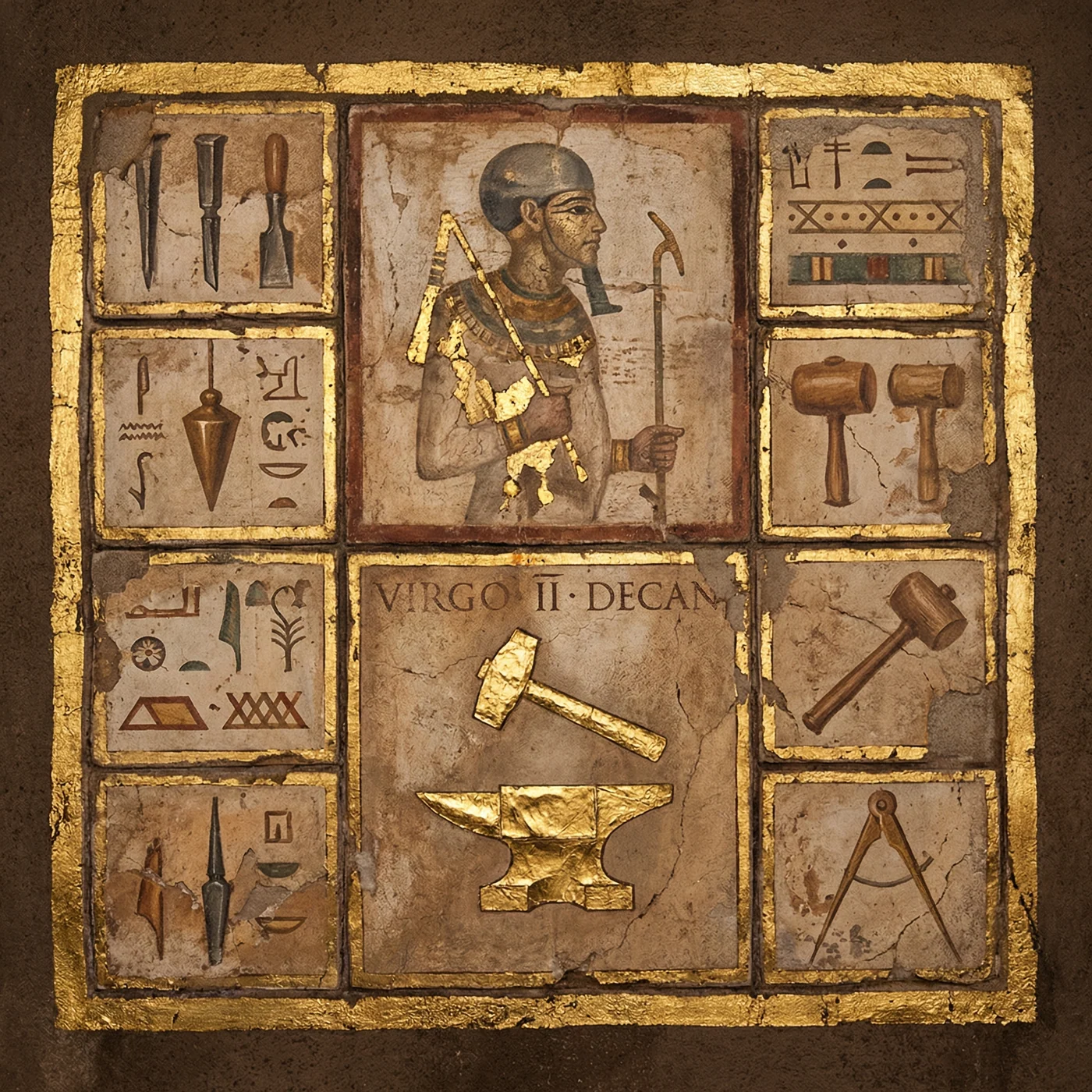
This face carries the image of the hammer and the anvil, those primordial tools by which raw metal becomes something useful and beautiful. The hammer strikes, the anvil receives, and between them the work takes form. But the true magic happens in the repetition—blow after blow, each one guided by knowledge, each one bringing the work closer to its intended shape. The craftsman's skill lies not in any single perfect strike but in the accumulated wisdom of a thousand patient adjustments.
Venus and Saturn: The Alchemical Marriage
Venus rules this face alongside Saturn, creating an unlikely partnership that defines its essential character. Venus brings the eye for beauty, the instinct for proportion, the ability to recognize quality and refinement. But this is not the Venus of easy pleasure—here she is discriminating, particular, willing to reject what merely looks good in favor of what truly is good.
Saturn provides the structure, the discipline, the understanding that excellence requires time and methodical effort. Together, they create the master craftsman: one who can envision beauty and possess the patience to manifest it through careful work.
The Nine of Pentacles captures this marriage perfectly. In the Rider-Waite image, a woman stands in a garden of her own creation, a hooded falcon perched on her gloved hand. She has trained this wild creature through patience and skill, just as she has cultivated the abundance that surrounds her. The Thoth version, titled "Gain," shows the fruits of disciplined effort—not wealth that falls from the sky, but prosperity earned through mastery of process.
This is not the gain of speculation or luck, but of genuine skill applied consistently over time. The craftsman who can see flaws others miss, who understands the relationship between technique and outcome, who values quality over speed—such a person inevitably accumulates both wealth and reputation. Their gain comes not from exploiting others but from creating value that others recognize and willingly pay for.
When the Sun Carries the Hammer
Those born with the Sun in this face possess a natural authority that comes not from rank or title but from demonstrable competence. They are the ones others turn to when precision matters, when the work must be done right rather than done quickly. Their identity is closely tied to their capacity to improve whatever they touch, whether that be a business process, a creative project, or their own skills.
These individuals often struggle with delegation, not from ego but from their acute awareness of how easily quality can be compromised. They see the shortcuts others take, the details others miss, the places where "good enough" falls short of actual excellence. This gives them tremendous value in roles where precision matters, but it can also isolate them from colleagues who operate by different standards.
Their path to leadership is gradual and earned. They do not seek the spotlight but find it seeking them as others recognize the consistent quality of their output. Their success comes through building systems, refining processes, and training others to see what they see. When they finally achieve positions of authority, they do so with the deep respect of those who understand what they have accomplished.
When the Moon or Rising Shapes the Work
With the Moon in this face, the need for quality and refinement operates at an emotional level. These individuals are comforted by environments of order and excellence, disturbed by shoddiness or carelessness in ways others might find excessive. Their security comes through mastering their craft, whatever that craft might be.
They often have complex relationships with praise and recognition. On one hand, they take deep satisfaction in work well done. On the other, they may be their own harshest critics, always aware of how their latest effort could have been improved. They need creative outlets where they control the entire process, from conception to completion, where their standards can be applied without compromise.
When this face rises, it marks individuals who present themselves as competent and reliable before they reveal their warmth or creativity. They dress carefully, speak precisely, and pay attention to details others overlook. Their first impression is often one of quiet authority—people sense they know what they are doing without needing to announce it.
These rising individuals often find themselves in advisory roles, consulted for their judgment and attention to detail. They have the gift of seeing patterns and problems before others do, of recognizing quality and its absence at a glance. Their presence raises the standard of whatever group they join.
The Practice of Patient Excellence
This face teaches the spiritual discipline of process over product, of cumulative improvement over dramatic breakthrough. Its practice involves learning to find satisfaction in the work itself rather than only in its completion, to take pride in doing something well regardless of who notices.
The hammer and the anvil become meditation tools, symbols of the relationship between active effort and receptive endurance. Every project becomes an opportunity to apply this principle: the careful attention to each step, the willingness to revise and refine, the understanding that true mastery reveals itself in the smallest details.
Those who work with this energy learn to trust in gradual improvement rather than seeking instant results. They develop the craftsman's patience—the ability to work steadily toward long-term goals while finding meaning in each day's incremental progress. They become connoisseurs of process, able to see the beauty in well-executed technique even when others see only the final product.
The ultimate teaching of this face is that excellence is not a destination but a practice, not a achievement but a way of working. The hammer rises and falls, the anvil receives and supports, and slowly, surely, something beautiful takes shape.
For those seeking deeper understanding of their own decanic placements and how these ancient faces shape their personal astrology, The Book of the Self offers comprehensive analysis of all planetary positions within the thirty-six faces of the zodiac, revealing the specific ways these archetypal patterns manifest in individual charts.