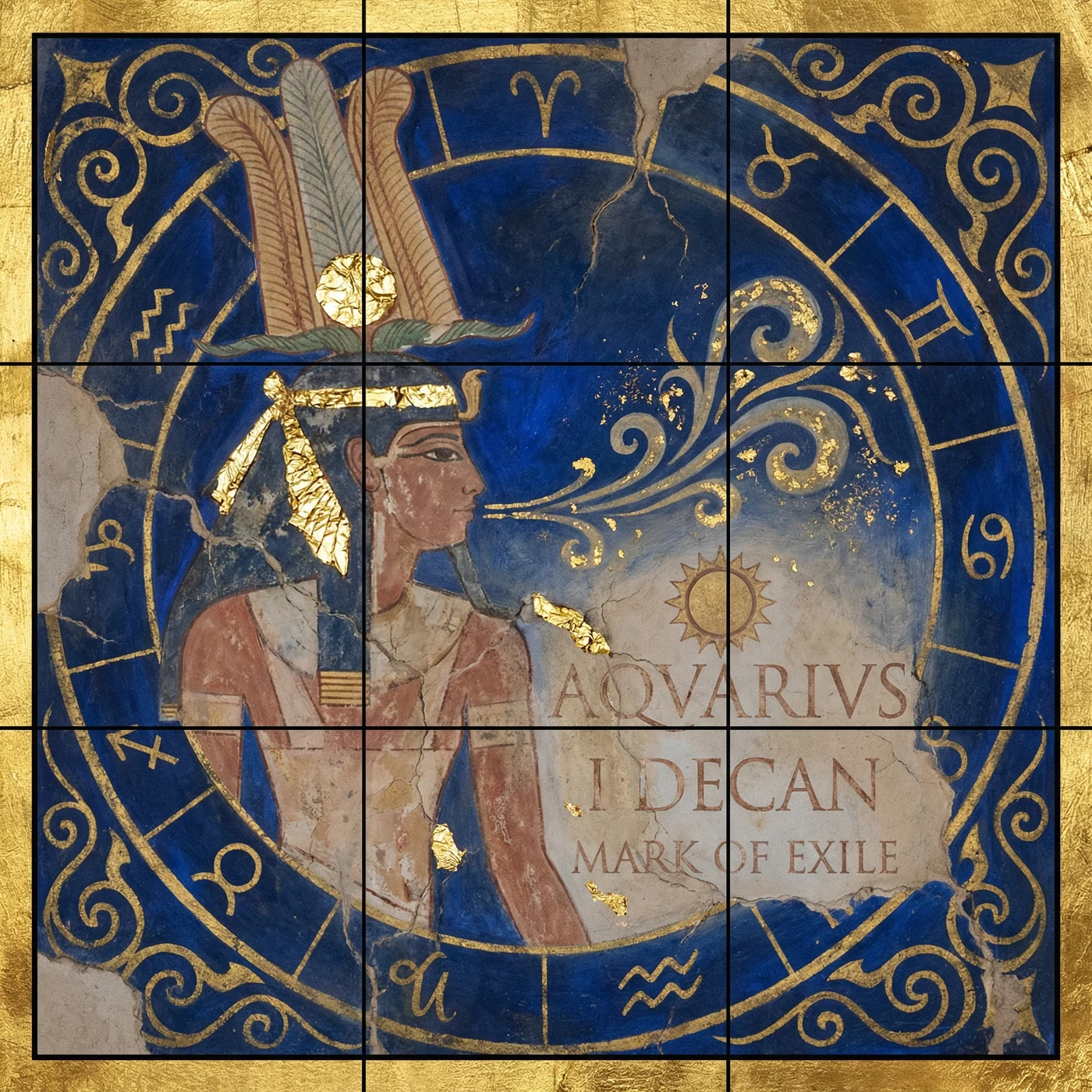
The first face of Aquarius — The Mark Of Exile, ruled by Venus. What this face asks of the people born wearing it.
You stand at the edge of the known world, watching smoke rise from the city you once called home. The weight of your small pack reminds you that everything you own now fits on your shoulders. Behind you lies the comfort of belonging, the warm certainty of acceptance, the easy rhythm of days that follow expected patterns. Ahead stretches unmarked territory—dangerous, perhaps, but alive with possibility. The wind carries both the scent of familiar hearths and the promise of distant shores. You are no longer citizen or subject. You are exile, pioneer, and something entirely your own making.
This is the threshold moment that defines all who carry the Mark of Exile. Whether by choice or circumstance, they find themselves pushed beyond the boundaries of conventional life, bearing the particular mixture of loss and liberation that comes with standing outside the established order.
The Face of Exile
The Mark of Exile appears as a sigil burned into the forehead of one who can never again claim the comfort of unthinking belonging. It is not merely exclusion—it is the active choice to step away from what others accept without question. Those who bear this mark understand intuitively that the price of genuine freedom is the surrender of easy answers.
This face encompasses the full spectrum of displacement: the political refugee and the spiritual seeker, the artist who refuses to paint what sells and the entrepreneur who abandons corporate security for uncertain ventures. What unites them is not the circumstances of their exile, but their capacity to find meaning and even richness in marginality.
The traditional images speak of poverty and labor, of the coppersmith working base metal while others trade in gold. Yet copper has its own beauty, its own utility, and those who understand its properties may craft objects of genuine worth. The exile learns to see value where others see only absence, to discover resources in the spaces others have abandoned as worthless.
There is often real hardship here. The Mark of Exile does not guarantee success, only the opportunity to define success on one's own terms. Many who bear it struggle financially, socially, or emotionally. They face the constant tension between their vision of what life might be and the practical demands of survival in a world that operates by different rules.
Yet within this struggle lies the particular genius of this face: the ability to create new forms of value, new ways of living, new solutions to old problems. The exile sees with fresh eyes because they cannot rely on established patterns. They innovate because they must.
Venus and the Five of Swords
Venus rules this decan, lending it an unexpected magnetism despite its apparent disadvantages. This is not the Venus of conventional beauty or easy pleasure, but Venus as the discoverer of hidden treasures, the patron of alternative aesthetics, the goddess who finds splendor in what others discard.
Under Venus's influence, those marked by exile develop a refined ability to perceive quality that exists outside mainstream recognition. They are drawn to the undervalued: the artists whose work won't be recognized for decades, the neighborhoods others consider undesirable, the ideas too strange for immediate acceptance. Their aesthetic sense runs toward the eclectic, the handmade, the authentic rather than the polished.
This Venusian quality also manifests in their relationships. They attract others who live on the margins, who question established norms, who value freedom over security. Their romantic partnerships often form outside conventional frameworks—they may marry late, live unmarried, choose partners from different backgrounds, or structure their relationships in ways that mystify their more traditional acquaintances.
The Five of Swords depicts the bitter victory that characterizes this territory. In the Rider-Waite version, a figure collects swords while defeated opponents walk away. He has won, but at great cost. The victory is real but hollow, achieved through methods that isolated him from his community. This is the shadow of exile—the possibility that in gaining freedom, one loses connection; that in refusing to compromise, one ends up alone.
Yet the card also suggests that something valuable has been preserved or gained. The swords represent ideas, principles, or capabilities that might have been lost if the figure had chosen conformity over conflict. The defeated figures may represent not conquered enemies but abandoned possibilities—the safer paths that were rejected in favor of the more difficult but authentic choice.
The Five of Swords reminds those who carry the Mark of Exile that their victories will often be misunderstood, their successes unrecognized by conventional measures. They must learn to value their achievements internally, to find satisfaction in integrity rather than approval.
The Sun in Exile
When the Sun carries the Mark of Exile, it creates individuals whose very identity is tied to their outsider status. These are people who cannot help but question authority, challenge conventions, and seek what lies beyond accepted boundaries. Their sense of self depends on their ability to remain independent of systems that would define them.
Solar exiles often become leaders of movements, founders of institutions, or creators of entirely new fields. Their vision extends beyond what currently exists to what might be possible. They possess the confidence to act on beliefs that others consider impractical or impossible. Their light illuminates possibilities that remain invisible to those content with existing structures.
Yet the Sun in exile struggles with the tension between leadership and belonging. These individuals often inspire others but find it difficult to truly collaborate. Their independence, which is their strength, can also be their isolation. They may gather followers but struggle to create equals, disciples but not peers.
The challenge for the Sun in this position is learning to share authority without surrendering authenticity. They must discover how to lead without demanding that others become copies of themselves, how to build communities that honor individual freedom while accomplishing collective goals.
The Moon and Rising in Exile
When the Moon bears this mark, the emotional life centers around themes of belonging and displacement. These individuals feel most comfortable when they are somewhat apart from mainstream culture. They find emotional nourishment in alternative communities, unconventional living situations, or spiritual practices that exist outside established religions.
Lunar exiles possess a remarkable ability to make themselves at home anywhere. They can find comfort and meaning in circumstances that would distress others. Their emotional resilience comes from being anchored in something deeper than social position or material security. They draw sustenance from the invisible, the eternal, the aspects of existence that remain constant regardless of external circumstances.
Yet they may struggle with feelings of alienation, particularly in youth. The very sensitivity that allows them to perceive alternatives to mainstream culture also makes them acutely aware of their difference. Learning to see this difference as a gift rather than a burden is often a lifelong process.
When the Mark of Exile appears on the Rising, it shapes how individuals present themselves to the world and how the world responds to them. These people often appear somewhat foreign or mysterious regardless of their actual background. There is something in their manner, their aesthetic choices, or their way of being that signals their outsider status.
Rising exiles frequently find themselves cast in the role of the stranger, the foreign expert, the person who brings news from elsewhere. Others may project onto them expectations of wisdom or danger, of exotic knowledge or threatening difference. Learning to navigate these projections while maintaining authentic self-expression becomes a crucial skill.
The Practice of Exile
The Mark of Exile is not a burden to be overcome but a calling to be fulfilled. Its practice involves learning to thrive in the spaces between established categories, to find resources in what others overlook, to create value through vision rather than inheritance.
The first discipline is the cultivation of genuine independence. This means developing the practical skills necessary to survive outside conventional support systems: financial literacy, creative problem-solving, the ability to build new networks rather than relying on existing ones. It also means developing the psychological capacity for solitude, for making decisions without consensus, for finding validation internally rather than externally.
The second discipline is the art of translation. Exiles often serve as bridges between different worlds—the artistic and commercial, the spiritual and practical, the traditional and innovative. They must learn to speak multiple languages: to communicate their vision in terms others can understand while preserving its essential integrity.
The third discipline is the practice of discernment. Not all exile is meaningful; not all marginality is creative. The Mark of Exile calls for the wisdom to distinguish between rebellion that serves growth and rebellion that serves only ego, between independence that opens new possibilities and independence that merely avoids responsibility.
Those who master these disciplines often find that their exile transforms from limitation to liberation. They discover that freedom from conventional expectations allows for authentic achievement. They may never be wealthy by traditional measures, but they often find themselves rich in experiences, relationships, and accomplishments that money cannot buy.
The deepest practice is learning to see exile not as separation from home but as expansion of what home might mean. The true exile discovers that belonging is not about fitting into existing categories but about creating spaces where authenticity is possible—for themselves and others who share their vision of what life might become.
Your birth chart reveals the specific ways the Mark of Exile operates in your life, showing where you are called to step outside conventional boundaries and what gifts you carry into uncharted territory. The Book of the Self maps these patterns with precision, illuminating both the challenges and opportunities that await those brave enough to make their home at the edge of the known world.