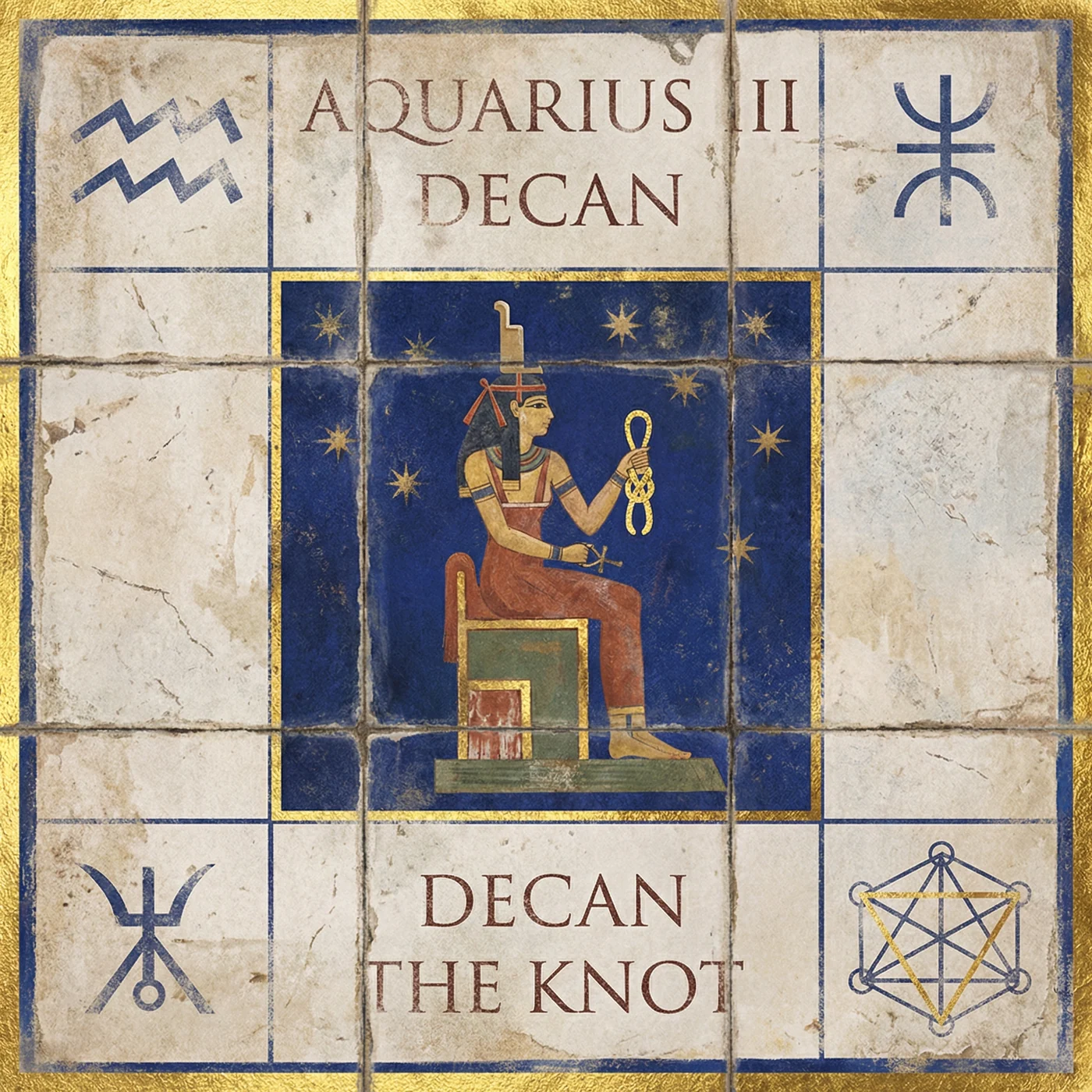
The third face of Aquarius — The Knot, ruled by Moon. What this face asks of the people born wearing it.
She sits at her kitchen table at three in the morning, surrounded by papers that should have been organized months ago. Tax documents, medical bills, insurance forms, letters from her ex-husband's lawyer—each thread of her life tangled with another until she can no longer see where one obligation ends and another begins. She picks up one paper, then another, but every choice feels wrong. To move forward means leaving something behind. To stay means remaining trapped in this web of her own making. The coffee grows cold as she stares at the mess, understanding finally that this is not about paperwork at all. This is about every choice that brought her here, every thread she helped weave into the knot that now holds her fast.
The Knot Itself
The third face of Aquarius bears the image of The Knot—not the simple tangle that can be undone with patience, but the complex weave where every strand depends upon every other. Here we find karma made visible, the accumulated weight of choices and connections that bind us to particular patterns of living. This is the Gordian knot of the zodiac, challenging us to find the wisdom that knows when to untie patiently and when to cut clean through.
The ancient texts speak of this decan with a mixture of frustration and recognition. Ibn Ezra describes an angry, restless figure pacing about, while Agrippa writes of "a black and angry man" whose behavior tends toward "insolence and imprudence." The Picatrix notes this as a face of "insulting behavior." Yet beneath the ill temper lies a deeper truth: these figures rage because they can see the problems clearly but cannot easily extract themselves from the situations that bind them.
The Seven of Swords in the Rider-Waite deck captures this struggle perfectly. A figure steals away from an encampment, carrying five swords while leaving two behind. Called "Futility" in Crowley's Thoth deck, the card reveals the complex nature of departure. This is not simple escape but strategic retreat—the art of salvaging what can be saved while abandoning what cannot. The futility lies not in the attempt but in the wish to take everything, to leave nothing behind.
The Rulers: Moon and Venus
The Moon rules this decan alongside Venus, creating a tension between emotional attachment and aesthetic detachment. The Moon pulls toward the past, toward the comfort of familiar patterns, even when those patterns have become chains. She represents the emotional investment we have in our entanglements, the way our hearts become entwined with situations that no longer serve us.
Venus brings a different quality—the vision of what could be beautiful if we could only arrange things differently. She sees the ideal relationship, the perfect living situation, the harmonious resolution. But Venus here learns the hard lesson that sometimes beauty requires sacrifice, that the most elegant solution may be the one that hurts most to implement.
Together, Moon and Venus create the core conflict of The Knot: the tension between what we feel attached to and what we know would be beautiful to create. The Seven of Swords, in its futility, shows us what happens when we try to have both—when we attempt to carry forward every connection while still moving toward freedom.
The Sun in The Knot
When the Sun travels through this decan, it illuminates the karmic patterns that usually operate in shadow. These individuals possess an almost uncomfortable clarity about the webs of connection and obligation that bind people. They can see the strings that pull others, the unconscious agreements that keep relationships and situations in place. This gift of perception is also their burden—they often feel frustrated by others' inability to see what seems so obvious.
Sun in The Knot individuals often struggle with their own identity because they can see how much of what we call "self" is actually a collection of relationships and roles. They understand intuitively that to change requires untangling from patterns that involve other people, and this knowledge can create a detached, almost clinical approach to their own lives. They may appear cold or calculating when they are simply trying to navigate the complex geometry of human connection.
Their strength lies in their capacity for strategic thinking about relationships and life situations. When others are trapped in emotional reactions, Sun in The Knot can step back and see the whole pattern. Their challenge is learning when to act on this knowledge and when to accept the beautiful futility of human entanglement.
The Moon and Rising in The Knot
When the Moon inhabits this face, the emotional nature becomes paradoxically both attached and detached. These individuals form deep bonds but maintain an internal distance that allows them to let go when necessary. They are emotionally independent in the truest sense—capable of finding comfort in solitude, of making themselves at home wherever they land.
There is often a quality of sadness here, the melancholy of one who loves deeply but holds lightly. Moon in The Knot people understand that all connections are temporary, and this knowledge both frees them and isolates them. They make excellent friends for those going through transitions because they can offer support without trying to hold others back from necessary changes.
With The Knot rising, the life path itself becomes about learning the art of conscious entanglement and deliberate release. These individuals often find themselves in situations where they must choose between loyalty and growth, between maintaining connections and pursuing their authentic direction. Their biography reads like a series of strategic retreats, each departure teaching them more about what is truly essential to carry forward.
The rising sign shows how we meet the world, and Knot rising meets life with an understanding that every connection is also a potential binding. This can create hesitation around commitment, but it also brings wisdom about the true cost of our choices. They learn to enter relationships and situations with full awareness of what they might need to untangle later.
The Practice: The Art of Strategic Departure
The Knot teaches the sophisticated art of leaving—not the dramatic exit or the sudden flight, but the careful disentanglement that honors what was valuable while releasing what has become constraint. This is perhaps the most difficult skill to master because it requires us to act against both sentiment and social pressure.
Begin by mapping your knots. Take inventory of the situations, relationships, and commitments that bind you. Notice which ones energize and which ones drain, which ones support your growth and which ones keep you small. The key is to see the whole pattern without immediately judging it or trying to change it.
Practice the art of gentle withdrawal from situations that no longer serve. This might mean gradually reducing your involvement in certain activities, slowly shifting the dynamic of draining relationships, or incrementally removing yourself from obligations that were taken on from guilt rather than genuine commitment. The Moon in this decan teaches patience with this process—most knots are tied slowly and must be untied slowly.
Cultivate Venus's gift of aesthetic discernment about your life. Ask not just "What do I want?" but "What would be beautiful to create from here?" Sometimes the most beautiful choice requires leaving behind things we love but that no longer fit the life we are growing into.
Learn to recognize the difference between healthy interdependence and karmic entanglement. Healthy connections enhance both parties' freedom and growth. Karmic tangles keep both parties stuck in familiar patterns, even when those patterns have become prisons.
Most importantly, practice taking only what truly belongs with you when you move from one phase of life to another. Like the figure in the Seven of Swords, learn to leave behind what cannot come on the journey ahead, even when it means letting go of things that once felt essential.
The deepest practice of The Knot is learning to love without binding, to commit without imprisoning, to connect while remaining free. This requires a maturity that sees attachment and detachment not as opposites but as dance partners, each enabling the other to create something beautiful.
Your birth chart is a map of these karmic knots and the wisdom to work with them skillfully. The Book of the Self reveals where your particular tangles lie and shows you the threads that lead toward greater freedom and authentic connection.