Saturn to Moon and back again — the ancient order behind every decan.
You've felt it before—that sense that your birthday holds more than a single solar signature, that the ten degrees surrounding your Sun contain layers upon layers of meaning your standard horoscope never quite captures. Perhaps you've noticed how people born in early Scorpio feel entirely different from those born in late Scorpio, even though they're supposedly the same sign. Or maybe you've wondered why your Venus in Gemini seems to carry such specific flavors of restlessness that generic Gemini descriptions never quite pin down. The answer lies in an ancient system that divides each sign into three faces, each ruled by a different planetary intelligence following a sequence so old it predates our written records.
This is the Chaldean order—a ladder of planetary rulership that begins with Mars and descends through Sun, Venus, Mercury, Moon, Saturn, and Jupiter, then repeats this seven-fold pattern across all thirty-six faces of the zodiac. But calling it a "system" undersells its true nature. The Chaldean order is more like a cosmic heartbeat, a rhythm of planetary influence that shapes not just your natal chart but every ten-degree arc of celestial time.
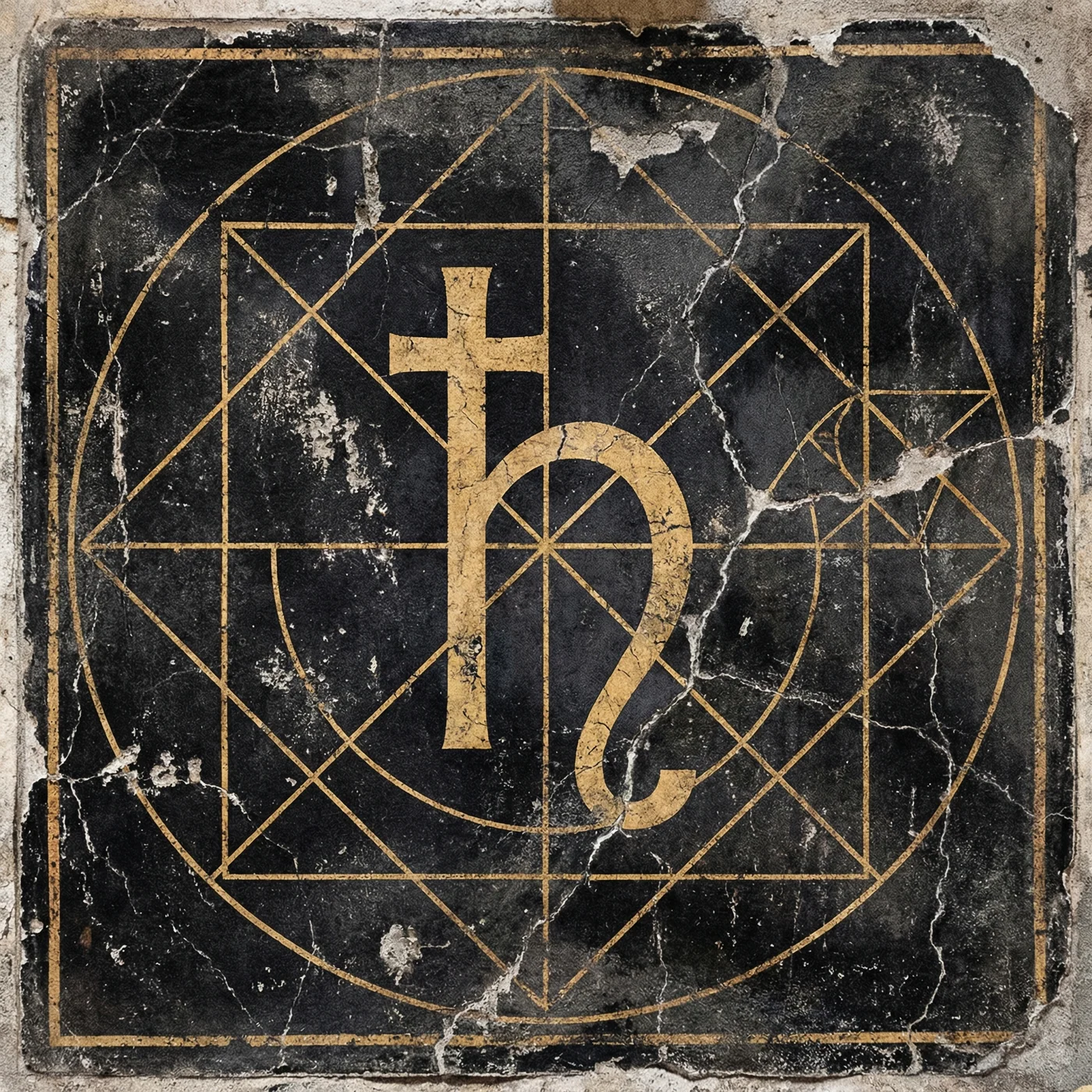
The Ancient Rhythm
The sequence begins with Mars ruling the first face of Aries—THE AXE—where the zodiacal year opens with pure, undiluted initiation. From there, the ladder descends: Sun takes the second face of Aries (THE CROWN), Venus the third (THE BURNING ROSE), Mercury the first face of Taurus (THE PLOW), and so on, cycling through the seven traditional planets in their Chaldean order until all thirty-six faces have received their governors.
This isn't arbitrary assignment. The Chaldeans arranged the planets by their apparent speed through the sky, from fastest to slowest: Moon, Mercury, Venus, Sun, Mars, Jupiter, Saturn. But for the faces, they reversed this order, beginning with Mars and working backward through the sequence. Why? Because the faces govern not the quick, changeable aspects of personality that the Moon rules in daily life, but the slower, more fundamental patterns that require the weight of the outer planets to fully manifest.
When you understand this rhythm, certain mysteries resolve themselves. Why does early Leo feel so different from late Leo? Because Leo I (THE SPOTLIGHT) is ruled by Saturn, creating the strife and struggle depicted in the Five of Wands, while Leo III (THE BANNER) belongs to Mars alone, manifesting as the pure valor shown in the Seven of Wands. The Sun may rule Leo as a whole, but within that solar kingdom, different planetary ministers hold court over different territories.
The Faces Themselves
Each face contains exactly ten degrees and carries a specific name that captures its essential nature. These aren't poetic metaphors but functional descriptions of how planetary energy manifests when filtered through that particular arc of the zodiac. THE AXE of Aries I describes Mars in its most direct, cutting form. THE CROWN of Aries II reveals how solar energy expresses itself when it must establish dominion in Mars-ruled territory. THE BURNING ROSE of Aries III shows what happens when Venus and Jupiter attempt to create beauty and expansion within the urgency of early spring.
The faces follow seasonal logic as well. The first faces of cardinal signs—Aries, Cancer, Libra, Capricorn—initiate their seasons with the raw force needed to shift from one climatic mode to another. The middle faces of fixed signs—Taurus, Leo, Scorpio, Aquarius—anchor their seasons at the peak of stability, which is why they often carry the most intense and crystallized expressions of their planetary rulers. The final faces of mutable signs—Gemini, Virgo, Sagittarius, Pisces—perform the necessary sacrifice of breaking down the old season to prepare for the new.
This creates a double signature for every planetary placement. Your Venus might be in Taurus, but is it in Taurus I (THE PLOW), ruled by Mercury and Venus together, creating artistic works that require technical precision? Or Taurus II (A LINGA-YONI), where Venus meets Saturn to forge relationships that must survive the test of time? Or Taurus III (A STRING OF PRAYER BEADS), where Saturn rules alone, turning Venusian pleasure toward spiritual discipline and the accumulation of merit through devotion?
A Living Example
Consider someone born with Venus in Aquarius II—HEAVEN AND EARTH—ruled by Mercury, Venus, and Mars in combination. This isn't simply "Venus in Aquarius" but Venus expressing herself through the particular lens of this face, which governs scientific innovation and the bridging of opposites. Here, Venusian attraction becomes fascination with elegant solutions to complex problems. The native might find beauty in mathematical equations, fall in love with revolutionary ideas, or feel most attractive when explaining how seemingly contradictory forces can work in harmony.
The tarot correspondence—the Six of Swords, "Science" in the Thoth deck, "The Ferryman" in traditional interpretations—reveals how this Venus operates: moving valuable cargo across difficult waters, applying knowledge to navigate between different states of being. This person's relationships likely involve teaching and learning, their aesthetic sense runs toward clean, functional design, and their values center on progress and the improvement of systems.
But place that same Venus in Aquarius I (THE MARK OF EXILE), ruled by Venus and Saturn together, and everything shifts. Now Venusian love must operate under Saturn's constraints of separation and testing. The Five of Swords, "Defeat" or "The Bitter Victory," suggests relationships that involve necessary losses, attractions that come with built-in obstacles, or an aesthetic that finds beauty in abandonment and the elegant ruins left by time.
Working With the Ladder
The faces aren't just for natal interpretation—they're active magical territories. When you know that Scorpio II (AN APPARATUS FOR MUTUAL DISTILLATION) is ruled by Sun and Jupiter together, you understand why this face excels at transformative work that involves mutual benefit and the creation of something greater than the sum of its parts. The Six of Cups, "Pleasure" or "The Alchemical Union," describes exactly this process: two elements combining to create a third thing that serves both.
If you're planning important work during a Scorpio II period—whether that's a business partnership, a creative collaboration, or literal alchemical operations—you're working with solar authority channeled through Jupiterian expansion in Scorpio's transformative waters. The timing supports endeavors that require trust, mutual transformation, and the kind of pleasure that emerges when separate entities discover they can create more together than apart.
This is why the ancient astrologers paid such careful attention to these ten-degree divisions. They understood that Mars in Sagittarius I (THE POISONED ARROW), ruled by Jupiter and Mercury, would manifest differently than Mars in Sagittarius III (A HORSE'S SKULL), ruled by Sun and Saturn. In the first case, martial energy gets expanded and intellectualized—think strategic thinking applied at great speed, or the kind of sharp wit that can cut through confusion to reach truth. In the latter, martial force becomes crystallized and authoritative—executive decisions that end entire phases of development, or the kind of discipline that knows when to stop fighting and accept the inevitable.
The Inheritance
The Chaldean ladder gives you a more precise language for understanding not just your own nature but the nature of time itself. When you realize that every period of your life has been colored by whichever face the relevant planets were transiting, patterns that seemed random begin to make sense. That difficult Saturn transit wasn't just "Saturn opposing your Moon"—it was Saturn in a specific face, carrying the particular combination of planetary influences that face contains, manifesting through the imagery and energy that belongs to that ten-degree arc alone.
More importantly, the faces restore astrology to its rightful complexity. Human experience is too rich to be captured by twelve signs alone, too nuanced to be described by the aspects between seven planets. We need the full palette of thirty-six faces, each with its own planetary signature, its own imagery, its own gifts and challenges. The Chaldean ladder provides exactly this: a system sophisticated enough to match the actual complexity of a human life, ancient enough to carry the weight of tradition, and precise enough to offer genuine insight into the particular way celestial forces shape your unique path through time.
Your complete personalized analysis of all thirty-six faces—including your natal placements, current transits, and the specific face combinations that shape your chart—awaits in The Book of the Self.