How one book rebuilt the decans for the present age.
You know that moment when you catch your reflection in a shop window and see something unexpected there — not quite yourself, but not quite a stranger either? Perhaps it's the angle of the light, or the way the glass fractures your image, but suddenly you glimpse something that feels both foreign and familiar. This is what happens when you first encounter the thirty-six faces of the zodiac. Each ten-degree arc carries its own expression, its own particular way of being human, and recognizing yours can feel like meeting a version of yourself you never knew existed.
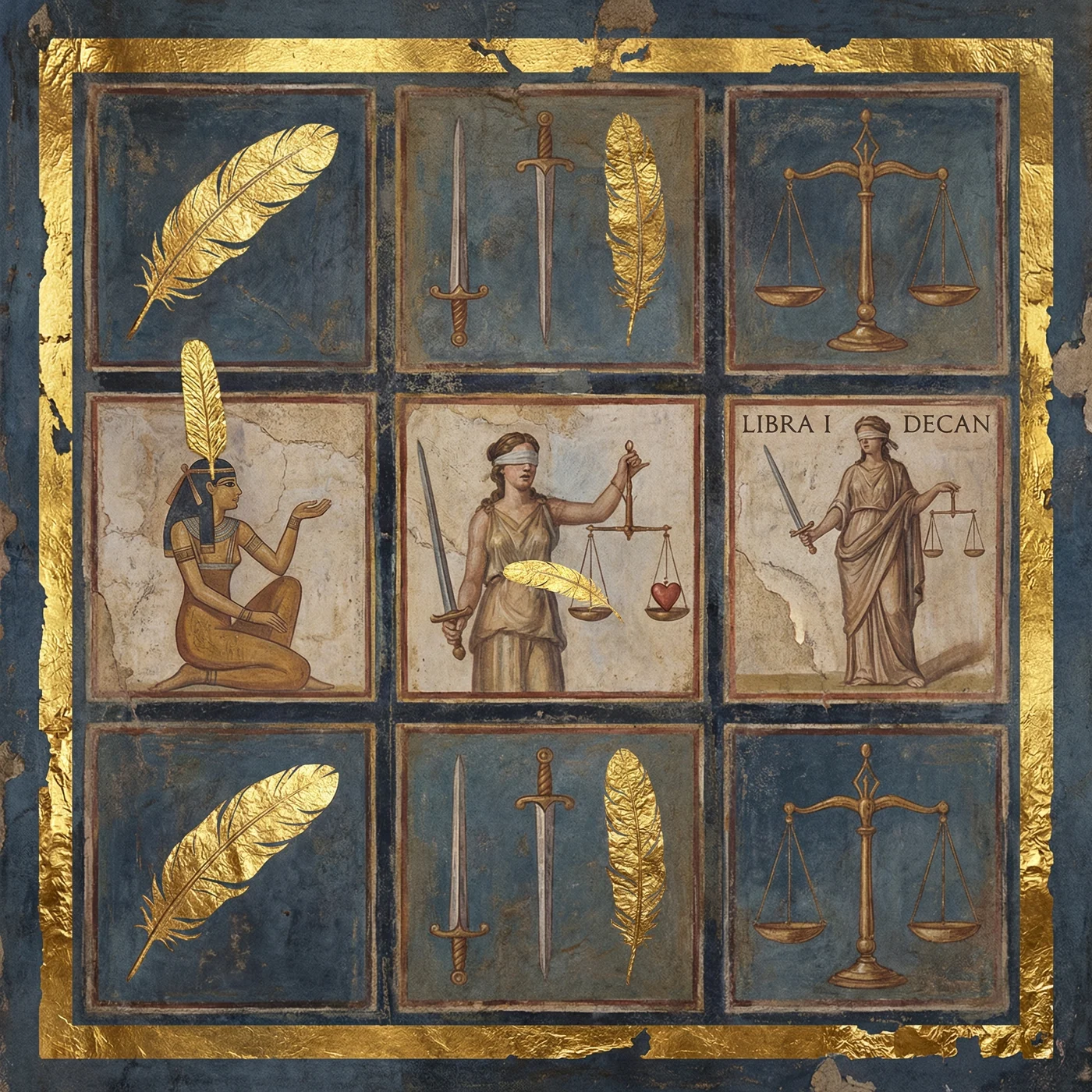
The Architecture of Time
The thirty-six faces, or decans, divide each zodiacal sign into three precise segments of ten degrees. This creates a more granular map of celestial influence than the familiar twelve-sign system most people know. Where traditional astrology paints in broad strokes — "you're a Scorpio" — the decanic system works with a finer brush, distinguishing between the different qualities that emerge as the sun progresses through each sign's territory.
Austin Coppock's contribution to this ancient art lies not in invention but in recovery and synthesis. He traced the decanic tradition through multiple cultural streams — Egyptian temple astronomy, Hellenistic magic, Arabic astrology, Renaissance grimoires — and wove them into a coherent modern practice. His thirty-six faces bear evocative names: THE AXE of Aries I, ruled by Mars and corresponding to the Two of Wands. A LINGA-YONI in Taurus II, governed by Venus and Saturn, linked to the Six of Pentacles. THE KNOT in Aquarius III, under the influence of Moon and Venus, reflected in the Seven of Swords.
Each face carries its own mythology. THE BURNING ROSE of Aries III tells of beauty born from conflict, while THE SARCOPHAGUS of Virgo III speaks to the completion that comes through careful preparation. These are not arbitrary symbols but distillations of observed patterns — the recurring themes that emerge when celestial mathematics meets lived human experience.
The Thread Through History
The story of the decans begins in Egypt, where priest-astronomers divided the night sky into thirty-six sections to track the passage of time. Every ten days, a new decan rose heliacally — appearing just before dawn — marking both celestial time and divine presence. These were not merely astronomical markers but spiritual entities, each with its own power and personality.
When Hellenistic culture absorbed Egyptian wisdom, the decans became embedded in the magical practices of late antiquity. The Greek Magical Papyri contain elaborate rituals for invoking decanic spirits, while astrological texts like the Yavanajataka preserved their interpretive meanings. The tradition traveled through Arabic translation into medieval Europe, where it found expression in works like Agrippa's Three Books of Occult Philosophy.
But the faces were never simply preserved — they evolved. Each culture that encountered them added new layers of meaning while maintaining the essential core. The Arabic astrologers emphasized their talismanic properties. Renaissance mages connected them to angelic hierarchies. Modern practitioners like Coppock have linked them to tarot symbolism, creating bridges between ancient wisdom and contemporary divination.
This evolution reflects something crucial about the decanic system: it remains alive because it describes something real about human nature and cosmic rhythm. The faces persist because they work — not as superstition, but as a sophisticated technology for understanding personality, timing, and transformation.
Beyond Sun Signs
Most people encounter astrology through their sun sign — the zodiacal position of the sun at birth. But this creates a curious flattening effect, where millions of people supposedly share the same basic nature. The decanic system restores nuance to this picture. Three people born under Scorpio might embody THE JAWBONE, AN APPARATUS FOR MUTUAL DISTILLATION, or A CROW — each expressing the Scorpionic principle through distinctly different archetypal lenses.
Consider someone born with the sun in Gemini II, THE HERMAPHRODITE, ruled by Mars and Venus with correspondence to the Nine of Swords. Their Gemini nature doesn't simply involve communication and duality in the abstract. It carries the specific quality of creative tension between opposing forces — the masculine and feminine, the assertive and receptive — that must be consciously integrated. When this person encounters the Nine of Swords in a tarot reading, they're not just seeing a card about mental anguish; they're seeing their own process of psychological integration reflected back to them.
This level of specificity transforms astrology from a system of broad generalizations into a precise instrument for self-knowledge. The decans explain why two Leos can be so different — one embodying THE SPOTLIGHT with its need for attention and recognition, another expressing A CROWN OF LAURELS with its emphasis on earned achievement, and a third manifesting THE BANNER with its drive to create lasting legacy.
The Living Symbol
Each decanic face operates as what could be called a "living symbol" — an image that contains both descriptive and transformative power. Take THE PLOW of Taurus I, ruled by Mercury and Venus, corresponding to the Five of Pentacles. On one level, this describes someone who approaches material security through careful preparation and methodical work. They understand that wealth must be cultivated like crops — planted, tended, and harvested in proper season.
But the symbol goes deeper. THE PLOW breaks virgin soil, making the first cut that enables cultivation. People with strong Taurus I placements often find themselves pioneering new approaches to abundance and security. They may struggle initially — the Five of Pentacles speaks to material hardship — but their instinct for systematic development eventually yields lasting prosperity.
The symbol also suggests how to work with this energy consciously. If you're navigating a Taurus I period in your life, or if this decan features prominently in your chart, you might invoke THE PLOW in meditation or visualization. See yourself breaking new ground in your financial or material life. Feel the resistance of the earth giving way to persistent, methodical effort. Use the image to align your actions with the deeper pattern the stars describe.
A Practice of Recognition
Working with the thirty-six faces requires developing what might be called "decanic perception" — the ability to recognize these archetypal patterns as they manifest in daily life. This begins with identifying your own primary decanic placements, particularly the face containing your sun, moon, and rising sign. But it extends into recognizing the faces as they're activated by planetary transits and progressions.
When Mars moves through Scorpio III, A CROW, you might notice themes of scavenging wisdom from decay, finding treasure in what others discard, or dealing with the darker aspects of desire. When Venus enters Cancer I, A MOTHER AND CHILD, relationship dynamics might shift toward nurturing, protection, and the creation of emotional sanctuary.
The faces also provide a framework for understanding other people with remarkable precision. Once you learn to recognize THE AXE personality versus THE CROWN versus THE BURNING ROSE — all within Aries, but each distinctly different — you develop a more sophisticated appreciation for human variety and complexity.
This recognition practice transforms the faces from interesting symbolism into practical wisdom. You begin to see the archetypal patterns that weave through your life, relationships, and circumstances. You develop the ability to work with cosmic timing rather than against it, aligning your efforts with the particular energies each period makes available.
The Book of the Self contains your complete decanic analysis — the specific faces activated in your birth chart, their interactions and implications, and guidance for working with their energies throughout your life. It's an invitation to know yourself through the precise language of the stars.