Same sign, different people — the mechanism underneath.
You know that moment when someone asks your sign and you answer "Leo," but something feels incomplete? As if you've given them the country when they asked for your address? That restlessness comes from somewhere real. The zodiacal signs we casually name—those twelve familiar territories—are too broad to capture the intricate truth of who you are. Each sign contains three distinct faces, three decans of ten degrees each, and it is your decan, not your sign, that holds the most precise key to your nature.
The Architecture of Precision
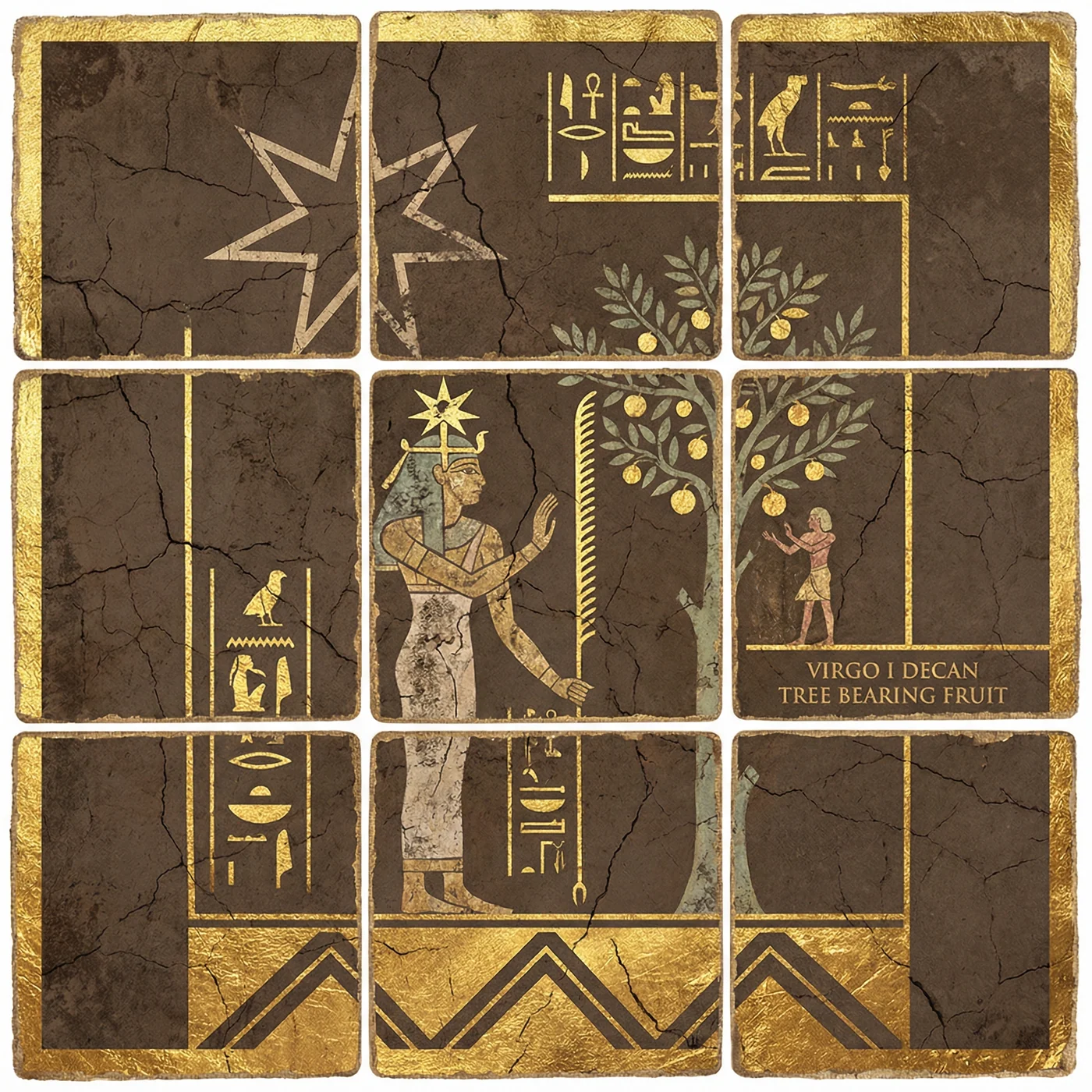
Think of the zodiac as a great mansion with twelve rooms. Most astrology stops at naming which room you occupy, but the rooms themselves are divided into three distinct chambers. These are the decans, from the Greek dekanos, meaning "ten-day period." Each decan spans exactly ten degrees of the zodiac and carries its own ruler, imagery, and essential character that refines and often contradicts the broader sign's reputation.
Where Leo as a sign speaks generally of leadership and creative fire, the three faces of Leo tell vastly different stories. The first decan, THE SPOTLIGHT, ruled by Saturn, manifests as the contested stage where leadership must be fought for and won. The second decan, A CROWN OF LAURELS, ruled solely by Jupiter, embodies the triumph already achieved, the victory already secured. The third decan, THE BANNER, ruled by Mars, represents the embattled defender, holding position against all challengers.
Notice how THE BANNER—the third face of Leo—carries martial undertones that have nothing to do with the sunny, generous Leo of popular astrology? This is why the face outranks the banner. The decan's specific imagery and rulership reveal truths that the sign's general character obscures.
The Ancient Inheritance
The decans emerged from Egypt's most practical needs. The ancient Egyptians divided their calendar into thirty-six ten-day periods, each presided over by a different star group rising before dawn. These weren't abstract symbols but functional timekeepers, agricultural guides, and spiritual markers rolled into one. A farmer knew which decan governed the current period by watching which stars announced the sunrise.
When Hellenistic astrologers encountered this Egyptian wisdom, they recognized something profound: these weren't just calendar markers but discrete spiritual territories, each with its own governing intelligence and practical influence. The marriage between Egyptian star-lore and Greek philosophical astrology gave birth to the system we've inherited—thirty-six faces, each carrying its own planetary ruler, imagery, and magical signature.
The medieval Arabic astrologers refined this inheritance further, creating the vivid imagery that still defines each decan today. When they gazed into the first decan of Aries and saw a dark man with crimson eyes clutching a battle axe, they weren't inventing fantasy—they were documenting the spiritual reality they encountered within those specific degrees.
What Signs Cannot Tell You
Your sun sign gives you a general climate; your decan gives you the specific weather. Consider two people born in Scorpio: one in the first decan, A JAWBONE, ruled by Mars, and another in the third decan, A CROW, ruled by Venus. The first carries the crushing power of direct confrontation, the ability to break through resistance by sheer force of will. The second embodies something more complex—the intelligence that feeds on decay, finding nourishment in what others discard, wielding attraction as a form of subtle power.
Both are undeniably Scorpio in their intensity and depth, but their methods, their challenges, and their gifts could hardly be more different. Traditional Scorpio descriptions—mysterious, passionate, transformative—apply to both, but fail to capture the essential difference between the warrior's direct assault and the scavenger's patient opportunism.
This is where the tarot correspondence becomes illuminating. That first Scorpio decan connects to the Five of Cups in both the Rider-Waite-Smith and Thoth systems—disappointment, the hungry ghost energy that cannot be satisfied. The third decan corresponds to the Seven of Cups—debauch, the drunken indulgence that comes from too many options. Same element, same sign, completely different spiritual territories.
A Living Example
Consider someone born with their Sun at 25 degrees of Gemini, placing them firmly in the third decan, AN EXECUTIONER'S SWORD. This is not the playful, curious, endlessly adaptable Gemini of popular astrology. This is the face where decisions become final, where the multiplicity that defines Gemini reaches its breaking point and choices must be made.
This person might spend their youth agonizing over decisions, paralyzed by seeing too many sides of every question. But their gift—once developed—lies in making the difficult calls that others cannot. They become the editor who can cut a manuscript to its essence, the mediator who can end protracted disputes, the friend who tells you the truth you need to hear. Their Gemini intelligence serves not exploration but resolution.
The traditional rulership places Saturn in this decan, lending gravity and finality to what would otherwise remain perpetually open-ended. The tarot correspondence—the Ten of Swords—speaks of ruin but also completion, the necessary ending that allows new beginnings. This is not Mercury's Gemini of endless questions but Saturn's Gemini of ultimate answers.
Such a person might recognize themselves in moments of crisis when everyone else remains frozen by complexity, but they somehow cut through to clarity. They might notice how their presence changes group dynamics, how conversations that have been circling for hours suddenly reach conclusions. This is the specific gift of their decan, something no general Gemini description could predict.
Working with Your Face
To engage your decan's full power, you must first discover its specific imagery and rulership. This requires precision—not just knowing your Sun sign, but knowing the exact degree of your Sun's position at birth. Once you identify your decan, you can begin working with its particular planetary ruler through focused practice.
If your Sun falls in THE PLOW, the first decan of Taurus ruled by Mercury, you might develop the mercurial aspects of your earthy nature through writing about practical subjects, teaching craft skills, or becoming fluent in the language of material transformation. If you belong to THE OVERFLOWING CUP, the third decan of Cancer ruled by Jupiter, you could cultivate the abundant, generous aspects of your emotional nature while learning to manage the discontent that comes with plenty.
The imagery itself serves as a meditation focus and practical guide. THE GYROSCOPE of Libra III suggests maintaining balance through constant subtle adjustments. A STRING OF PRAYER BEADS in Taurus III points toward patient, repetitive practices that slowly accumulate spiritual merit. THE KNOT of Aquarius III indicates both the binding that creates structure and the puzzle that demands solution.
Each decan also carries challenging expressions alongside its gifts. THE SPOTLIGHT of Leo I can manifest as the desperate attention-seeker rather than the natural performer. THE NET of Pisces II can become the trap that ensnares rather than the tool that gathers abundance. Working consciously with your decan means accepting both its light and shadow expressions, understanding how its gifts can become distortions when misapplied.
Beyond the Generalities
The decans restore astrology's precision and depth, rescuing it from the vague generalities that make horoscope columns possible but render personal insight impossible. They remind us that the ancient astrologers were not dealing in psychological types or personality categories but in specific spiritual technologies, each calibrated to particular degrees of the zodiac.
When you know your decan, you possess something far more useful than a sign description. You have a specific practice, a particular imagery, a focused planetary energy to cultivate. You have a face, not just a banner—an individual expression of cosmic principle rather than a generic tribal affiliation.
This is why serious astrology has always been personal astrology. The birth chart reveals not just where you belong generally, but where you stand specifically within the great mandala of celestial influences. Your decan is your precise spiritual address, the exact coordinates of your cosmic citizenship.
The 36 Codex offers personalized books that map every decan in your complete birth chart, revealing not just your Sun's face but the specific imagery and rulership that govern your Moon, your rising sign, and every planetary placement. This is astrology restored to its original precision—not fortune-telling, but spiritual cartography of the highest order.