The 15/6 pair — desire's chain and desire's freedom.
You know the moment when you realize you've been living someone else's life. It arrives without fanfare—perhaps while brushing your teeth, or sitting in traffic, or lying awake at three in the morning. The recognition cuts clean: this job, this relationship, this careful arrangement of days was never your choice at all. You inherited it, the way you inherited your eye color or your tendency toward worry. And suddenly you understand that what you call freedom has been an elaborate performance of captivity.
This is the great revelation that runs like lightning between two of the tarot's most potent archetypes: The Lovers and The Devil. Where The Lovers speaks of conscious choice and authentic union, The Devil reveals the unconscious bondage that masquerades as decision. They are not opposites but intimates, locked in the eternal dance of liberation and enslavement that defines human existence. To understand one without the other is to miss the profound truth they offer together: that freedom and bondage are often indistinguishable until examined with ruthless honesty.
The Architecture of Inheritance
Every choice you make today was shaped by choices made long before you were born. Your great-grandmother's decision to stay in an unhappy marriage rather than face social exile. Your grandfather's choice to bury his artistic dreams in favor of steady wages. Your parents' unconscious agreement to repeat patterns they swore they would never replicate. These choices, made in boardrooms and bedrooms, in moments of desperation and resignation, become the invisible architecture of your life.
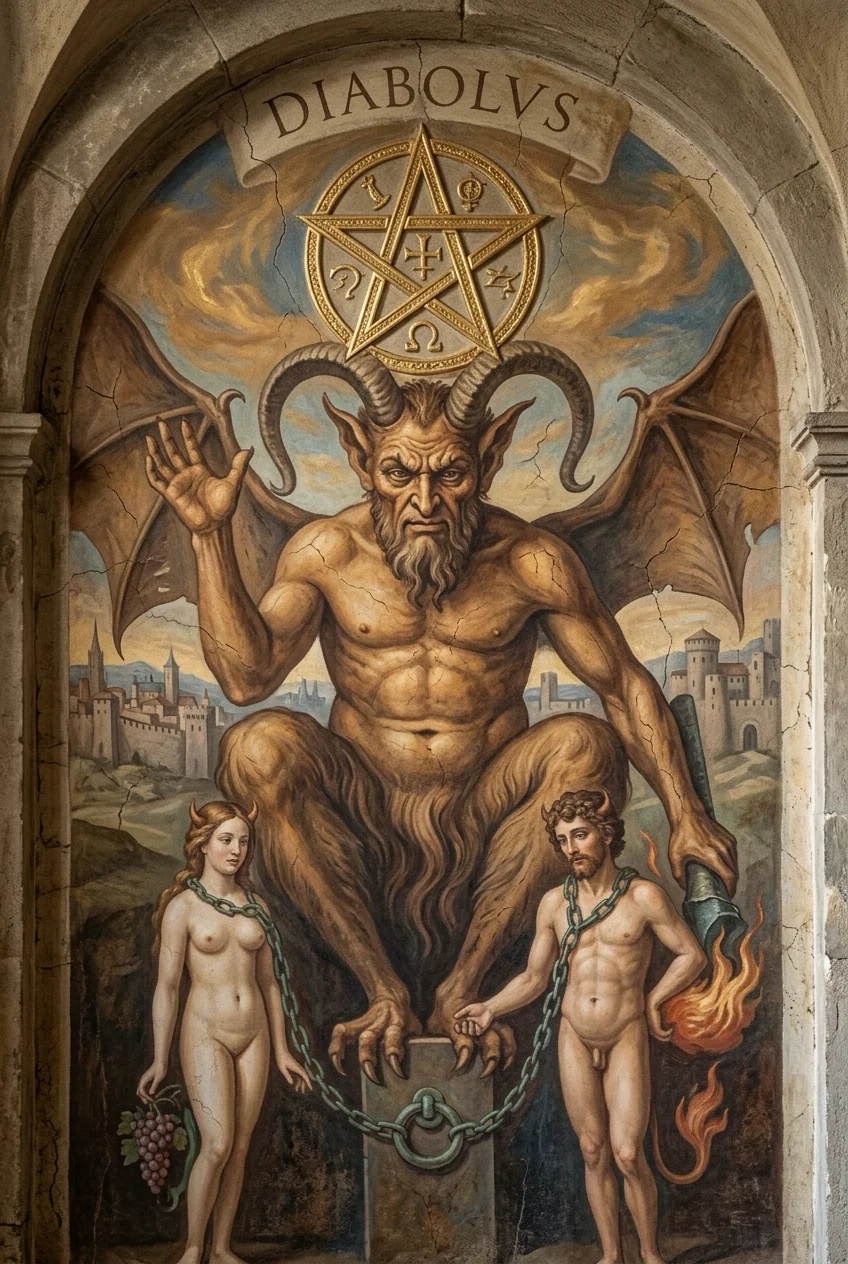
The Devil card reveals this architecture in all its seductive horror. In the Rider-Waite-Smith image, two figures stand chained before a horned creature, but their chains are loose enough to slip off. They could leave at any time, yet they remain. This is the card's terrible wisdom: most of our bondage is self-imposed, maintained not by external force but by the conviction that we have no other choice.
The chains are forged from inherited beliefs about what is possible, what is safe, what is acceptable. "People like us don't do that." "Money doesn't grow on trees." "Love is supposed to hurt." "You can't have everything you want." These phrases, heard in childhood and absorbed like poison, become the metal that binds us to lives we never consciously chose.
The astrological correspondence deepens this understanding. The Devil governs Capricorn, the sign of structure, authority, and social climbing. But Capricorn's shadow is the prison of respectability, the golden handcuffs of status, the slow suffocation that comes from building a life designed to impress others rather than fulfill the self. In Capricorn's energy, we see how bondage often wears the mask of success, how the very achievements we pursue can become the bars of our cage.
The Cruel Mercy of Choice
The Lovers card appears to offer the antidote to The Devil's bondage—the promise of authentic choice. In its imagery, a man stands between two women beneath the watchful eye of an angel. The scene depicts not just romantic choice but the fundamental human capacity to select one path over another, to exercise the will in service of the heart's true calling.
Yet The Lovers contains its own shadow. Choice, once made, eliminates all other possibilities. To choose one love means rejecting all others. To choose one path means abandoning a thousand alternatives. The very act of choosing creates its own form of bondage—the bondage of commitment, of responsibility, of living with consequences.
This paradox finds its most acute expression in the second decan of Gemini, known as THE HERMAPHRODITE. This face of the zodiac, ruled by Mars and Venus in eternal tension, corresponds to the Nine of Swords—a card depicting a figure awake in torment, surrounded by the blades of cruel thought. Here we see the agony of the mind that recognizes its dual nature but cannot reconcile the contradictions. Angel and demon, lover and warrior, creator and destroyer—all exist simultaneously within the same consciousness.
The hermaphrodite represents the moment before choice, when all possibilities remain open but their very multiplicity becomes a form of torture. This is the cruel mercy of consciousness: to see clearly what we are, in all our contradictory glory, and to understand that choosing one aspect means temporarily abandoning others. The mind that accepts these oscillations, that learns to flow between love and war, solve and coagulate, attains what the old texts call "infamous and dishonest agility"—the ability to be fully present to whatever the moment demands.
The Alchemy of Authentic Decision
Between the unconscious bondage of The Devil and the paralyzing multiplicity revealed by The Lovers lies a third possibility: the alchemy of authentic decision. This process begins with the recognition that most of what we call choice is actually compulsion dressed in the clothes of free will. We choose the job that pays well rather than the work that feeds our soul. We choose the relationship that looks good on paper rather than the love that sets us on fire. We choose the life that makes sense to others rather than the existence that makes sense to us.
The first step in this alchemy is developing what the ancient texts call "sober judgment in the face of difficult questions." This means learning to distinguish between choices made from fear and choices made from desire, between decisions that serve our authentic nature and decisions that serve our inherited programming.
Consider Sarah, a successful attorney who spent fifteen years climbing the corporate ladder before recognizing that her entire career was an elaborate attempt to win her father's approval—a father who had died when she was twelve. Her "choice" to pursue law was actually a form of bondage to a ghost, a desperate attempt to complete a conversation that would never be finished. The recognition arrived like lightning: she was living someone else's dream of success while her own dreams atrophied in darkness.
Sarah's breakthrough came not through abandoning her legal training but through asking a different question: "If I were designing my life for my own approval rather than his memory, what would I choose?" The answer led her to environmental law, then to starting her own practice focused on protecting indigenous land rights. She kept the skills but transformed the intention, alchemizing bondage into authentic choice.
The Practice of Conscious Choosing
The movement from unconscious bondage to authentic choice requires developing what might be called "decanal consciousness"—the ability to recognize which archetypal energy is driving our decisions in any given moment. Are we choosing from the inherited patterns of our family lineage, or from the authentic impulse of our individual nature?
This recognition begins with tracking the bodily sensations that accompany our choices. Bondage feels different in the body than freedom. Inherited patterns often produce a subtle constriction, a sense of effort or obligation that requires pushing through resistance. Authentic choices tend to generate expansion, even when they involve sacrifice or difficulty. The body knows the difference between chosen difficulty and imposed suffering.
The practice involves learning to pause at moments of decision and ask: "Is this choice expanding my authentic nature or constraining it? Am I choosing from love or from fear? Am I selecting what serves my deepest values or what serves my inherited programming?" These questions don't provide easy answers, but they illuminate the unconscious forces at work in our decision-making process.
The goal is not to eliminate all constraints—some degree of structure and commitment is necessary for a functional life. Rather, the aim is to consciously choose our constraints, to select the forms of bondage that serve our authentic development rather than unconsciously accepting those imposed by circumstance or inheritance.
The Inheritance of Freedom
The deepest teaching of The Devil and The Lovers working in harmony is that we can transform the very patterns we inherited from bondage into choice. The family tendency toward addiction can become a gift for understanding altered states of consciousness. The generational pattern of abandonment can evolve into a fierce commitment to presence. The inherited fear of scarcity can transform into a deep appreciation for abundance in all its forms.
This transformation requires recognizing that we are both heir and ancestor—receiving the patterns of those who came before while simultaneously creating the patterns we will pass to those who come after. Every authentic choice we make weakens the chains of unconscious inheritance not just for ourselves but for the entire lineage, forward and backward through time.
The ultimate freedom is not the absence of bondage but the conscious choice of which bonds to accept. In choosing our constraints wisely, in selecting our commitments from love rather than fear, we transform bondage itself into a form of liberation. The chain becomes an anchor, the prison becomes a sanctuary, and what once felt like limitation reveals itself as the very structure that makes authentic expression possible.
Your personal astrological blueprint contains the complete map of this journey—the inherited patterns encoded in your family lineages, the authentic choices available to your individual nature, and the specific alchemical processes through which bondage transforms into freedom. The Book of the Self reveals these patterns in exquisite detail, showing you not just what you inherited but how to transform that inheritance into conscious choice.