Where to look, what to round, and why 9° and 11° are different lives.
You've felt it before—that moment when someone describes your zodiac sign and gets half of it right, but misses something essential. The description captures part of you, perhaps the broad strokes, but leaves out the specific flavor that makes you unmistakably you. A Scorpio who burns with Venus rather than broods with Mars. A Leo whose crown feels heavy with responsibility instead of light with glory. The missing piece isn't in your Moon sign or your rising sign. It's in the face your Sun actually wears.
Every sign of the zodiac has three faces, called decans. Each decan spans exactly ten degrees and carries its own planetary ruler, its own mythology, its own particular genius. While popular astrology treats all Leos the same, or all Virgos as identical, the ancient tradition knew better. The Leo born in the first ten days of the sign walks with THE SPOTLIGHT—ruled by Saturn, carrying the weight of performance and the burden of being watched. The Leo born in the middle ten days claims A CROWN OF LAURELS—ruled by Jupiter alone, embodying pure solar victory. The final Leo carries THE BANNER—ruled by Mars, defending territory with valor that borders on defiance.
The Ancient Division of Time and Space
The decan system reaches back to ancient Egypt, where priest-astronomers divided the night sky into thirty-six sections, each ruled by a different star group that rose heliacally throughout the year. These weren't abstract mathematical divisions—they were living powers, each with its own personality, its own gifts, its own shadows. The Egyptians painted these figures on coffin lids and temple walls, understanding that time itself had texture, that each ten-day period carried a distinct spiritual fingerprint.
When the Greeks encountered this system, they married it to their own planetary gods, creating the Chaldean order that still governs our understanding today. Mars, Venus, Mercury, Moon, Saturn, Jupiter, Sun—this sequence repeats three times around the zodiac, but never mechanically. Each decan takes its planetary ruler and filters it through the element and quality of its host sign, creating something entirely new.
The system survived the fall of empires precisely because it worked. Medieval Arabic astrologers preserved the decan images in texts like the Picatrix. Renaissance mages like Heinrich Cornelius Agrippa catalogued their powers in grimoires. The tradition adapted and evolved, but never lost its essential insight: the zodiac isn't twelve uniform bands of energy. It's thirty-six distinct faces, each with its own story to tell.
The Planetary Rulers and Their Secret Logic
Understanding your decan means understanding its ruler, but not in the way you might expect. When we say Taurus II—A LINGA-YONI—is ruled by both Venus and Saturn, we're not talking about a simple blend. We're describing an alchemical marriage, a sacred union that creates something that transcends both planets individually.
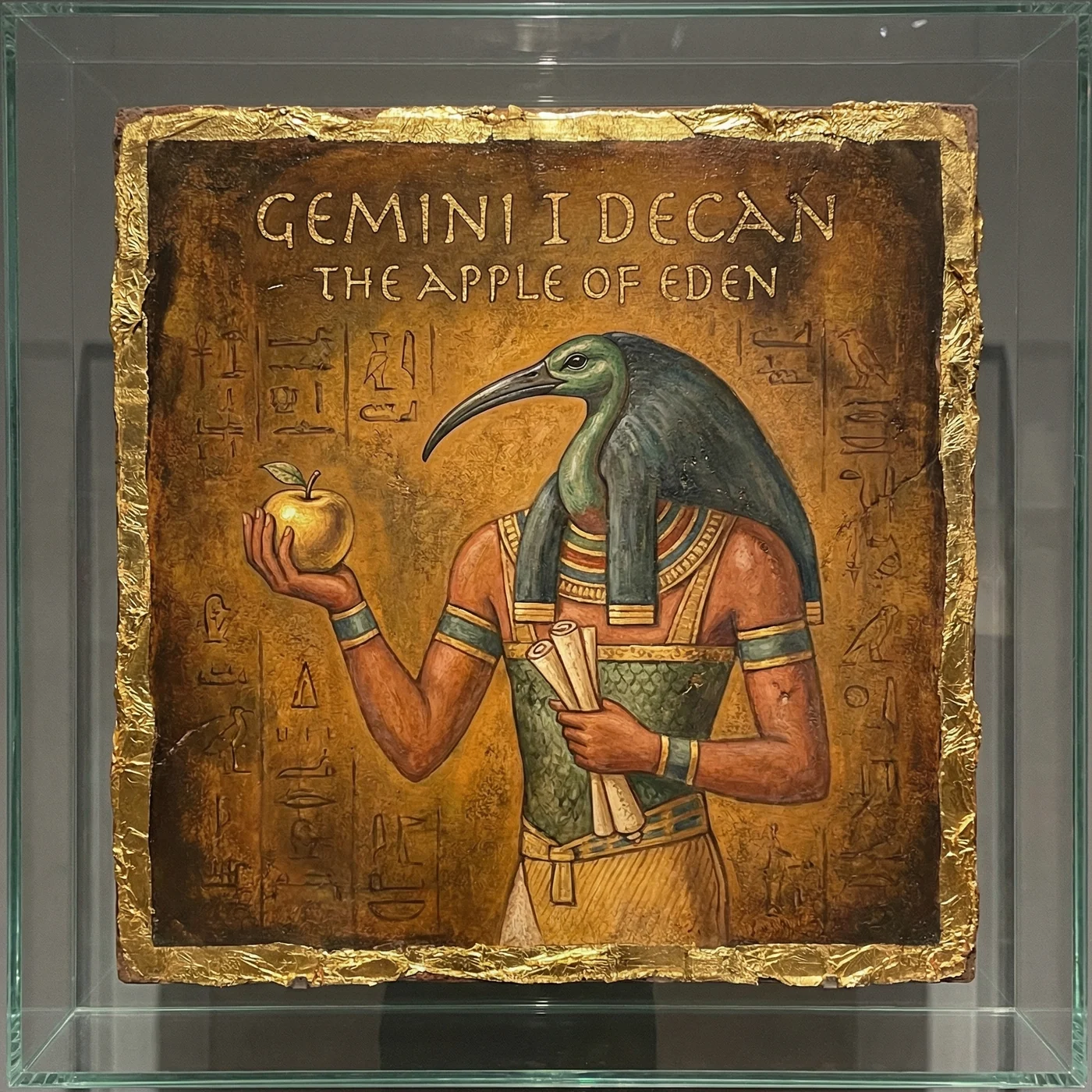
Consider Gemini I, THE APPLE OF EDEN, ruled by Jupiter and Mercury. This isn't Mercury's usual quick-silver chatter expanded by Jupiter's enthusiasm. It's the dangerous wisdom that comes from infinite options, the paralysis that strikes when you can see every possibility simultaneously. The tarot card assigned to this decan—the Eight of Swords, called "The Prison of Options"—captures this perfectly. You're not trapped by external circumstances but by your own ability to perceive too much, know too much, want too much at once.
Or take Scorpio II, AN APPARATUS FOR MUTUAL DISTILLATION, ruled by the Sun and Jupiter. Here, Scorpio's natural intensity becomes a transformational furnace. Instead of the typical Scorpio dwelling in emotional depths, this decan offers the alchemical promise of purification through pleasure. The Six of Cups—"The Alchemical Union"—suggests that the deepest transformations come not through suffering but through joy consciously embraced.
Each decan's ruling planets tell a story about how that particular slice of the zodiac processes experience. They reveal not just what you do, but how you do it—the specific mechanism by which you transform raw life into meaning.
The Tarot Mirror: Seeing Your Process
Every decan corresponds to one of the numbered cards in the minor arcana, and these connections illuminate the decan's inner workings with startling precision. The cards don't predict what will happen to you—they reveal the psychological and spiritual process that's always happening within you.
Take Cancer III, THE OVERFLOWING CUP, ruled by the Moon and Jupiter. Its tarot correspondence is the Four of Cups, called "Luxury" in the Thoth system and "The Discontent of Plenty" in the Rider-Waite tradition. If you were born in the final ten degrees of Cancer, this card shows you your core pattern: abundance that somehow feels insufficient, plenty that breeds its own peculiar emptiness.
This isn't a character flaw—it's a spiritual technology. The restless discontent you feel in the presence of material satisfaction is designed to drive you toward something deeper. Your sensitivity to what's missing, even when you have everything you thought you wanted, is precisely what makes you capable of perceiving the sacred in the ordinary.
Or consider Capricorn II, THE PYRAMID, ruled by Mars and Venus. Its card is the Three of Pentacles—"Works" or "The Master Builder." Here we see how Capricorn's natural ambition gets channeled through the collaboration between Mars (action) and Venus (harmony). You don't just build for the sake of achievement—you build to create something beautiful that will outlast you. Your success depends not on solitary grinding but on your ability to orchestrate the talents of others toward a shared vision.
A Living Example: The Crown and Its Weight
Imagine someone born on August 7th, placing their Sun in Leo II—A CROWN OF LAURELS. Traditional astrology would simply call them a Leo and speak of pride, generosity, natural leadership. But the decan reveals something more specific and more useful.
Leo II is ruled by Jupiter alone among the fire decans, making it a concentration of pure solar-Jupiterian energy. This person doesn't just want attention—they want to be worthy of it. The crown of laurels isn't inherited; it's earned through victory, through proving oneself in actual competition or challenge. Their tarot card, the Six of Wands—"Victory" or "The Triumph"—shows a figure receiving acclaim, but the acclaim comes after the battle, not before it.
In practice, this means they're driven not by ego but by the desire to embody an ideal. They feel the weight of being watched, judged, measured against some standard of excellence. Unlike Leo I, which struggles with the performance aspect of visibility, or Leo III, which fights to defend its position, Leo II seeks to transcend through achievement. They understand instinctively that real authority comes from demonstrated competence, not claimed privilege.
This person might find themselves repeatedly thrust into situations where they must prove themselves—not because they seek conflict, but because their energy naturally invites others to test them. The crown of laurels must be won fresh in each arena they enter. Their challenge isn't learning to lead, but learning that victory without virtue becomes hollow, that the crown loses its meaning if worn without wisdom.
Working with Your Decan
Once you know your decan, you can begin to work with its specific energy consciously. This isn't about changing who you are—it's about understanding the particular spiritual technology you were born with and learning to use it with greater skill and awareness.
If your Sun falls in Pisces I, A LABYRINTH, ruled by Saturn and Jupiter, you can stop apologizing for your tendency to take circuitous routes toward your goals. Your apparent indirectness isn't inefficiency—it's your psyche's way of gathering the full experience, of allowing the solution to ripen in its own time. The Eight of Cups, your corresponding card, shows a figure walking away from material success toward something unknown but spiritually necessary. Your gift lies in knowing when to leave, when the next phase of growth requires abandoning what you've already built.
Or if you're born under Virgo III, THE SARCOPHAGUS, ruled by Mercury alone, you can understand why you're drawn to situations that require total commitment, complete immersion. The Ten of Pentacles—"Wealth" or "The Inheritance of the Earth"—suggests that your meticulous attention to detail isn't mere perfectionism but a form of devotion, a way of honoring the sacred through absolute presence to the material world.
Working with your decan means studying its symbols, meditating on its ruling planets, and paying attention to how its tarot card shows up in your life. It means recognizing that your particular way of being human isn't random but follows an ancient pattern with its own logic, its own gifts, its own necessary shadows.
The degree is the doorway because it leads you from generic astrology into your specific cosmic inheritance. Your decan is your face in the zodiac, your particular expression of universal themes, your unique contribution to the great conversation between heaven and earth.
For those seeking to explore their complete decanal nature—including the positions of all their planets within the thirty-six faces—The Book of the Self offers the full mapping of your personal cosmos, revealing how each planet in your chart expresses itself through its decan's specific wisdom.