Why the deepest readings are the ones you write yourself.
You sit with your birth chart spread before you—not on a screen, but drawn by hand on paper. The lines feel different when traced by pencil rather than pixels. Each glyph carries the weight of ink, each aspect line crosses the page with deliberation. Something shifts in this analog encounter. The chart becomes less information and more conversation, less data and more dialogue with the deeper currents of your existence.
This is the practice that precedes all others: the slow, meditative construction of your natal chart by hand. Not because technology fails us, but because something essential awakens only through the marriage of contemplation and craft. When your fingers guide the compass to mark the horizon, when you calculate each planetary position and inscribe it with intention, the chart transforms from abstract symbol into living mandala.
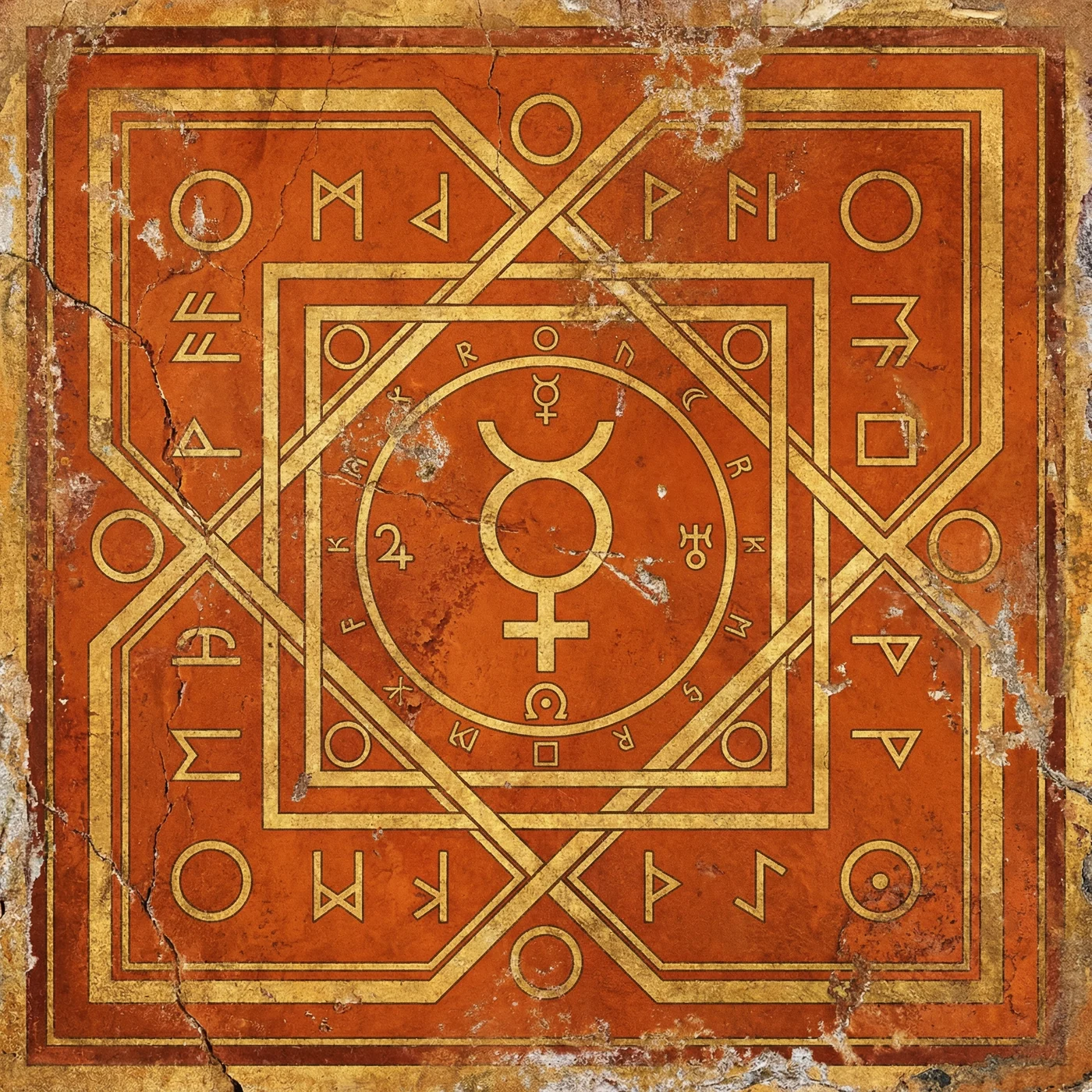
The Ancient Art of Manual Construction
The tradition of hand-drawn charts stretches back to Mesopotamian clay tablets, where the first astrologers carved celestial positions into wet earth with reed styluses. These early practitioners understood something we have nearly forgotten: the physical act of chart construction is itself a form of divination. Each calculation engages both intellect and intuition, each plotted degree builds relationship between astrologer and cosmos.
The medieval Arabic astrologers elevated this practice to high art. They would spend entire nights constructing a single chart, consulting astrolabes and ephemeris tables by candlelight. The deliberate pace was not inefficiency but wisdom—time allowed the chart's deeper patterns to emerge through contemplation. As each planetary position was calculated and inscribed, the astrologer entered deeper communion with the celestial story being revealed.
In our age of instant gratification, we have mistaken speed for precision and automation for accuracy. Yet the masters knew that astrology's deepest truths emerge not from rapid calculation but from sustained engagement. The hand-drawn chart becomes a meditation in circular time, where past calculations inform present understanding, and each revisit reveals new layers of meaning.
What Manual Practice Reveals
When you construct your chart by hand, you discover nuances that remain invisible in digital renderings. The slight tremor in your hand as you mark a difficult conjunction—this too becomes part of the reading. The places where you pause to double-check calculations often mark the chart's most significant features, as if your unconscious already recognizes what your conscious mind has yet to understand.
The physical act of drawing each aspect line creates embodied awareness of the chart's energy flows. You feel the smooth arc of a trine as your pencil glides across the paper, sense the sharp tension of a square as you connect points that resist connection. These kinesthetic impressions add dimension to intellectual understanding, creating what the ancients called "practical wisdom"—knowledge that lives in the body as well as the mind.
Consider the difference between reading about the opposition between your natal Mars and Saturn versus drawing that aspect line with your own hand. In the manual process, you must pause at each degree of separation, feeling the distance between planets as physical distance on paper. This embodied measurement often reveals timing patterns invisible in digital charts—the way certain transits will trigger this aspect through geometric resonance, or how the aspect's tension manifests differently in various life areas.
The Journaling Integration
Once constructed, the hand-drawn chart becomes the foundation for a deeper practice: chart journaling. This involves returning to your natal mandala regularly—weekly or monthly—and adding new layers of observation and insight. You might mark current transits in different colored ink, noting how they activate various natal configurations. You might add marginal notes about life events that correlate with specific aspects or planetary periods.
The practice reveals the chart as living document rather than fixed blueprint. Your understanding of a particular planetary placement deepens through years of observation and experience. That Mars in your seventh house meant one thing at twenty, another at forty. The hand-drawn chart, revisited and annotated over time, becomes a visual record of your evolving relationship with your own celestial signature.
Some practitioners develop personal notation systems—small symbols for significant dreams, color coding for different types of insights, or geometric patterns that represent recurring themes. These additions transform the chart from formal diagram into personal grimoire, a unique visual language that bridges conscious analysis with unconscious knowing.
A Worked Example: The Third Decan of Gemini
Consider how manual construction might illuminate a challenging placement: the Sun in Gemini III, THE EXECUTIONER'S SWORD. When you calculate this position by hand, you encounter its complexity through direct engagement. First, you determine the exact degree—perhaps 27 degrees Gemini. As you mark this position, you realize its proximity to the sign boundary, feeling the approaching transition into Cancer.
Drawing the aspects to this placement, you discover a tight square to Saturn in Virgo II, THE HAMMER AND THE ANVIL. The aspect line cuts across the chart's center, creating visual tension on the page. This physical representation helps you understand the placement's core challenge: the mutable, exploratory nature of Gemini III constantly opposed by Saturn's demand for practical mastery and disciplined craft.
In your chart journal, you might note how this configuration manifests during Mercury retrograde periods, when the ruler of your Gemini Sun appears to move backward. You observe how these times bring not confusion but clarity—periods when you must choose between multiple possibilities, wielding THE EXECUTIONER'S SWORD to cut away options that no longer serve growth. The manual practice reveals patterns invisible to quick digital consultation.
The Daily Contemplation
The completed hand-drawn chart becomes object for daily contemplation. Unlike screen-based charts that require devices and electricity, your paper mandala remains constantly accessible. Many practitioners develop a morning practice of spending ten minutes with their chart, allowing current concerns or questions to dialogue with natal potentials.
This contemplative approach often yields insights unavailable through analytical study. You might notice that your eye consistently returns to a particular house, or that certain planetary symbols seem to pulse with relevance to current circumstances. These non-linear perceptions complement rational interpretation, adding intuitive depth to intellectual understanding.
The practice also cultivates patience—the essential virtue for any serious astrological work. In our age of instant gratification, we expect immediate answers from our charts. Manual practice teaches a different rhythm, one aligned with the slow dance of planetary cycles. You learn to sit with questions, to allow understanding to ripen through time rather than forcing premature conclusions.
The physical chart also weathers with you. Coffee stains and pencil smudges accumulate, creating patina that reflects your journey with the work. Some practitioners frame their charts and hang them where they can be seen daily, while others keep them folded in journals or meditation spaces. The chart becomes talisman as well as tool, a physical anchor for ongoing relationship with cosmic forces.
When you work with chart by hand, you join an unbroken lineage stretching back millennia. Your careful calculations echo those performed by ancient Babylonian astronomers, your contemplative engagement mirrors medieval Arabic astrologers working by lamplight. This continuity with tradition adds weight to the practice, connecting personal insight with collective wisdom.
The Book of the Shadow offers complete instructions for manual chart construction alongside traditional calculation methods, ensuring this ancient art continues into future generations of serious practitioners.