The one who beautifies — and the one who bargains with beauty.
You know the moment when desire becomes dangerous. Not the safe wanting of things you can purchase or achieve, but the terrifying magnetism that pulls you toward another person so completely that your carefully constructed boundaries dissolve. In that instant, you are no longer yourself but something larger and more vulnerable—a creature capable of creation and destruction in equal measure. This is Venus awakened, the Lover archetype in its full glory and terror.
The Lover is not the romanticized figure of greeting cards or the surface pleasure-seeker of consumer culture. It is the primordial force that drives all connection, the cosmic principle that draws disparate elements into union. When Venus rises in your chart, she carries with her the promise of beauty, harmony, and fulfillment—but also the shadow of obsession, dependency, and the loss of self in another.
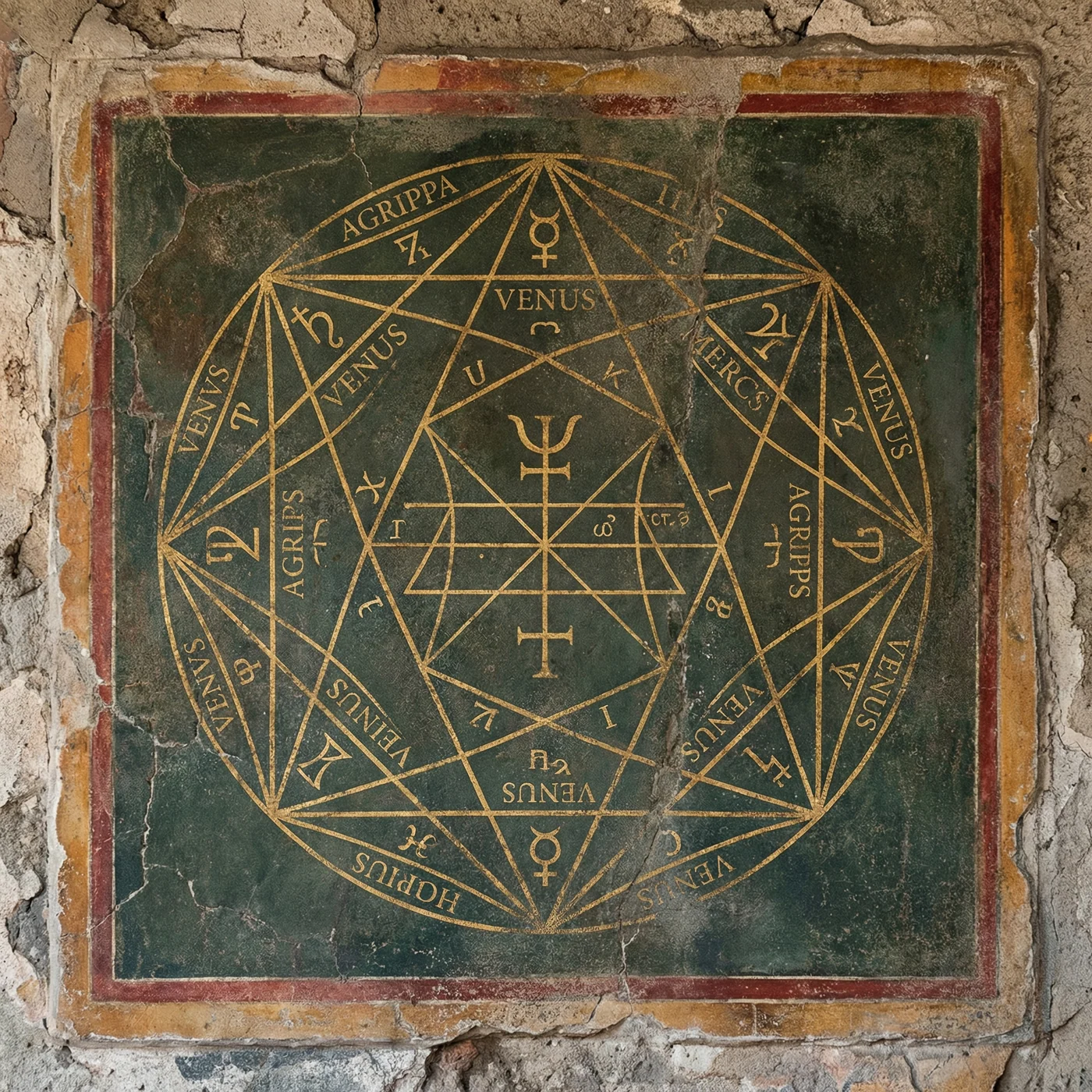
The Architecture of Desire
Venus operates through a profound paradox: she creates unity by first creating separation. Before there can be love, there must be two distinct beings aware of their apartness. Before there can be beauty, there must be an observer separate from the observed. The Lover archetype exists in this tension between autonomy and merger, between the fierce independence that makes love possible and the surrender that makes it meaningful.
In the ancient cosmology, Venus was understood as the force that draws the elements together—not through compulsion like Mars, but through irresistible attraction. She is the magnetism that pulls iron to lodestone, the gravity that binds planets in their dance, the mysterious chemistry that transforms two separate lives into something unprecedented. Yet this same force that creates can also consume.
Consider Venus in her fall in Virgo II, THE HAMMER AND THE ANVIL, where her desire-nature meets Saturn's harsh discrimination. Here, the Lover learns the excruciating lesson of refinement through rejection. Those born with Venus in this decan often experience love as a forge where their natural affections are hammered into more precise and worthy forms. They may attract partners who challenge their every assumption about what love should be, forcing them to separate true intimacy from mere sentiment.
The shadow here manifests as perfectionism in relationships—the crushing need to craft the perfect partner or become the perfect beloved. These natives may find themselves perpetually disappointed by the human messiness of actual love, preferring the clean lines of their expectations to the organic chaos of genuine connection. Yet when they embrace the anvil's teaching, they develop an extraordinary capacity for lasting, grounded partnerships that improve with age.
The Exaltation and the Fall
Venus reaches her highest expression in Pisces, particularly in Pisces III, A CUP OF BLOOD, where the traditional degree of exaltation falls. Here, the Lover archetype transcends personal desire and touches the universal. Those born with Venus in this decan possess an almost supernatural ability to magnetize their deepest desires. Their very presence seems to bend reality toward beauty, drawing forth hidden possibilities from the people and situations they encounter.
Yet this blessing carries its own curse. With Venus so potent in Pisces III, desires operate independently of conscious will. These natives may find themselves pursued by phantoms from their unconscious, attracting not just what they want but what they fear they want. A woman with Venus in this decan once confided that she repeatedly attracted men who embodied her father's worst qualities, even though consciously she sought something entirely different. Only when she began to examine the shadowy desires that lived beneath her conscious preferences did her magnetism begin to serve her rather than torment her.
In her traditional detriment in Aries I, THE AXE, Venus faces her greatest challenge. Here, the Lover must learn to maintain connection while preserving individual fire. Those born with Venus in this decan often struggle with the compromise inherent in partnership. They understand dominance and submission but find the subtle negotiations of equality baffling. Their brightness of spirit is undeniably magnetic, yet they may repeatedly choose solitude over the complex dance of mutual accommodation.
The shadow of Venus in Aries manifests as the warrior-lover who conquers rather than courts, who takes rather than receives. These natives may mistake intensity for intimacy, confusing the thrill of pursuit with the satisfaction of genuine partnership. Yet when they learn to channel their independence not as a weapon against connection but as a gift they bring to it, they become capable of extraordinarily dynamic and vital relationships.
The Sacred Marriage
The deepest teaching of the Lover archetype appears in Gemini II, THE HERMAPHRODITE, where Venus rules alongside Mars in the ancient system. This decan presents the image of the sacred marriage—not the union of two people, but the integration of the masculine and feminine principles within a single being. Here, desire learns to embrace paradox rather than resolve it.
Those born with significant placements in this decan carry within themselves the eternal dialogue between receptivity and assertion, between yielding and claiming. They may find themselves attracted to partners who embody whichever principle they have not yet integrated within themselves. A man might repeatedly fall in love with women who express the fierce independence he has disowned; a woman might be drawn to partners who exhibit the tender vulnerability she fears to show.
The shadow here manifests as the perpetual search for the other half—the belief that completion must come from outside rather than from within. These natives may exhaust themselves and their partners in the attempt to create externally what can only be resolved internally. Yet when they recognize that every relationship is ultimately a mirror of their own inner wholeness or division, they begin to use love as a path of self-discovery rather than self-completion.
Working with Venus's Dark Light
The Lover archetype demands a sophisticated relationship with shadow. Unlike other planetary forces that can be approached with relative safety, Venus work inevitably stirs the deepest chambers of the psyche where our most primitive needs for connection and validation reside. To work with Venus consciously is to court both ecstasy and terror.
Begin by examining your own patterns of attraction. What qualities in others consistently magnetize you? What types of people or situations do you find yourself repeatedly drawing into your life? Venus reveals herself not through our conscious preferences but through the unconscious magnetism that operates beneath our awareness. The man who claims to want a gentle, supportive partner yet inevitably becomes involved with brilliant, sharp-tongued women is experiencing Venus through projection—his own suppressed quick wit and intellectual fire drawing its complement from the external world.
The practice involves learning to own your projections without losing the capacity for genuine attraction. This is delicate work. The goal is not to become self-sufficient in some sterile way, but to bring consciousness to the dance of desire so that your attractions serve your growth rather than your compulsions. When you can recognize your own hidden qualities in what attracts you, you begin to love from wholeness rather than neediness.
Venus also teaches through aesthetic experience. Cultivate beauty not as decoration but as a form of prayer. Surround yourself with objects, environments, and experiences that genuinely move you—not what you think should move you, but what actually stirs something alive in your depths. Venus awakens through direct aesthetic encounter with the world. The painting that stops you in your tracks, the piece of music that brings unexpected tears, the natural scene that opens something in your chest—these are Venus teaching you about the structure of your own soul.
Pay attention to what you find beautiful in others, not just romantically but in all your relationships. Beauty here means whatever quality in another person makes them seem more fully themselves, more alive, more real. Venus operates through appreciation, and learning to see accurately—to recognize the actual beauty present rather than projecting beauty onto inappropriate objects—develops what could be called aesthetic discrimination.
The shadow work of Venus often involves facing the ways you have used beauty, charm, or desirability as manipulation rather than genuine expression. Most of us have learned to perform attractiveness rather than embody it, to use our Venusian qualities as tools for getting what we want rather than as authentic expressions of our nature. This creates a split between the public self that knows how to be appealing and the private self that fears it is not inherently lovable.
The Cup of Blood
In the deepest Venus work, we encounter what the tradition calls A CUP OF BLOOD—the recognition that all love involves sacrifice, that to truly connect with another requires the death of some version of ourselves. This is not the neurotic self-sacrifice that seeks to purchase love through service, but the conscious offering of our smaller, defended self to something larger.
The Cup of Blood teaches that genuine intimacy is always initiatory. To allow another person to truly see you, to let yourself be affected and changed by love, requires a kind of dying. The person who emerges from deep intimacy is never quite the same as the person who entered it. Venus at her most profound is a death-and-rebirth mystery disguised as romance.
This understanding transforms how we approach both solitude and partnership. Solitude becomes not a retreat from connection but a preparation for it—a time to develop the self-knowledge and inner stability that allows for genuine vulnerability. Partnership becomes not an escape from aloneness but a crucible for mutual transformation. The goal is not to find someone who will make you happy, but to become someone capable of creating beauty and meaning with another person.
For those called to work with Venus consciously, there comes a point where personal relationships become a form of spiritual practice. Not in some ethereal way that avoids the messiness of actual human connection, but in recognizing that love is one of the most powerful forces for awakening available to us. Every relationship becomes an opportunity to practice seeing truly, loving without attachment to outcome, and maintaining both autonomy and intimacy simultaneously.
The mature expression of Venus moves beyond the endless seeking of new attractions toward a deepening appreciation of what is actually present. This might mean finding ways to fall in love again and again with the same person, or learning to perceive the extraordinary beauty hidden within ordinary experience. It always involves the recognition that love is not something we find but something we create through the quality of our attention and the generosity of our presence.
Those who wish to explore their personal Venus signature more deeply—to understand how this archetype manifests through their specific birth pattern—will find detailed analysis in The Book of the Shadow, our comprehensive exploration of the shadow dynamics operating within individual charts.