Where the big story meets Tuesday afternoon.
You wake at three in the morning with your mind racing through tomorrow's presentation, next month's rent, and that conversation you should have had with your mother weeks ago. The thoughts spiral: practical concerns mixing with emotional tangles, creative impulses bumping against financial realities. This is not the realm of cosmic revelation or mythic transformation. This is Tuesday. This is your actual life, with its endless procession of small decisions, mundane struggles, and quiet victories. This is the territory of the Minor Arcana.
While the Major Arcana maps the soul's great journey through archetypal experiences—Death, The Star, The World—the fifty-six cards of the Minor Arcana document something far more intimate: the texture of human existence as it unfolds day by day. These are not the mountain peaks of spiritual awakening but the valleys where we actually live, work, love, and wrestle with the stubborn particulars of being embodied in time.
The Four Kingdoms of Experience
The Minor Arcana divides our ordinary reality into four distinct kingdoms, each governed by one of the classical elements. The Wands burn with the fire of creative will and spiritual ambition—these are your passionate projects, your drive to create something meaningful, your moments of inspired action. When you feel that electric surge of "I must do this thing," you have entered the realm of Fire.
The Cups flow with the water of emotional life and relationship—love affairs and heartbreak, the bonds of friendship, the complex choreography of intimacy. Every tear shed in joy or sorrow, every moment of communion with another soul, belongs to this watery domain. The Swords cut through the airy realm of thought and communication—your ideas and anxieties, the constant chatter of the mental realm, the way you perceive and judge your world. And the Pentacles ground us in the earth of material existence—money and work, health and security, everything that anchors spirit to form.
Each suit unfolds its story through the numbered cards, beginning with the raw potential of the Ace and culminating in the completed manifestation of the Ten. But it is in the middle numbers—the Fours through Nines—that we find the true genius of this system, for here we encounter the astrological decans, the thirty-six faces that divide the zodiac into its most precise psychological territories.
The Thirty-Six Faces of Time
Long before tarot existed, ancient astrologers recognized that each zodiacal sign contained three distinct faces, each lasting ten degrees and ruled by different planetary forces. The Egyptians called them the decans, and they used them to track both time and the subtle fluctuations of cosmic influence as it moved through the year. When the medieval and Renaissance mages began mapping these ancient divisions onto the emerging tarot system, they created something unprecedented: a precise symbolic language for the granular experiences of human life.
Consider the Seven of Pentacles, which corresponds to the third decan of Taurus, ruled by Saturn. This is the face called A String of Prayer Beads, and its card shows a figure leaning on a garden tool, gazing at crops that have been planted and tended but are not yet ready for harvest. Here is the exact psychological territory of patient waiting after effort has been expended—not the initial planting (Five of Pentacles) nor the final abundance (Eight of Pentacles), but that specific liminal space where you have done what you can and must now trust larger forces to bring fruition. Anyone who has ever waited for test results, job interviews responses, or creative projects to find their audience knows this precise flavor of suspended hope tinged with anxiety.
The ancient image for this decan captures something that Saturn's rulership makes clear: this is where we learn that our personal will, no matter how sincere or skillful, cannot control all outcomes. The prayer beads suggest the turning toward larger forces, the acknowledgment that some portion of every endeavor must be surrendered to time, circumstance, and grace. Yet this is not passive resignation—it is active patience, the mature recognition that life unfolds according to rhythms larger than our immediate desires.
The Precision of Lived Experience
What makes the Minor Arcana revelatory is its uncanny ability to name experiences that standard language cannot quite capture. The Nine of Swords, corresponding to the second decan of Gemini called The Hermaphrodite, depicts the specific torture of the mind at war with itself. This is not simple worry or even depression, but the particular anguish that comes from holding two contradictory truths simultaneously—loving someone who is wrong for you, wanting success while fearing it, believing in your dreams while knowing their practical impossibility.
The astrological correspondence reveals the deeper pattern: Gemini's natural duality amplified by the Mars-Venus rulership that sets the warrior and the lover in eternal conflict within the same psyche. The hermaphrodite of the decan's title represents not sexual ambiguity but psychological wholeness achieved through the marriage of opposites—yet the Nine of Swords shows us what this integration feels like from the inside before it is accomplished. It is the dark night of the divided soul, the nine blades of thought that pierce us when we cannot yet reconcile our contradictions.
This precision extends through all fifty-six cards. The Four of Cups captures not generic emotional dissatisfaction but the specific restlessness that comes from having achieved emotional security—the luxury that breeds its own discontent. The Eight of Wands shows not just speed but the particular momentum that builds when all obstacles to a creative project suddenly clear, when the universe seems to conspire in favor of your vision. The Two of Pentacles reveals the exact juggling act required when resources are limited but multiple priorities demand attention—not poverty or abundance, but the dynamic dance between competing necessities.
Working with the Ordinary Sacred
The Minor Arcana offers us something that purely spiritual or psychological systems cannot: a way of recognizing the sacred dimension within our most mundane concerns. Your Tuesday morning anxiety spiral contains the same archetypal energies that move planets and shape myths, but filtered through the particular circumstances of your incarnated life. The bills that need paying participate in the same cosmic dynamics as the building of temples; the difference is one of scale and awareness, not fundamental nature.
To work with these energies consciously begins with recognition. When you find yourself in the suspended space of the Seven of Pentacles, you can name it as such rather than simply suffering the unnamed tension. This naming transforms anxiety into participation in a known cosmic pattern—you are not merely worried about outcomes but actively engaged in the archetypal process of surrendering personal will to larger timing.
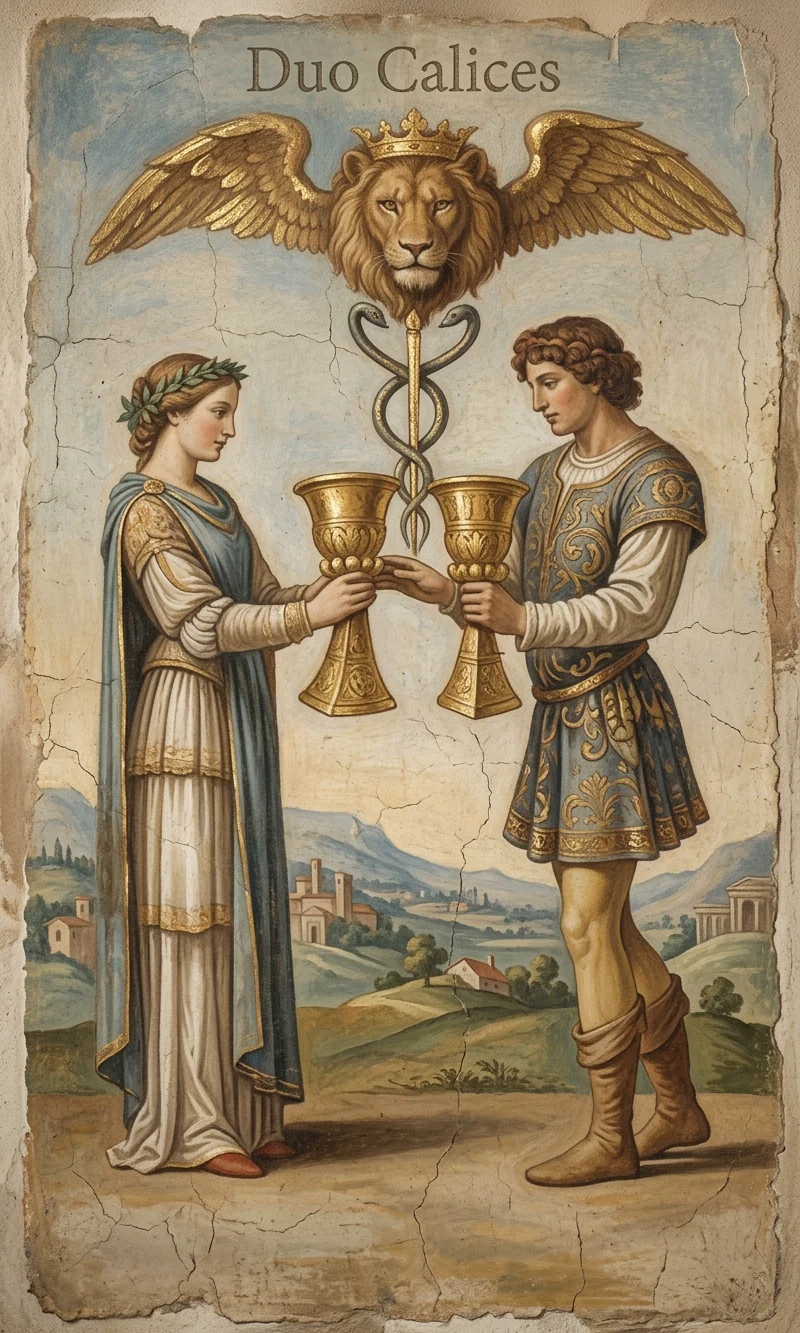
The cards become practical tools for navigating specific situations. Facing a difficult conversation where emotions run high? The Two of Cups reminds you that authentic relationship requires the alchemical marriage of separate selves, while the Three of Swords acknowledges that sometimes truth cuts before it heals. Struggling with a creative project that demands both discipline and inspiration? The suits of Wands and Pentacles map the entire territory from initial spark through sustained effort to material manifestation.
Most importantly, the Minor Arcana teaches us that there is no experience, however ordinary or painful, that falls outside the scope of cosmic meaning. The same intelligence that orchestrates the dance of galaxies is present in your morning coffee ritual, your work frustrations, your attempts to love well despite your limitations. Every moment contains all the elements—fire, water, air, and earth—in some proportion, and every situation can be understood as one of the fifty-six fundamental patterns of human experience.
The Minor Arcana asks us to become aware participants in our own lives rather than unconscious sufferers of circumstances we do not understand. It offers not escape from the ordinary world but deeper engagement with it, recognition that the mundane and the mystical are not opposed but intimately wed. In learning to read the cards of our daily experience, we discover that we have been living inside a teaching story all along—not as victims of meaningless chaos, but as conscious participants in the endlessly creative unfolding of cosmic intelligence through the particular circumstances of our embodied lives.
The Book of the Self contains your personal map to these fifty-six rooms, showing precisely which archetypal energies shape your own experience and how to work with them consciously as they cycle through your days, seasons, and years.