Life Path 1, Destiny 1, Soul Urge 1 — the digit's full character.
You have felt it before—that moment when something inside you says "I am" with such startling clarity that everything else falls silent. Not the small "I" that argues with traffic or worries about tomorrow's meeting, but the vast "I" that seems to contain entire worlds. This is your first encounter with what the number 1 truly carries: not mere singularity, but the original creative force that splits the void into being and non-being, self and other, here and there.
The number 1 is not simply the first in a sequence of counting. It is the mathematical mystery that remains unchanged when multiplied by itself, the only number that creates itself from itself. In the ancient teachings, 1 represents the monad—the indivisible unity from which all multiplicity emerges. It carries within itself the blueprint of every number that will follow, yet remains eternally itself, unchanged by what it births.
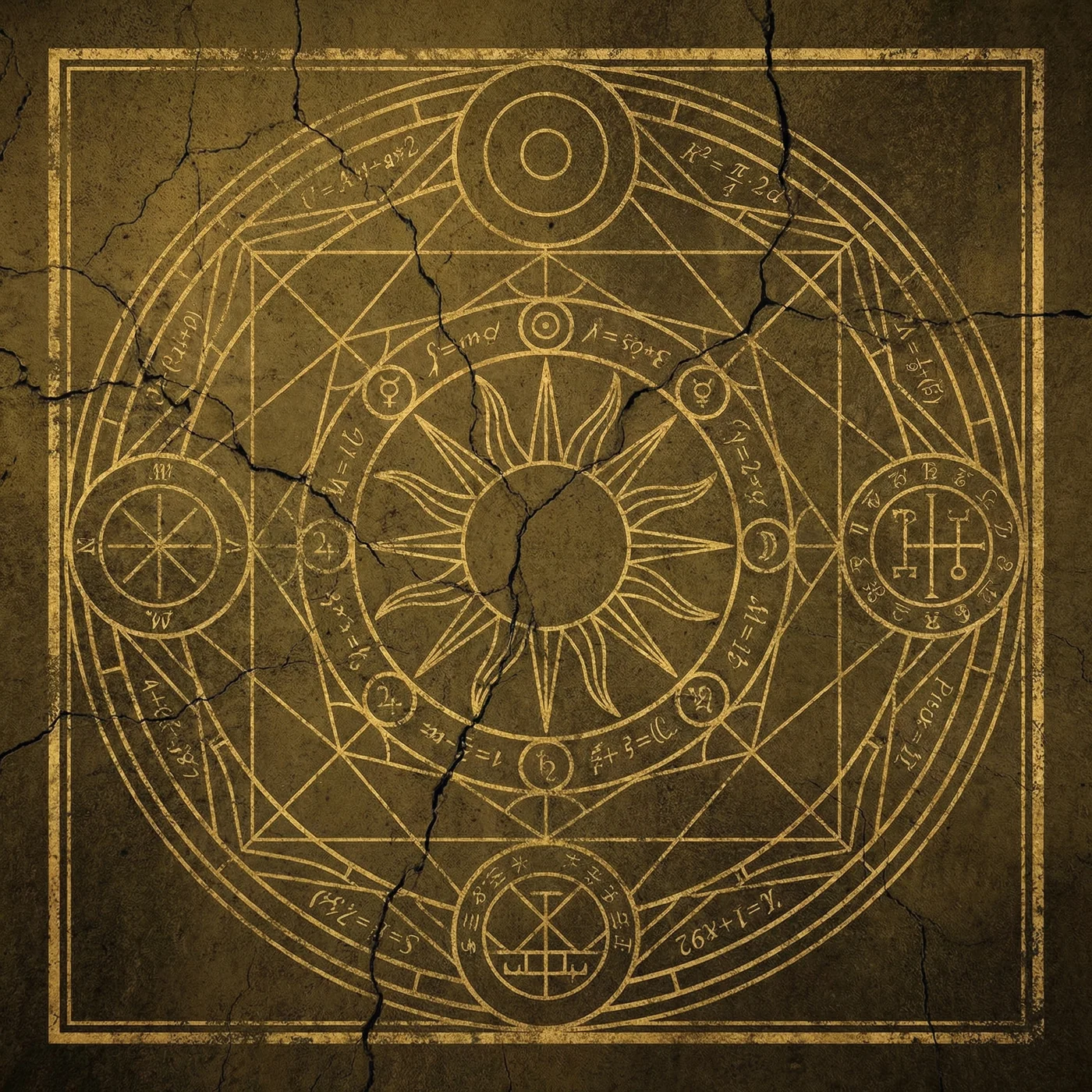
The Primordial Splitter
In the decanic wisdom, we find the archetype of 1 embodied in Aries I: The Axe, ruled by Mars and associated with the Two of Wands in both Rider-Waite and Thoth systems—though the Thoth names it more directly as "Dominion." Here we see 1's true nature: it is the force that creates the first division in undifferentiated reality. The axe does not destroy; it separates what was once whole into meaningful parts.
This is why those who carry strong 1 energy in their charts—through Aries placements, Mars dominance, or significant First House emphasis—often feel like pioneers in whatever realm they enter. They cannot help but be first, not out of competitiveness, but because 1 naturally creates the categories that others will later inhabit. The entrepreneur who invents an entirely new industry, the artist who breaks open a previously unknown form, the spiritual seeker who finds God in a place no one thought to look—these are expressions of 1's primordial splitting power.
Yet this creative division comes with its shadow. The Two of Wands shows a figure holding the world in his palm, gazing out at vast territories of possibility. But notice his position—he stands between two wands, balanced at the threshold between potential and manifestation. This is 1's eternal dilemma: it contains everything but can only express one thing at a time. Every choice to be something specific is simultaneously a choice not to be everything else.
The Mathematics of Selfhood
The deeper mystery of 1 lies in its mathematical properties, which mirror the nature of consciousness itself. When you multiply 1 by any number, that number remains unchanged—yet it has been touched by 1's presence. This is precisely how the individual self operates in the world: you can engage with countless experiences, relationships, and ideas, yet something essential in you remains constant throughout all transformations.
This constancy is not rigidity but rather what the ancient Taoists recognized as the "uncarved block"—the original nature that can become anything precisely because it is not yet specifically something. The number 1 carries this same quality: it is the most defined number (indivisibly itself) and simultaneously the most undefined (containing infinite potential).
Consider how this plays out in the spiritual traditions. In Kabbalah, 1 corresponds to Kether, the Crown, which is called "the most hidden of all hidden things." It is the first emanation from the unknowable Ain Soph, yet it remains so close to the source that it is barely distinguishable from it. In Hindu thought, 1 represents the Atman, the individual self that is simultaneously the universal Self. In Christian mysticism, it is the spark of divine light in every soul that remains untouchable by any worldly experience.
The Conqueror's Gaze
The Rider-Waite Two of Wands carries the evocative subtitle "The Conqueror's Gaze," which reveals another layer of what 1 carries. This is not the conqueror who subdues others, but the one who has conquered the illusion of separation between self and world. The figure gazes out at the landscape with the recognition that what he sees is not separate from who he is—the territory and the map-maker are one.
This gaze represents the achievement of what the alchemists called the "first matter"—the recognition of the unified field from which all apparent diversity emerges. When you truly inhabit the energy of 1, you stop experiencing yourself as a separate entity bumping into other separate entities. Instead, you begin to recognize yourself as the consciousness within which all experiences arise and pass away.
A modern example might be the jazz musician who has mastered her instrument so completely that there is no longer a separation between player and played. The music emerges from a unified field of awareness that includes her technical knowledge, emotional state, the other musicians, the room, the audience, and something indefinable that is simply "music happening." She has achieved what the Two of Wands depicts: dominion through unity rather than control through separation.
The Shadow of Isolation
Yet 1 carries its own particular shadow, which manifests when the unity becomes isolation instead of integration. This occurs when the recognition "I am one" becomes "I am alone." The healthy 1 energy knows itself as the source from which relationship becomes possible; the shadowed 1 energy experiences itself as fundamentally cut off from everything else.
This shadow appears in the spiritual traditions as what Buddhists call the "hungry ghost"—the being who has correctly perceived that the ordinary world of multiplicity is illusory, but has missed the deeper recognition that unity includes rather than excludes diversity. Such beings become spiritual narcissists, convinced of their own enlightenment precisely because they have lost touch with the relatedness that true unity creates.
In psychological terms, this shadow manifests as grandiosity or existential loneliness. The person touched by shadowed 1 energy might feel that they are the only real person in a world of automatons, or conversely, that they are the only one who truly understands how meaningless everything is. Both positions share the same fundamental error: they mistake the recognition of unity for a judgment of superiority or inferiority.
Working with the Current
To work skillfully with 1 energy requires understanding that it is not a destination but a current—the ever-present source from which each moment's experience emerges. Like the breath that animates the body without the body's conscious direction, 1 operates as the background awareness that makes all foreground experience possible.
The practice, then, is not to achieve 1-ness but to recognize the 1-ness that is already present. This might involve simple exercises like spending a few minutes each day in complete stillness, not trying to stop thoughts but recognizing the awareness within which thoughts appear. Or it might involve creative practices that bypass the analytical mind—automatic writing, improvisational dance, or any activity that allows something to move through you rather than being created by your deliberate effort.
The key is learning to distinguish between the small "I" that wants to control outcomes and the large "I" that is the space within which outcomes unfold. The small "I" experiences 1 as loneliness or grandiosity; the large "I" experiences 1 as the creative source that delights in expressing itself as the infinite diversity of manifest experience.
In relationships, working with 1 energy means bringing your full presence rather than your persona to each encounter. It means speaking from the place in you that has never been hurt rather than the place that remembers every wound. It means listening not just to words but to the silence from which words emerge and into which they return.
Those who learn to work with 1's current often become natural leaders, not because they seek power over others but because they embody the unified field from which authentic action spontaneously arises. They make decisions not from calculation but from a deeper knowing that includes and transcends rational analysis. They create not from ambition but from the overflow of an inexhaustible source.
If you recognize yourself in these words, if something in you has been quietly insisting on its own fundamental unity while the world teaches you to experience separation, you might find deeper insight in The Book of the Self, where the particular way 1's current moves through your unique astrological signature reveals itself in the intimate details of your own becoming.