Reading the degrees of the well-known — and watching the images land.
You know that moment when you're reading about a historical figure and something clicks—not just their biography, but the precise way they moved through the world, as if their very soul had been stamped with a particular signature? That recognition points to something astrologers have tracked for centuries: the notion that each degree of the zodiac carries its own distinct quality, its own archetypal fingerprint that shows up in the lives of those born under its influence.
The Sabian symbols represent one of the most vivid attempts to map this celestial typography. Yet beneath their seemingly simple imagery lies a deeper current—one that connects to the ancient tradition of decanic astrology, where each ten-degree section of the zodiac becomes a concentrated lens for understanding human destiny.
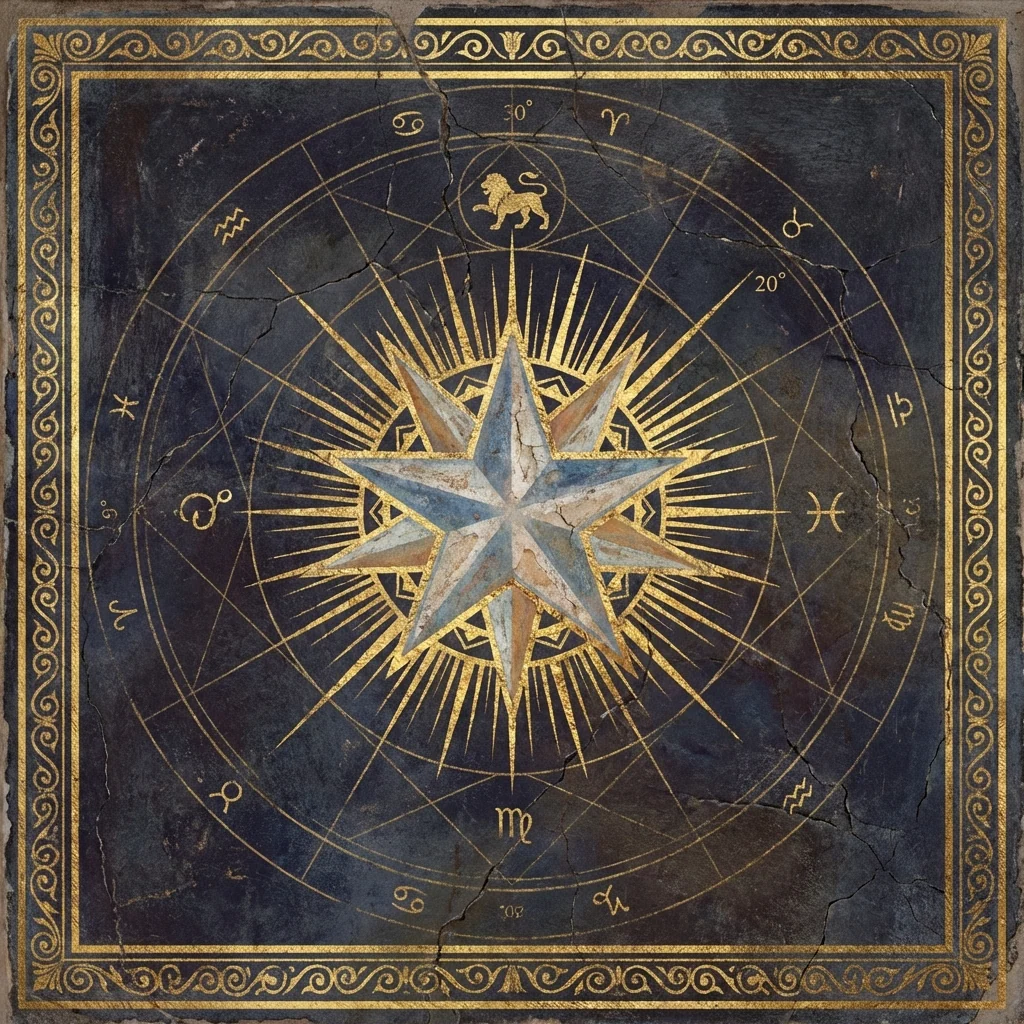
The Oracle of Elsie Wheeler
The Sabian symbols emerged from a remarkable collaboration in 1925 San Diego. Marc Edmund Jones, an astrologer seeking to decode the individual degrees of the zodiac, partnered with Elsie Wheeler, a clairvoyant who had lost her sight in childhood but possessed an extraordinary capacity for symbolic vision. Together, they produced 360 images—one for each degree of the zodiac—in a single afternoon session.
Wheeler would receive each degree position from Jones and immediately offer a symbolic image. "A woman and two men castaways on a small island of the south seas" for the first degree of Aries. "A comedian reveals human nature" for the fifteenth degree of Sagittarius. Each symbol arrived fully formed, without revision or hesitation, as if Wheeler were reading from an invisible book written in the language of cosmic meaning.
What makes these symbols particularly compelling is their American character—they emerged from the New World's relationship with ancient wisdom, translating primordial archetypal patterns into images that spoke to the twentieth century. Yet their deeper resonance connects them to traditions far older than their modern birth.
The Ancient Geography of Heaven
Long before Wheeler and Jones sat down in that San Diego parlor, ancient astrologers had mapped the zodiac into thirty-six faces, each governing ten degrees of celestial territory. These decans, as they came to be known, represented a sophisticated understanding of how cosmic influence operates—not as broad zodiacal generalities, but as precise archetypal territories with their own ruling powers, imagery, and characteristic effects.
The Egyptians placed thirty-six deities in charge of these faces, creating a divine bureaucracy that governed the flow of time and fate. The Greeks inherited this system, assigning planetary rulers to each decan and developing elaborate magical images for working with their powers. Medieval Islamic astrologers preserved and expanded these teachings, particularly in texts like the Picatrix, which detailed how each ten-degree section could be approached through specific ritual practices and talismanic work.
What the decans reveal is that the zodiac operates more like a detailed map than a simple twelve-part division. Each sign contains three distinct regions, each with its own character, challenges, and gifts. Sagittarius I, THE POISONED ARROW, ruled by Jupiter and Mercury, carries the swift certainty of the Eight of Wands—direction incarnate, the arrow that finds its target through focused will. Sagittarius II, THE BRIDLE, under the combined influence of the Moon and Mars, manifests as the Nine of Wands—the strength that comes from defending what you've built against contrary forces. Sagittarius III, A HORSE'S SKULL, governed by the Sun and Saturn, appears as the Ten of Wands—the final mile where exhaustion and victory intermingle.
When Ancient Patterns Meet Modern Lives
Consider how these precise celestial territories show up in actual biographies. A person born with significant planets in Scorpio III, THE CROW, often demonstrates an unusual capacity to transform decay into new life—they're drawn to work that involves cleaning up after others, whether as therapists processing psychological debris, artists who find beauty in abandoned places, or entrepreneurs who revitalize failing enterprises. The Crow feeds on what has died, returning it to the cycle of renewal.
Someone with strong emphasis in Capricorn I, A HEADLESS BODY, frequently operates through pure function rather than ego-driven ambition. They become masters of instinctual action, capable of tremendous productivity precisely because they've learned to work without the interference of self-consciousness. Their power comes from embodied knowledge rather than mental planning.
The precision becomes even more striking when we examine the exact degree positions in historical charts. The patterns that emerge suggest that Wheeler's clairvoyant glimpses were accessing something real—a celestial language that operates beneath the surface of ordinary awareness but reveals itself in the recurring themes of human lives.
This is where the Sabian symbols prove their worth as a bridge between ancient decanic wisdom and contemporary insight. They offer immediate, visceral access to the archetypal content of each degree, while the deeper decanic framework provides the traditional foundation that grounds symbolic interpretation in centuries of accumulated knowledge.
The Living Sky in Practice
Working with degree-by-degree interpretation requires a different kind of attention than broad-stroke astrology. Instead of asking "What does it mean to be a Sagittarius?" you learn to ask "What does it mean to be born at 17 degrees Sagittarius?"—a question that opens into much more specific territory.
The ancient texts suggest that each degree carries not just symbolic meaning but actual magical potential. The medieval astrologers created talismans keyed to specific degrees, understanding that celestial influence operates with surgical precision when properly focused. A talisman made during the Moon's passage through Pisces II, THE NET, ruled by Jupiter and Mars and corresponding to the Nine of Cups, would be designed to capture happiness and material satisfaction—but only when crafted with attention to the exact timing and symbolic correspondences.
Modern practice might not involve literal talisman creation, but the same principle applies: the more precisely you can identify the celestial signature operating in a situation, the more specifically you can work with its energies. Someone struggling with the challenges of planets in Gemini III, AN EXECUTIONER'S SWORD, needs different guidance than someone dealing with Gemini I, THE APPLE OF EDEN. The first involves learning when to cut away what no longer serves; the second requires discernment about which opportunities to pursue in a garden of endless options.
The Sabian symbols provide the imagery that makes these distinctions accessible, while the decanic framework supplies the traditional structure that prevents symbolic interpretation from drifting into fantasy. Together, they restore astrology's capacity to speak with both poetry and precision about the intricate ways celestial patterns manifest in human experience.
Your birth chart contains multiple degree positions, each carrying its own symbolic weight and archetypal significance. Learning to read these celestial coordinates with both ancient depth and contemporary insight opens a more nuanced understanding of your personal mythology—the specific combination of cosmic influences that shaped your particular way of being in the world.
The 36 Codex: Your Book of the Self offers a complete exploration of these celestial territories as they appear in your personal chart, weaving together Sabian symbolism, decanic wisdom, and traditional correspondences to create a comprehensive map of your astrological signature.