Two camps facing each other — and the person mediating between them.
You know that moment when everything tips. The weight shifts suddenly to one side, and you're scrambling to find your footing again, recalibrating what you thought was stable ground. Perhaps it was the day you realized your partner needed more space just as you were discovering how much you needed connection. Or the morning you woke up understanding that the career that had given you security was slowly suffocating your creative soul. These moments of acute awareness — when the delicate balance you've been maintaining suddenly reveals itself as the central organizing principle of your life — are the signature of those born under the influence of the cardinal air signs, where the art of perpetual adjustment becomes not just a survival skill, but a way of being.
This is the territory of the seesaw consciousness, where life unfolds as an endless series of negotiations between opposing forces, each demanding attention, each pulling you toward a different version of yourself. Unlike the fixed signs that plant their feet and declare their position, or the mutable signs that adapt and flow, the cardinal air energy operates from a different premise entirely: that truth emerges not from taking sides, but from the dynamic tension between sides, the living relationship between apparent opposites.
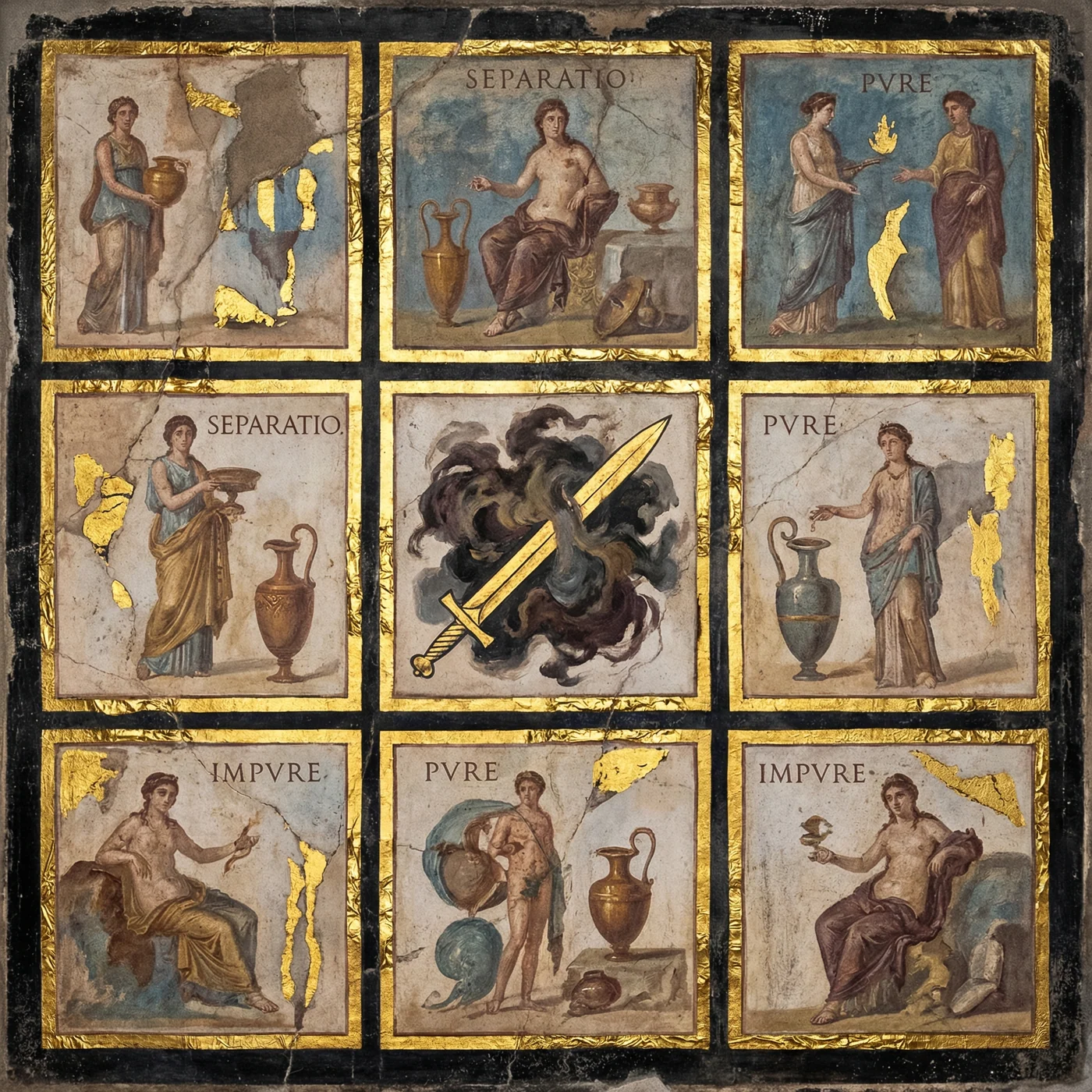
The Architecture of Perpetual Adjustment
The seesaw life reveals itself most clearly in the three faces of Libra, each offering a different lens through which the fundamental challenge of balance expresses itself. In the first decan, THE BLINDFOLD AND A SWORD, ruled by Moon and Venus, we encounter the archetypal image of justice — not as a final verdict, but as the ongoing process of weighing what cannot be fully seen. This is the realm of the RWS Two of Swords, titled "Peace," though it's a peace that exists precisely in the tension between equally valid choices.
Here, in the first ten degrees of Libra, the blindfold isn't a limitation but a technology of fairness. When you can't see the external markers that usually guide your decisions — wealth, status, familiar patterns — you're forced to rely on something more subtle: the felt sense of equilibrium itself. The sword represents the capacity to make distinctions, to cut through the paralysis of endless consideration, but only after the weighing is complete.
Moving deeper into Libra's second face, TWO LINKS OF A CHAIN, ruled by Saturn and Mercury, the seesaw dynamic shifts from internal negotiation to relational architecture. The RWS Three of Swords may be called "Sorrow," but this sorrow isn't the end of the story — it's the recognition that true partnership requires the piercing of individual will. The chain links suggest that balance isn't achieved through separation but through conscious interdependence, where your movement affects not just your own position but your partner's as well.
The third decan, A GYROSCOPE, presents the most sophisticated image of the seesaw consciousness. Ruled by Jupiter, Mercury, and Saturn in complex interaction, this face governs the RWS Four of Swords, "Rest" — but this is the rest that comes from finding the still point within constant motion. A gyroscope maintains its stability not by remaining static but by spinning, using momentum itself as the source of balance. This is the mastery that comes after years of conscious negotiation: the ability to find peace within the perpetual adjustment rather than despite it.
The Historical Transmission
The wisdom of the seesaw consciousness was first articulated in the ancient systems that recognized balance not as a destination but as a skill. The Greek concept of justice, embodied by Themis, was never about finding the perfect solution but about maintaining the ongoing relationship between competing claims. The scales of justice aren't meant to remain perfectly level — they're meant to move, to respond, to engage in the constant dance of evaluation and reevaluation.
Medieval astrologers understood this principle through their observation of the cardinal signs' relationship to seasonal transitions. The autumn equinox, where Libra begins, marks the moment when day and night achieve perfect equality — but only for an instant. Immediately after this moment of balance, the scales tip toward darkness, beginning the journey toward winter. The lesson embedded in this timing is profound: balance isn't a static state but a dynamic process, a brief moment of equilibrium within constant change.
This understanding was preserved in the tarot traditions that assigned the suit of swords to the element of air. Swords cut, discriminate, separate — but in the hands of conscious practitioners, they become tools of clarity rather than weapons of division. The progression from the Two of Swords through the Four reveals the journey from initial recognition of opposing forces, through the pain of making necessary distinctions, to the rest that comes from accepting the process itself.
The Deep Pattern Revealed
What the everyday understanding of balance cannot explain is why some people seem to thrive in situations that would exhaust others — the natural mediators, the diplomatic troubleshooters, those who gravitate toward complexity rather than simplicity. The seesaw consciousness operates from a fundamentally different relationship to stability itself.
Where most people seek to resolve tension, the seesaw consciousness seeks to inhabit it skillfully. This isn't indecision or conflict avoidance, though it can masquerade as both. It's the recognition that many of life's most important truths exist in the spaces between opposites, in the dynamic relationship rather than in either pole.
This pattern explains the curious phenomenon of people who seem to complicate simple situations and simplify complex ones. They're not being contrary — they're responding to the underlying energy dynamics, sensing where the natural balance wants to emerge. In relationships, they instinctively know when to push and when to yield, when to stand firm and when to bend, not from strategic calculation but from a felt sense of the relational field itself.
The seesaw consciousness also illuminates why certain people are drawn to careers that others find impossibly stressful: mediation, diplomacy, counseling, any field that requires holding space for conflicting perspectives without immediately rushing to resolution. They understand intuitively that the tension itself often contains the wisdom needed for authentic resolution.
A Lived Example
Consider Maya, born with her Sun in the second decan of Libra. From childhood, she found herself naturally positioned between others' conflicts — not as a victim caught in the crossfire, but as someone who could genuinely see the validity in opposing viewpoints. In school, while other children formed rigid cliques, Maya moved fluidly between different groups, translating between different social languages, helping erstwhile enemies discover their common ground.
Her career path reflected this same pattern. After starting in corporate law, where she expected to find clear adversarial lines, she discovered her real talent lay in the gray areas — complex negotiations where multiple parties had legitimate but conflicting interests. She specialized in environmental disputes, where community needs, corporate interests, and ecological concerns created intricate webs of competing values.
In her personal relationships, Maya initially frustrated partners who wanted clear positions from her. They interpreted her constant weighing of options as indecisiveness, her ability to see multiple perspectives as lack of conviction. It wasn't until she met someone who understood that her thoughtfulness wasn't weakness but a sophisticated form of intelligence that she found her relational balance.
Maya's breakthrough came when she stopped trying to land on one side or the other and began to identify with the seesaw itself — with her capacity to sense the subtle shifts in any situation and respond with appropriate adjustments. She learned to communicate this process to others, helping them understand that her careful consideration wasn't delay but precision.
In her consulting practice now, Maya works with organizations stuck in seemingly intractable conflicts. Her gift isn't in providing solutions but in helping each party understand the legitimacy of their opponents' positions, creating the relational field in which creative solutions can emerge. She has learned to trust the process of negotiation itself, understanding that premature resolution often creates more problems than it solves.
Working with the Seesaw Consciousness
If you recognize yourself in this pattern, the first skill to develop is distinguishing between productive tension and destructive conflict. Productive tension feels dynamic, alive, full of potential. It's the feeling of being stretched but not strained, challenged but not overwhelmed. Destructive conflict feels static, repetitive, draining — the same arguments cycling endlessly without movement or resolution.
Learn to communicate your process to others. Many people interpret careful consideration as indecision or lack of conviction. Help them understand that your willingness to examine multiple perspectives isn't weakness but thoroughness. Share your thinking process rather than just your conclusions. Let others see how you weigh different factors, what you're balancing, why certain considerations matter to you.
Develop rituals that honor the process rather than rushing to outcomes. Before making important decisions, create time and space for genuine consideration. This might mean sleeping on it, talking it through with trusted advisors, or simply sitting with the complexity until clarity emerges naturally. Resist pressure to decide prematurely, but also recognize when you're using consideration as a way to avoid necessary action.
Practice holding paradox without immediately seeking resolution. Some tensions aren't meant to be resolved but to be held consciously. You can love someone and need space from them. You can be committed to your career and questioning your path. You can be grateful for what you have and still want something different. Learning to hold these apparent contradictions without rushing to collapse them into simple either-or choices is a crucial skill.
Pay attention to your energy levels around decision-making. The seesaw consciousness can become exhausted by too many small decisions that don't warrant its full engagement. Learn to distinguish between decisions that truly require your sophisticated balancing skills and those that can be handled more efficiently. Save your careful consideration for situations that truly benefit from it.
Cultivate relationships with people who appreciate your process rather than just your outcomes. Surround yourself with friends and colleagues who value thoughtfulness, who understand that good decisions often take time, who can distinguish between procrastination and genuine deliberation.
The Living Balance
The seesaw consciousness ultimately offers a profound gift to a world that often mistakes simplicity for clarity and speed for wisdom. In your willingness to inhabit complexity, to hold space for opposing truths, to trust the process of negotiation itself, you model a different way of engaging with life's fundamental challenges.
This isn't about being wishy-washy or noncommittal. It's about recognizing that many of life's most important questions don't have simple answers, that the willingness to hold tension consciously often leads to solutions that transcend the original problem. Your natural ability to see multiple perspectives, to sense the subtle dynamics in any situation, to adjust and readjust until equilibrium emerges — these are sophisticated skills that our complex world desperately needs.
The Book of the Self explores these patterns in the full context of your individual chart, revealing how your particular version of the seesaw consciousness expresses itself across all areas of life, and how to work with rather than against your natural rhythms of balance and adjustment.