The 17/8 pair — the gentle power that outlasts force.
You know that moment when the storm finally breaks—not into calm, but into something fiercer: the quiet determination that rises when you realize you're still standing. The bandages have been wrapped, the immediate crisis has passed, but something in your stance suggests you expect more conflict. Yet you're no longer afraid of it. This is the territory where hope and strength converge, not as gentle consolations but as inherited powers forged in the crucible of repeated testing.
The modern world teaches us that hope is passive waiting and strength is brute force. But the ancient wisdom preserved in the star maps tells a different story. True hope is the capacity to maintain vision when the world conspires toward blindness. True strength is not the power to break things, but the power to remain unbroken—and more crucially, to maintain the essential unity between what you believe and how you act, no matter what forces array themselves against that integration.
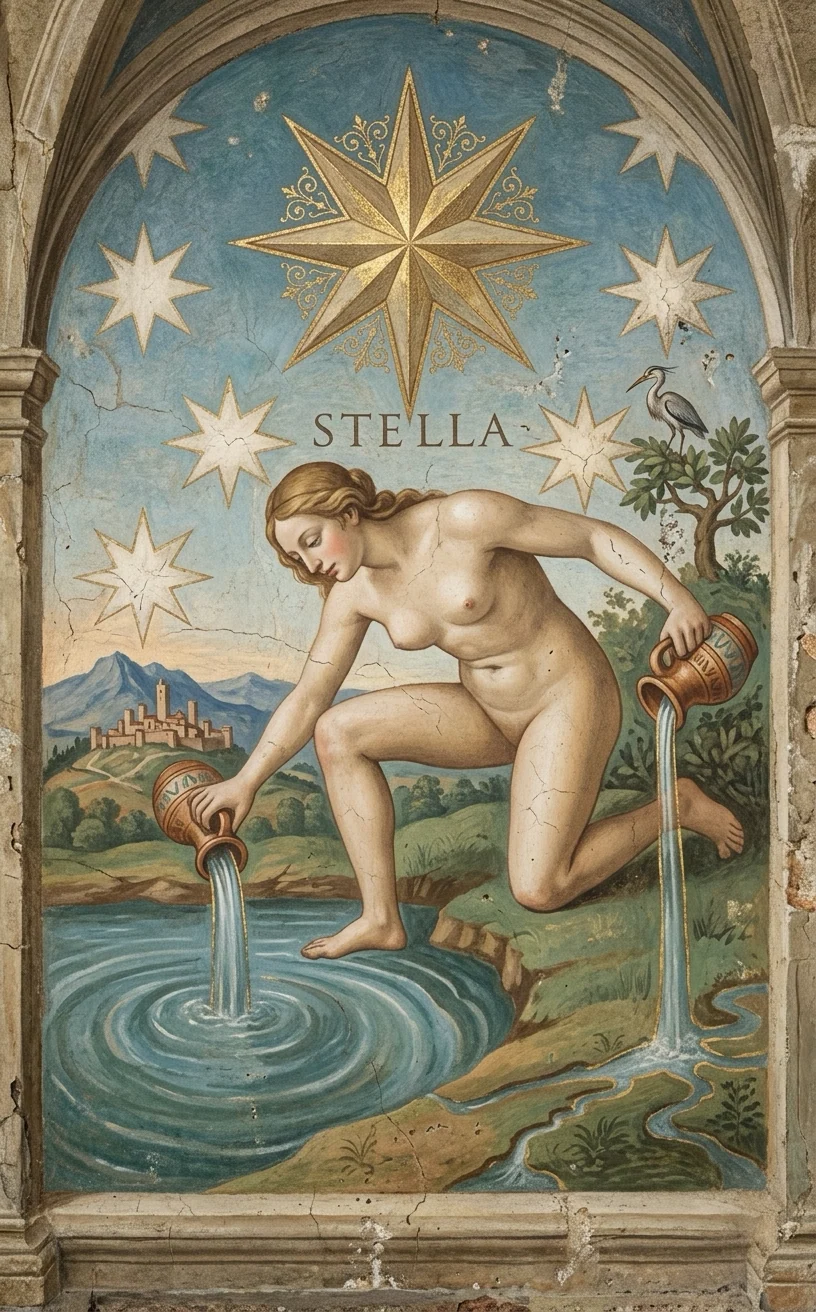
The Geography of Endurance
When we speak of hope and strength as inheritance, we're not speaking of genetic gifts but of earned wisdom passed down through the landscape of the heavens themselves. Consider the second decan of Sagittarius, known as The Bridle—that ten-degree arc from 10 to 19 degrees of the Archer's domain, where Jupiter's expansive vision meets Mars' focused will under the sign of the centaur.
Here lies the Nine of Wands, called Strength in its most essential form. The card shows a figure who has clearly seen battle, bandaged but unbowed, standing guard before eight vertical wands while holding a ninth. This is not the strength of the untested warrior, but the strength that emerges only after you've learned what you're truly defending. The bandages are not signs of weakness—they're evidence of engagement, proof that you've been willing to pay the cost of maintaining your position.
The bridle itself tells us everything about this particular inheritance. A bridle doesn't break the horse; it creates a communication channel between rider and mount, between higher will and animal power. In the human context, this decan governs the delicate art of harnessing your own nature—your impulses, your fears, your tendency to scatter energy—in service of something worthy of sustained effort.
This is where hope becomes active. Not the passive hope that things will somehow improve, but the hope that maintains its grip on the reins even when the path disappears into fog. It's the hope that says: "I may not see the destination, but I trust the direction." And strength here isn't about dominating opposition, but about maintaining the marriage between what you believe and how you live, regardless of what tries to split them apart.
The Alchemy of Friction
The ancients understood something we've forgotten: that certain kinds of strength can only be developed under pressure. The second decan of Sagittarius operates on this principle. It's ruled by the Moon and Mars in the traditional system—emotion and action forced into collaboration. The Moon brings the capacity to respond to changing conditions; Mars provides the focused will that refuses to abandon the chosen direction.
But here's what makes this inheritance unique: the strength developed here requires ongoing friction to maintain itself. Remove the pressure, and the strength doesn't rest—it begins to atrophy. This is why people born under this influence often seem to find themselves in situations that require them to defend their positions, their principles, or their territory. It's not that they seek conflict, but that they require a certain level of resistance to maintain their essential integration.
The hope that develops here is equally paradoxical. It's not the hope of eventual ease, but the hope that you'll continue to have something worth defending. It's the hope that your principles will prove strong enough to bear the weight of real-world testing. This creates a particular kind of optimism—not the sunny expectation that everything will work out, but the deeper confidence that you'll be able to handle whatever doesn't work out.
Consider someone with their Sun in this decan: they often appear as natural crusaders, but their challenge is selectivity. They have the strength to defend almost anything, but wisdom lies in choosing causes worthy of that defense. Their power is the ability to unify mind and body, belief and action, around a willed goal. Their danger is maintaining this expensive strength in service of positions that don't deserve it.
The Practical Magic of Sustained Will
There's a specific magic that operates in this territory—the magic of sustained will under pressure. It's the power that allows a person to remain centered around a chosen purpose even when circumstances argue for abandonment or compromise. This isn't stubbornness; it's something more like faithfulness to a future that hasn't yet materialized.
In practical terms, this manifests as an uncanny ability to outlast opposition through sheer consistency. Where others might escalate or surrender, those who've inherited this particular strength simply continue. They maintain their position, their practice, their commitment to the path they've chosen. Over time, this constancy becomes its own form of victory—not through conquest, but through persistence that eventually reshapes the landscape around it.
The hope aspect operates as a kind of spiritual metabolism. It's the capacity to transform resistance into fuel for the very commitment being resisted. Obstacles become confirmation rather than discouragement—proof that you're moving in a direction that matters enough for the world to push back against.
But this inheritance comes with a shadow warning. The same strength that allows you to maintain noble principles can trap you in patterns that have outlived their usefulness. The hope that sustains you through genuine adversity can become attachment to struggle itself. The bridle that channels power toward worthy goals can become a bit that restricts necessary growth.
The Living Example
Imagine a woman who decides to start a community garden in a neglected urban lot. The city council resists, citing zoning concerns. Neighbors complain about the disruption. The soil tests reveal contamination that requires expensive remediation. Local teenagers use the space for activities that require constant cleanup and boundary-setting.
Someone without this particular inheritance might abandon the project, escalate to legal action, or compromise the vision into something more manageable. But someone drawing on the strength of The Bridle approaches it differently. She maintains the vision while adapting the methods. She negotiates with the council while also organizing community support. She addresses the soil contamination while building relationships with the teenagers.
Most importantly, she doesn't interpret resistance as evidence that the project is wrong—she reads it as confirmation that something important is being born. Each obstacle becomes an opportunity to demonstrate the consistency of her commitment. Over months and years, her sustained presence and unwavering focus on the core vision gradually transforms not just the lot, but the community's understanding of what's possible in that space.
This is hope and strength as inheritance: not the power to avoid or overcome resistance, but the capacity to remain faithful to worthy goals while allowing the method to evolve. It's the strength that comes from knowing you've chosen something worth defending, combined with the hope that your defense will prove adequate to the task.
Working with the Inheritance
If you recognize this pattern in your own life—if you find yourself repeatedly in positions that require sustained defense of something you value—you're likely working with some version of this celestial inheritance. The key is learning to distinguish between causes that deserve this expensive form of strength and causes that are simply familiar.
The practice begins with honest assessment: What am I actually defending? Is it a principle worth the cost, or is it a position I've grown attached to? Am I maintaining something essential, or am I maintaining something simply because I've already invested so much in maintaining it?
The hope component requires its own cultivation. It's not enough to have the strength to persist; you need the vision to persist toward something worthy. This means regularly reconnecting with the larger purpose that makes the daily resistance meaningful. It means maintaining contact with the future you're trying to create, not just the position you're trying to hold.
The bridle metaphor offers the most practical guidance: learn to work with your own nature rather than against it. If you're someone who requires resistance to function at full capacity, don't try to eliminate friction from your life—learn to choose your frictions consciously. Seek out challenges that develop capacities you want to strengthen, rather than simply reacting to whatever opposition presents itself.
Most crucially, remember that this inheritance is meant to serve something larger than personal comfort or preference. The strength to maintain your position is ultimately about maintaining positions worth occupying. The hope that sustains you through adversity is hope for a world improved by your sustained presence in it.
Your personal astrology holds the specific blueprint of how these archetypal forces express through your unique nature—the precise ways your hope sustains itself, the particular forms your strength takes when tested, and the individual path by which you transform resistance into fuel for worthy service. This is where the ancient wisdom becomes personal guidance, where the star maps reveal not just what is, but what's possible when you fully inhabit your inheritance. The Book of the Self awaits those ready to discover how their celestial pattern translates into lived wisdom.