Air's fourteen lessons in truth, conflict, and clarity.
You know the moment when clarity cuts through confusion like lightning through storm clouds. When the mental fog suddenly lifts and you see the precise shape of what has been troubling you for weeks. That instant when your mind becomes a blade—not to harm, but to separate truth from illusion, signal from noise, what matters from what merely seems to matter. This is the domain of Swords, where every thought becomes an edge and consciousness itself is the weapon.
The Architecture of Air
The Suit of Swords governs the element of Air—not the gentle breeze that cools summer afternoons, but the fierce winds that reshape landscapes. Air is the element of movement, communication, and intellect. It carries sound from speaker to listener, oxygen from lung to blood, and thoughts from mind to manifestation. In the tarot, Swords embody this elemental force as it moves through human consciousness, sharpening perception and cutting away the unnecessary.
Unlike the earthy pragmatism of Pentacles or the flowing intuition of Cups, Swords operate in the realm of pure thought. They represent your capacity to analyze, discriminate, and understand. Every card in this suit depicts some aspect of the mind's power to divide reality into comprehensible pieces—and every card warns of the double-edged nature of that power.
The suit progresses through the zodiacal signs of Air: Gemini, Libra, and Aquarius. Each brings its own quality to the blade. Gemini gifts the sword with speed and versatility—the quick cut that separates one idea from another. Libra provides balance and justice—the careful weighing that determines where the cut should fall. Aquarius adds the revolutionary edge—the blade that cuts away entire systems of thought to make room for what has never been conceived.
The Blade That Cuts Both Ways
In Gemini, we encounter the suit's most challenging manifestations. The Hermaphrodite, ruling over Gemini's second decan, presides over the Nine of Swords—that card of cruel mental torment where thoughts become torturers. Here dwells the figure who sits awake in bed, head in hands, while nine swords hang overhead like crystallized anxieties. This is the mind turned against itself, the blade that cuts inward rather than through.
The traditional image for this decan shows both angel and demon, man and woman dwelling within a single form. It represents the fundamental duality of consciousness—our capacity to be both wise sage and cruel critic, loving friend and harsh judge. The Nine of Swords manifests when these internal contradictions remain unreconciled, when the mind's natural capacity for discernment becomes distorted into endless self-attack.
Yet even this cruelty serves a purpose. The sharp pain of mental anguish forces attention toward what needs examination. The sleepless nights depicted in the Nine of Swords often precede breakthrough insights. The blade must sometimes turn inward to cut away the false beliefs that masquerade as truth.
The Scales of Mental Justice
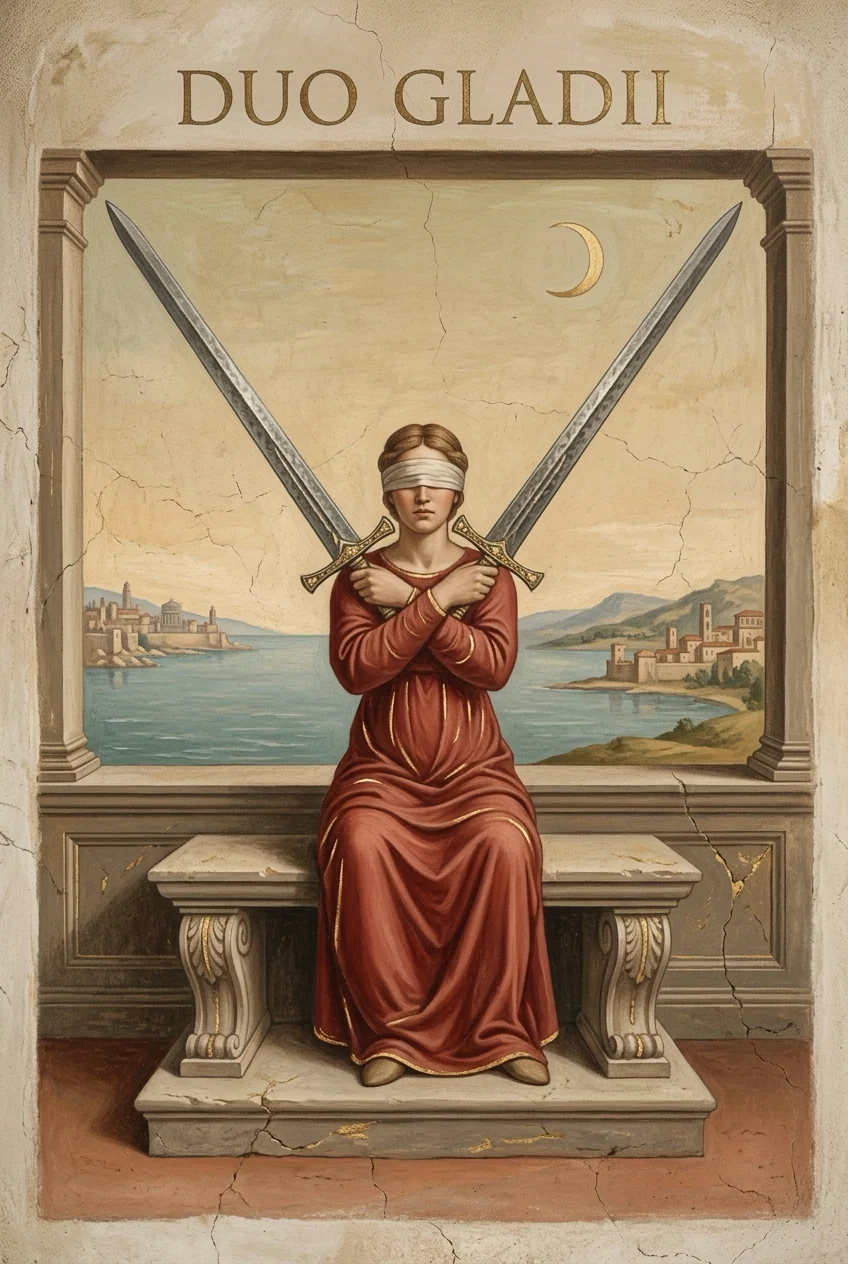
In Libra, the sword finds its proper balance. The suit here concerns itself with justice, decision-making, and the delicate art of weighing competing truths. The Two of Swords shows a blindfolded figure holding two blades in perfect equilibrium—not the paralysis of indecision, but the careful pause that precedes right action. A Blindfold and a Sword governs this decan, representing the necessity of setting aside personal bias to perceive what justice actually requires.
The progression through Libra's three faces tells the complete story of how consciousness processes conflict. First comes the blindfolded peace of suspended judgment. Then arrives the Three of Swords—Sorrow—where the heart is pierced by necessary truths. Finally emerges the Four of Swords—Rest—where the mind finds equilibrium in the eye of the storm, symbolized by A Gyroscope that maintains balance no matter how chaotic the surrounding motion.
Consider someone facing a difficult decision about ending a relationship. The Two of Swords represents the moment of recognizing that a choice must be made, consciously setting aside wishes and fears to see clearly. The Three of Swords manifests as the genuine grief that accompanies honest recognition of what isn't working. The Four of Swords appears as the strange peace that follows—not the absence of pain, but the centered calm that comes from alignment with truth.
The Revolutionary Blade
Aquarius brings the suit's most radical expression. Here the sword becomes an instrument of liberation, cutting away not just false ideas but entire systems of thought that have outlived their usefulness. The Mark of Exile in Aquarius's first decan corresponds to the Five of Swords—Defeat—but this defeat is often the bitter victory of those who refuse to participate in corrupted games.
The progression through Aquarius traces the path from exile through reconciliation to final departure. The Six of Swords depicts the ferryman's journey between worlds—Heaven and Earth bridged by one who belongs fully to neither shore. Finally comes The Knot of the third decan, paired with the Seven of Swords—Futility—where the figure steals away from the camp, carrying what swords can be salvaged before abandoning the situation entirely.
This is the sword of revolution, wielded by those who see too clearly to remain comfortable within existing structures. The Aquarian blade cuts through social conventions, traditional authorities, and collective beliefs that no longer serve truth. It's the sword carried by whistleblowers, reformers, and visionaries—sharp enough to sever the ties that bind consciousness to outdated paradigms.
The Edge of Transformation
Working with the Suit of Swords requires understanding that mental clarity always comes at a cost. Every insight demands the sacrifice of some cherished illusion. Every moment of true perception requires releasing attachment to how you wish things were in favor of seeing how they actually are.
The suit teaches discrimination—not judgment in the sense of condemnation, but discernment in the sense of clear seeing. It develops the mind's capacity to separate truth from falsehood, necessary from superfluous, self from other. This is essential work, but it requires careful attention to the blade's balance.
When Swords energy becomes excessive, thoughts multiply into anxiety, analysis becomes paralysis, and the mind's natural capacity for clarity transforms into cruel self-criticism. When insufficient, consciousness grows foggy, decisions become impossible, and the vital work of mental discrimination ceases entirely.
The suit's highest expression appears in moments when thinking becomes so clear it transcends thought itself. When the blade grows so sharp it cuts through the very idea of separation between observer and observed. This is the sword of awakening—the consciousness that cuts through its own illusions to discover what remains when all false identities have been severed.
The wisdom of Swords ultimately points toward a paradox: the mind's greatest achievement is recognizing the limits of mental understanding. The sharpest blade eventually cuts through the need for blades entirely, revealing the unified awareness that underlies all apparent divisions.
The 36 Codex charts this complete journey through your personal cosmos, mapping how the suit of Swords manifests through your unique celestial inheritance, showing where your mind cuts clean and where it tangles, where your thoughts serve truth and where they create suffering.