The 16/7 pair — lightning and the reins.
You know the moment when everything you built comes apart in your hands. The relationship that defined your world suddenly ends. The career you spent years constructing dissolves overnight. The identity you wore like armor cracks and falls away, leaving you exposed and raw. In that moment of devastation, something else emerges—not immediately, not comfortably, but inevitably. It is your will, stripped of all the structures that once supported it, forced to discover what it can actually do when everything familiar has been taken away.
This is the territory where The Tower and The Chariot meet—not as opposing forces, but as two faces of the same inheritance. The Tower brings the necessary collapse, the moment when the false structures of your life are revealed and demolished. The Chariot brings the will that emerges from the rubble, the part of you that learns to move forward when all the old roads have been destroyed.
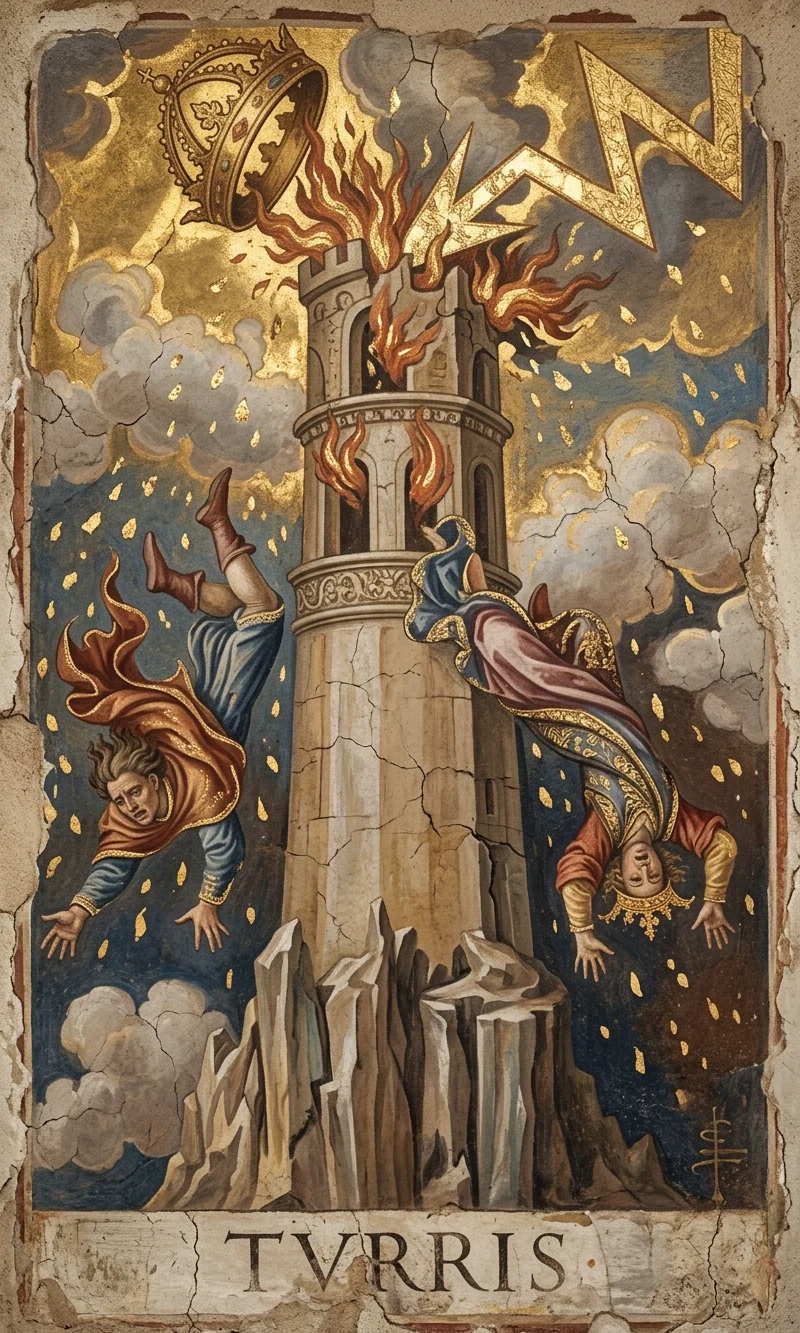
The Architecture of Collapse
The Tower appears in your life not as punishment, but as revelation. Every structure you build—every relationship, every role, every story you tell yourself about who you are—eventually reaches the limits of its foundation. The Tower moment comes when these limitations can no longer be ignored, when the gap between what you've built and what is actually true becomes too wide to bridge.
This is not random destruction. The Tower strikes precisely where your foundations are weakest, where you have been building on assumptions that were never examined, on promises that were never kept, on truths that were never true. The lightning that shatters the tower is the sudden recognition of reality breaking through the walls of your carefully constructed illusions.
What makes The Tower so terrifying is that it rarely announces itself. You wake up one morning thinking your life is solid, and by evening you're standing in the ruins, wondering how everything you trusted could have been so fragile. But the fragility was always there. The Tower simply reveals what was already broken, forces into the open what was already failing.
The figures falling from the tower are not victims—they are prisoners being liberated from a structure that had become their cage. The crown being knocked from the head of the tower represents not the loss of legitimate power, but the removal of false authority, the end of a reign that was never sustainable.
The Chariot Born from Ruins
In the aftermath of collapse, when the dust has settled and the debris has been cleared away, something else begins to move. The Chariot does not ride onto the scene as a conquering hero—it emerges from the wreckage itself, built from the materials that survived the fall. This is will refined by loss, purpose clarified by destruction, strength that knows its own limits because it has encountered them.
The Chariot represents your capacity to move forward without the old structures, to find direction when all the familiar landmarks have been destroyed. The sphinxes that pull the chariot are not tamed—they are held in dynamic tension, pulling in opposite directions but somehow still creating forward motion. This is the paradox of will refined by collapse: it learns to work with contradictions rather than resolving them, to find stability in movement rather than in fixed positions.
The charioteer holds no reins. The control is not external but internal, not about forcing compliance but about maintaining intention in the midst of chaos. This is will that has learned the difference between control and direction, between domination and purpose.
The Inheritance of Earned Strength
What you inherit from The Tower and The Chariot is not comfort—it is capacity. You inherit the knowledge of what can be taken from you and what cannot, what depends on external structures and what exists independent of them. This is perhaps the most valuable inheritance of all: the distinction between what you have and what you are.
Consider someone who builds their identity entirely around their career, their relationships, their social position. When The Tower strikes—when they lose their job, when their marriage ends, when their social world shifts—they feel as though they are losing themselves. But what they discover in the rubble is that the self which could be lost in this way was never really theirs to begin with. It was borrowed, constructed from external materials that were always temporary.
The Chariot that emerges from this collapse is their actual will, the part of them that exists independent of these external confirmations. This will is harder to destroy because it is not dependent on structures that can be taken away. It is also more flexible, more capable of adapting to new circumstances, because it has already survived the loss of everything it thought it needed.
The Sacred Function of Breakdown
In the tradition of the sacred decans, this pattern appears most clearly in Pisces III, ruled by Mars alone—A Cup of Blood. Here, at the very end of the zodiac, Mars appears not as the conqueror but as the warrior who has learned the ultimate lesson: that some victories require the willingness to lose everything else.
The Cup of Blood represents the final offering, the moment when you pour out everything you thought you were in service of what you actually are. This is not martyrdom but metamorphosis, not death but transformation so complete that it appears as death to everything that came before.
The shadow theme here is "The Cup of Martyrdom"—the blood that is poured but not transfigured, the final sacrifice that yields only death. The difference between sacred collapse and mere destruction lies in what emerges from the ruins. When The Tower and The Chariot work in harmony, collapse becomes the foundation for a more authentic form of power.
Imagine a master craftsman whose workshop burns down, destroying decades of work, tools passed down through generations, projects half-completed that represented years of effort. In the immediate aftermath, there is only loss. But as the craftsman stands in the ashes, something else begins to emerge. Without the familiar tools, they must remember the deeper principles that made the tools effective. Without the completed works, they must reconnect with the original inspiration that made the work meaningful. Without the inherited methods, they must discover what techniques actually serve their vision.
The new workshop they build will be different—simpler in some ways, more complex in others, but fundamentally more aligned with who they have become rather than who they inherited their craft from. The Chariot that carries them forward is built not from the old materials but from the understanding that survived the fire.
Working with Collapse and Will
The practice here is not to prevent The Tower—it cannot be prevented when it is needed—but to recognize it when it comes and to work consciously with the will that emerges from collapse. This means developing the capacity to distinguish between what is actually being destroyed and what only appears to be destroyed, between what you are losing and what you are shedding.
When The Tower strikes, ask yourself: What was I building that needed to come down? What foundation was I trusting that was never truly solid? What identity was I wearing that was never actually mine? The answers to these questions reveal not what you have lost, but what you have been freed from.
When The Chariot begins to emerge, ask yourself: What capacity do I have now that I didn't have before? What can I do without that I thought I needed? What direction am I being drawn toward that wasn't available when the old structures were in place?
The inheritance of The Tower and The Chariot is the discovery that your actual strength was never in the structures you built but in your capacity to build, never in the identity you constructed but in your ability to construct, never in the life you had but in your ability to create life from whatever materials remain.
Your personal Book of the Self reveals where these forces of collapse and reconstruction are most active in your own life, mapping the specific ways your will is being refined through encounter with limitation, loss, and the necessity of beginning again.