Jung's discovery, and why the planets are the oldest set we have.
You wake at three in the morning with a strange certainty: you've been here before. Not this room, not this life exactly, but this precise configuration of circumstance and choice. The pressure behind your sternum, the way moonlight cuts across the floor, even the quality of your own attention—all of it carries the weight of endless repetition. You are not the first person to stand exactly here, and you will not be the last.
This is your first real encounter with the archetypal realm, though you may not recognize it as such. Most people dismiss these moments as déjà vu or coincidence. But you have felt the presence of something vast and recurring, something that wears your face but existed long before you were born.
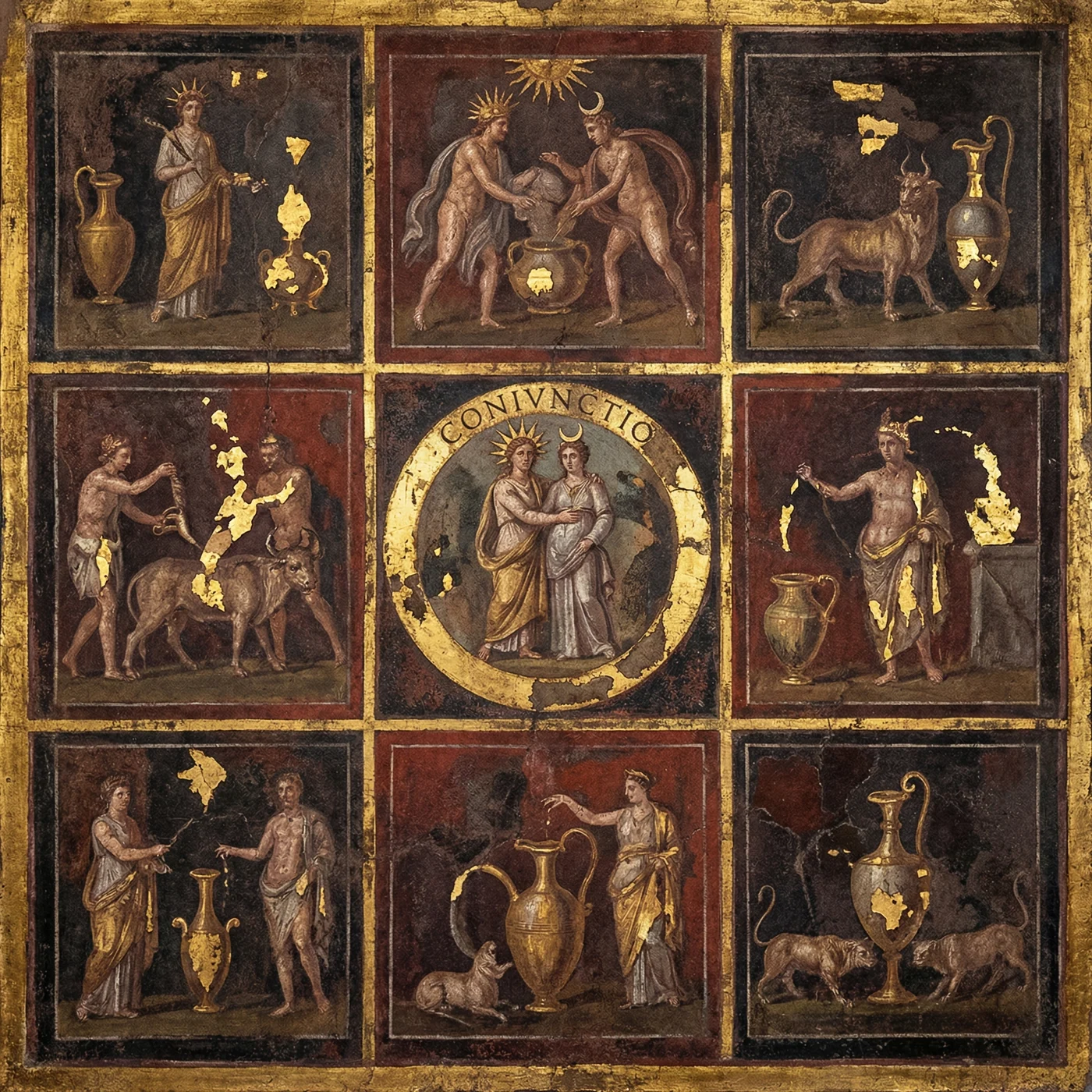
The Theatre of Recurrence
Archetypes are not abstract concepts or psychological categories. They are the fundamental patterns that consciousness itself uses to organize experience—the deep grooves worn into reality by countless iterations of the same essential dramas. Think of them as roles in an eternal play, each one containing the accumulated wisdom and shadow of everyone who has ever performed it.
When ancient astronomers divided the zodiac into faces, they were mapping this theatre of recurrence. Each ten-degree segment carries its own archetypal signature, complete with its ruling powers, symbolic image, and particular way of being human. These are not arbitrary divisions but natural boundaries, like watersheds in the landscape of consciousness.
The Leo II decan, A CROWN OF LAURELS, ruled by Jupiter alone, holds the archetype of the triumphant figure. In the Rider-Waite tarot, this appears as the Six of Wands—a crowned rider moving through cheering crowds, wreathed in the laurels of victory. But this is not merely about external success. The archetype speaks to that moment when spirit successfully inhabits the persona, when the mask becomes truly alive.
Every culture has recognized this pattern. The Romans called it the triumphus, where the victorious general was treated as king-for-a-day, processing through the streets until he reached Jupiter's temple. The Egyptians saw it in the Pharaoh at his jubilee, the Greeks in the Olympic champion crowned before the assembled multitude. Always the same essential drama: the individual temporarily elevated to embody something larger than themselves, becoming a vessel for collective celebration of human possibility.
Yet the archetype contains its own correction. Roman custom required a slave to whisper in the triumphator's ear: "Remember, you are mortal." The pattern includes both the crown and the reminder of mortality—triumph and the seeds of hubris that can destroy it.
The Shadow That Completes
Every archetype carries its shadow—not as flaw or failure, but as the necessary dark that gives the light its meaning. The shadows are not enemies to be defeated but aspects to be integrated, for they contain powers that the conscious persona cannot access alone.
The shadow of A CROWN OF LAURELS is the hubris of triumph—the forgetting of mortality that transforms victory into tyranny. When someone becomes so identified with their success that they can no longer remember their humanity, they have been consumed by the shadow. The slave's whisper goes unheard, and the triumphator begins to believe himself a god.
But even this contains wisdom. The shadow teaches through consequences, forcing recognition of the limits that the ego would prefer to ignore. Those who work consciously with archetypes learn to court their shadows deliberately, allowing them to emerge in controlled circumstances rather than waiting for them to erupt destructively.
Consider the Gemini I archetype, THE APPLE OF EDEN, ruled by Jupiter and Mercury, corresponding to the Eight of Swords in both traditions. Here the pattern is one of infinite possibility generating paralysis—the mind so dazzled by options that it becomes unable to choose. Ancient sources describe this as "a dark man with a golden belt, holding the Apple," evoking both the gift of knowledge and its price.
The shadow here is the paralysis of infinite choice, what the tarot calls "The Prison of Options." The mind becomes a brilliant dilettante, gathering information without ever committing to wisdom. Yet this shadow also contains the gift of genuine discrimination—the capacity to see beyond surface differences to underlying patterns.
The Practice of Recognition
Working with archetypes is not about choosing which ones you like or trying to embody their positive qualities. It is about learning to recognize which patterns are already operating in your life, then consciously collaborating with them rather than being unconsciously driven by them.
The first step is always recognition. When you find yourself in a particular emotional or circumstantial configuration, ask: What archetypal drama is playing out here? Am I the triumphant figure riding through crowds, or am I the one holding the apple of impossible choices? What role have I stepped into, and what does this pattern traditionally demand?
The second step is conscious participation. Once you recognize the archetype at work, you can begin to collaborate with it intelligently. If you are in the grip of A CROWN OF LAURELS, you can actively seek the slave's whisper—sources of humility and perspective that will keep the triumph from becoming tyranny. If you are paralyzed in THE APPLE OF EDEN's prison of options, you can deliberately limit your choices or seek wisdom traditions that value depth over breadth.
The third step is integration with the shadow. Every archetypal pattern contains both its light expression and its dark necessity. The crown requires the reminder of mortality; the apple of knowledge comes with the serpent of consequence. Learning to hold both aspects simultaneously transforms you from the archetype's victim into its conscious collaborator.
Take someone born with the Sun in Leo II, the decan of A CROWN OF LAURELS. Rather than simply seeking success or recognition, they might learn to recognize when they are being called into the role of the triumphant figure—and prepare accordingly. They would actively cultivate relationships with people who can offer honest perspective, create practices that maintain connection to their humanity even in moments of achievement, and learn to distinguish between the temporary elevation of the role and their permanent identity.
The Eternal Return
The deepest mystery of archetypes is that they are simultaneously ancient and immediate, collective and intensely personal. When you recognize yourself in one of these patterns, you are not discovering something new but remembering something eternal. You are taking your place in a drama that has been performed countless times, yet your particular performance has never existed before.
This is why the ancient traditions mapped these patterns onto the stars themselves. The decans are not merely symbolic conveniences but actual zones of space-time where specific archetypal energies concentrate. When planets transit these regions, they activate the corresponding patterns in human consciousness, calling certain roles to the stage while others wait in the wings.
The Pisces I archetype, THE LABYRINTH, ruled by Saturn and Jupiter, shows this most clearly. Here the pattern is one of confronting the fundamental structure of reality itself—discovering that what seemed like external limitation was actually an internal construction. The maze exists simultaneously as psychological pattern, karmic structure, and cosmic law, nested like Russian dolls, each layer requiring its own kind of liberation.
Those who have walked this pattern speak of a peculiar recognition: the moment when they realize that the architect of their prison and the key to their freedom are the same consciousness, viewed from different angles. The labyrinth becomes a palace not through escape but through acceptance of its necessity.
This is the ultimate teaching of archetypal work: you are not the victim of patterns but their conscious participant. The same forces that can drive you unconsciously toward destruction can, when recognized and collaborated with, become allies in the deepest work of becoming human.
The old patterns will continue wearing faces, because consciousness itself requires these fundamental structures to organize experience. The question is not whether you will participate in archetypal dramas, but whether you will do so consciously or unconsciously, as collaborator or as puppet.
Your birth chart maps which of these eternal roles called to you at the moment you drew first breath. It shows not your fate but your starting position in the great theatre, the particular combination of archetypal energies you came to work with in this lifetime.
If you find yourself drawn to explore these patterns more deeply, to understand which ancient dramas are playing out in your own life and how to work with them more consciously, The Book of the Shadow offers a complete mapping of your personal archetypal landscape—a detailed guide to recognizing and collaborating with the eternal patterns that wear your particular face.