Numerology deals you two cards at birth. What they govern — and how they read beside your chart.
You've felt it before—that moment when a tarot card falls in a reading and you think, "That's exactly me." Not the situation, not the advice, but you. As if someone had distilled your essential nature into seventy-eight possibilities and landed precisely on yours. Most people assume this recognition comes from the reader's skill or the moment's synchronicity. But what if the connection runs deeper? What if your birthday itself determines which cards carry your signature, marking you from birth with specific archetypal energies that pulse through your life like a hidden rhythm?
The birth tarot isn't about prediction or divination. It's about recognition—the ancient art of seeing yourself in the cosmic mirror and understanding why certain symbols feel like home.
The Ancient Architecture of Time
Every degree of the zodiac carries its own signature, but the ancients organized this vast wheel of meaning into thirty-six faces, each spanning ten degrees. These decans—from the Latin decanus, meaning "chief of ten"—became the foundation of the most sophisticated timing systems ever developed. Long before psychology gave us personality types, the Egyptians, Greeks, and Arabs mapped human nature through these stellar divisions.
Each decan bears a specific tarot correspondence, creating a birth signature that remains constant throughout your life. If you were born between August 23 and September 1, for instance, you carry the energy of Virgo I: A Tree Bearing Fruit, corresponding to the Eight of Pentacles—Prudence. This isn't arbitrary symbolism but an ancient technology of recognition, refined over millennia to capture the precise flavor of consciousness that emerges during each ten-day period.
The system works because personality itself follows cosmic rhythms. Just as the seasons shape the natural world, the celestial climate at your birth imprints you with specific archetypal patterns. Your decan doesn't determine your fate, but it does reveal the archetypal lens through which you naturally perceive and interact with reality.
The Living Symbols
Consider someone born in the first decan of Leo—Leo I: The Spotlight, corresponding to the Five of Wands. In the Rider-Waite-Smith deck, this card shows five figures engaged in mock combat, their wands crossing in a display that could be either conflict or choreography. The Thoth version calls it "Strife," but this isn't destructive warfare—it's the creative tension of multiple forces seeking expression through a single channel.
Those carrying this signature know the feeling intimately. They're drawn to stages both literal and metaphorical, but the spotlight brings its own challenges. Multiple voices within them compete for expression, creating the internal strife that drives their creativity. They understand that all performance contains an element of conflict—between who you are privately and who you become in public view, between the desire for attention and the vulnerability it brings, between individual expression and group dynamics.
The card doesn't predict their behavior but reveals their archetypal foundation. A Leo I person might become a theatrical performer, a corporate leader, a teacher, or a parent—but in each role, they'll navigate the same essential tension between the need for recognition and the complexities that attention brings. They're natural performers who understand that every stage has its shadows.
The Elemental Inheritance
The tarot suits follow the elemental sequence of the zodiac with mathematical precision. Fire signs (Aries, Leo, Sagittarius) correspond to Wands—the realm of will, inspiration, and creative energy. Earth signs (Taurus, Virgo, Capricorn) align with Pentacles—material manifestation, resources, and tangible results. Air signs (Gemini, Libra, Aquarius) match Swords—thought, communication, and mental processes. Water signs (Cancer, Scorpio, Pisces) flow into Cups—emotion, intuition, and spiritual connection.
But the correspondences aren't simply decorative. They reveal how each person naturally processes experience. Someone born under a Swords decan approaches life primarily through the mind, analyzing and communicating their way through challenges. A Cups person leads with emotion and intuition, while Wands people think in terms of energy and action. Pentacles natives focus on practical results and material manifestation.
The number of your card indicates your position within that element's journey. The Twos represent initial polarity and choice, the Threes show expansion and growth, continuing through to the Tens, which bring culmination and completion before the cycle renews. A person carrying the Seven of Cups (Scorpio III: A Crow) experiences the emotional realm through the lens of multiple possibilities and illusions, while someone with the Ten of Pentacles (Virgo III: The Sarcophagus) approaches material reality through themes of legacy, completion, and inheritance.
The Practical Oracle
Your birth tarot becomes a lifelong oracle, not for predicting the future but for understanding the present. When you encounter your decan card in readings, pay attention—it's highlighting moments when your essential nature is either fully expressed or somehow blocked. The card appears when you're being called to embody your archetypal signature more completely.
Someone with the Two of Swords (Libra I: A Blindfold and a Sword) as their birth card naturally seeks peace through apparent contradiction. When this card appears in their readings, it's often pointing to situations where their gift for finding balance is needed, or where they're avoiding necessary decisions in the name of false harmony. The card serves as both mirror and teacher, showing them when they're aligned with their nature and when they're resisting it.
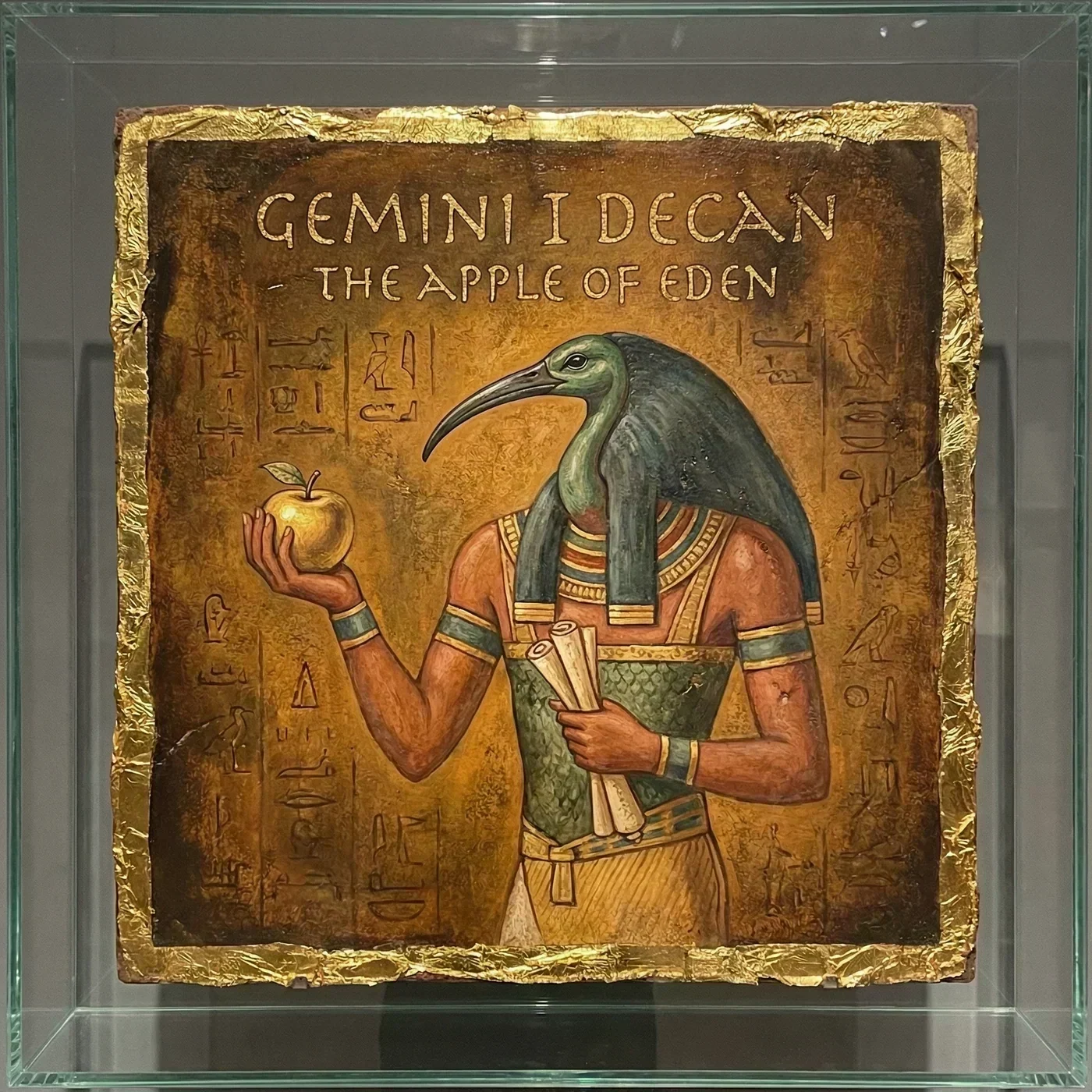
Understanding your birth tarot also illuminates your shadow patterns. The challenging aspects of your card reveal where your gifts become obstacles. The Eight of Swords (Gemini I: The Apple of Eden) carries brilliant mental agility, but can become trapped in endless analysis. The Four of Cups (Cancer III: The Overflowing Cup) possesses deep emotional wisdom but may withdraw into discontent when faced with too much stimulation.
Work with your birth card as a meditation focus, studying both its light and shadow expressions. Notice how its themes play out in your relationships, career, and personal growth. When you're struggling, ask what your card's highest expression would look like in this situation. When you're flowing, observe how you're naturally embodying its archetypal energy.
The birth tarot offers something rare in our fragmented age—a coherent lens for understanding your essential nature that connects you to thousands of years of wisdom while remaining utterly practical for navigating contemporary life. Your card isn't a limitation but a key, unlocking the particular doorway through which your soul chose to enter this world.
For those seeking deeper exploration of their cosmic signature, The Book of the Self provides the complete archetypal portrait, revealing how your birth tarot integrates with your ruling planets, fixed stars, and the entire celestial symphony present at your arrival.